
BUT, WHY BOTHER?
Once something you've identified is on a list you can return to it again and again and remind yourself that you were perceptive enough, smart enough, and lucky enough to list something special. And once you learn enough about something, it will be special. A name on a list is exactly like an athlete's trophy in a display case.
ON THE INTERNET
The iNaturalist.Org website is the most popular place for naturalists worldwide to post lists of organisms they've identified. The list help the scientific community know what is where, too. It's all for free, both for uploading your lists, and for an app designed for easy list making and browsing.
Lists are proof to yourself and others that you're initiated into secrets of Nature that used to be very important to our ancestors, but which now are ignored by most.
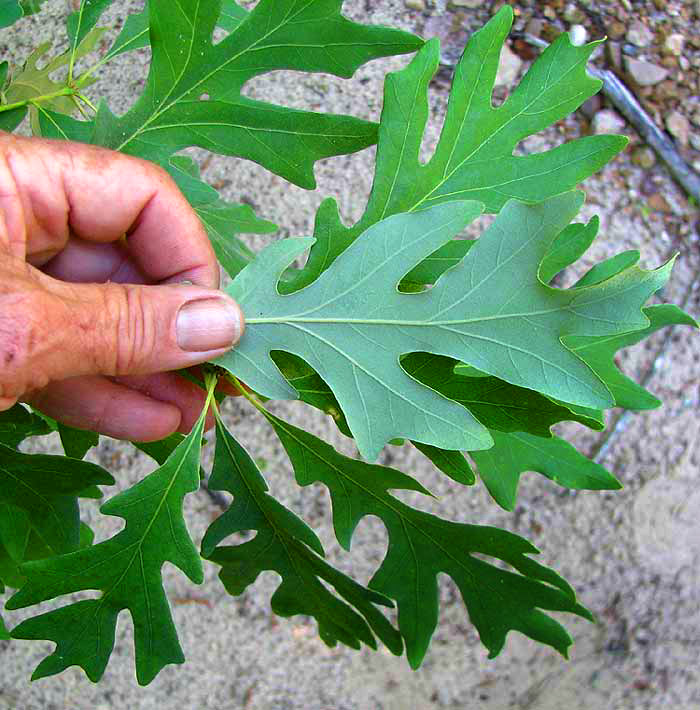
You've listed and now you know the White Oak, Quercus alba, shown at the right. You're the one who knows exactly how the White Oak leaf's deep sinuses are rounded at the bottoms, and the tips of the lobes lack the soft little spines at the tips of leaf lobes of many oak species. You know that the White Oak was cherished by indigenous Americans and our pioneer ancestors who made medicinal extracts by soaking the inner bark, for use against hemorrhages, sore throat, bleeding gums and hemorrhoids. And White Oak acorns were preferred for grinding into meal for a nutritious acorn-bread and porridge. You know that because when you had its name and listed it, you looked it up.
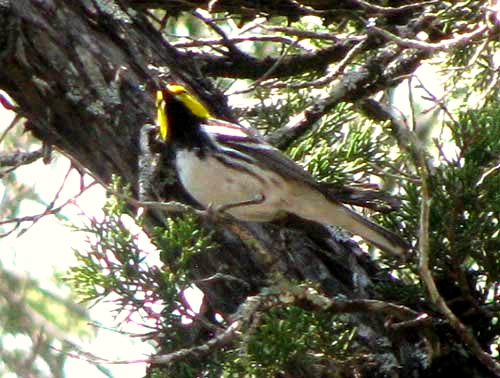
At the left, that Golden-cheeked Warbler, Dendroica chrysoparia, it's an officially endangered species. If you've listed it, you're doing great, and that bird needs your help to keep it from going extinct.
There's a social dimension to list making, too, which you'll discover when you join with others on organized field trips and at meetings of nature clubs:
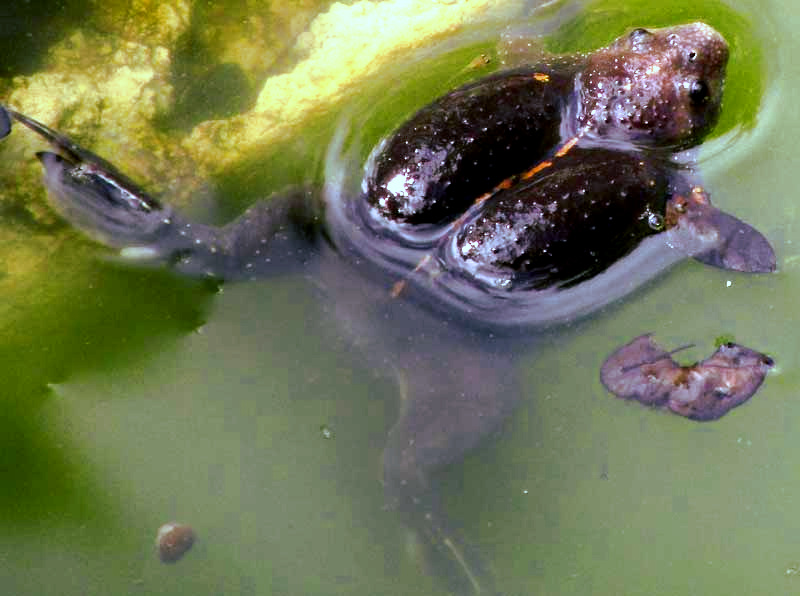
"You saw a Sheep Frog on your trip? I've been noticing that species in my field guide ever since I was a kid but I never thought I'd know someone who'd seen one. Did you hear it? Does it really bleat like a lamb?"
And, at the right, that's the Sheep Frog you saw, Hypopachus variolosus, just as its name on your list reminds you he looked.
RULES FOR LIST-MAKING
Here are some "rules" to be followed if your lists are going to mean anything to you.
- Never list anything unless you are absolutely sure about the identification -- not even if you're just 99 percent sure. If you were a champion high-jumper, you'd feel bad every time you caught sight of any trophy acquired by cheating, perhaps by installing springs in your shoes. It's the same with our lists. Many will be the times when a much-sought species "gets away." But, that's OK. You can note someplace that "such-and-such got away." Just don't place it in your "official list."
- Carefully note the date and location of your list's compilation, and describe carefully the natural setting. This will help you see and learn the connections between species and the ecological niches they occupy.
- Be precise about where your list and observations were made. Often as time passes a population considered to consist of a single species may be recognized as actually being represented by more than one, with differences between the newly erected species having been overlooked earlier. You may need a precise location to know which species you saw.