
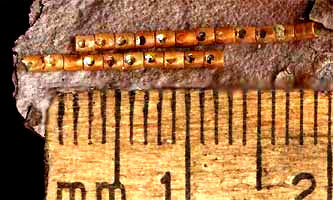
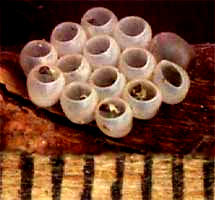
The above pictures show some tiny insect eggs, each egg only about 1 mm across (0.04 inch). The eggs at the top were on the bark of a pine tree in Mississippi, and were obviously attached to one another in long chains. Most of the eggs have hatched, leaving round black holes where the larvae emerged. The eggs were produced by one of many species of Leaf-Footed Bugs, genus Leptoglossus. The white-cup-like eggs pictured above on the right were on the scales of a pine cone, also in Mississippi. So far, they're unidentified but, whoever they are, they're neat.
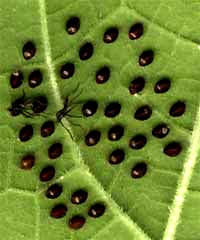 At the right you see eggs of the Squash Bug, Anasa tristis, found on the lower surface of a squash-plant leaf. The white marks on most of the eggs are holes from which Squash Bug nymphs have emerged. In fact, one great thing about this picture is that at the center, left in the picture you can see two discarded exoskeletons of Squash Bug nymphs. The eggs hatched, the nymphs hung around a while growing, and as they grew they discarded their old exoskeletons.
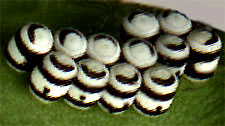 Sometimes you wonder why certain insect eggs are so pretty -- for example, at the left, barrel-shaped eggs of the Harlequin Bug, Murgantia histrionica, discovered on the underside of a mustard leaf. Usually Harlequin Bug eggs are laid in double rows, but you can see here that at least a couple of eggs are "in the wrong place." That just shows that Mother Nature doesn't always do exactly what the books say they do. Harlequin Bugs feed on many plants, and can really damage a garden. Serious gardeners not wanting to use chemicals (Thank you thoughtful gardener!) may systematically look for these eggs and squash them between their fingers.
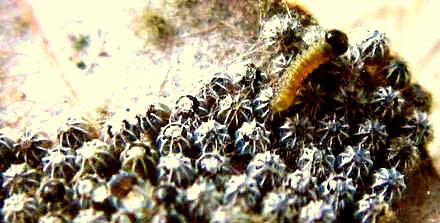
Above you see a Mourning Cloak Moth caterpillar emerging from one of many eggs. It's one of a series on photos on our page A Mourning Cloak Lays Eggs & the Eggs Hatch.
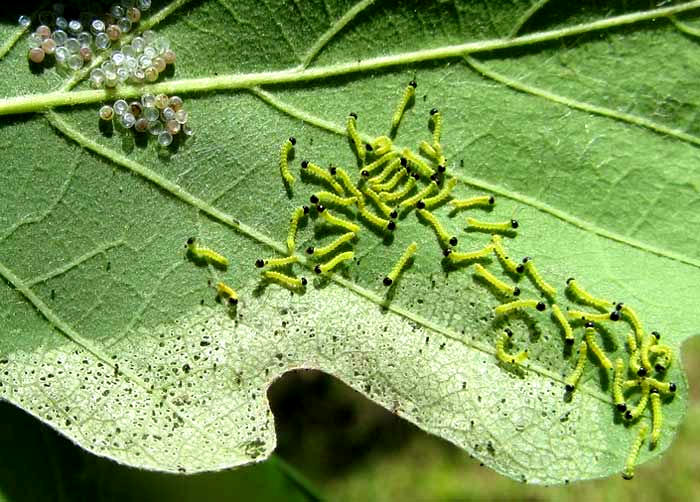
Below, an "army" of just-hatched Red-humped Oakworm Moth caterpillars have just emerged from their eggs -- insect eggshells are known as "chorions" -- and have gathered munching on their leaf.
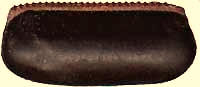 Some insects, such as cockroaches and mantids, cement together batches of eggs in the form of egg packets or "oothecas," like the American Cockroach's egg case at the left. That case is about ½-inch long (13 mm), contains about 16 eggs, and the thin covering is hard and shiny like a thin plastic shell. Each cockroach species produces an egg case of a different shape. When eggs inside the case hatch, the young emerge along the rough edge seen at the top in the image, first just one or two, but before long there's a whole mass of tiny, wriggling creatures, until finally the case is deserted. This case was found in late winter and probably after a few warm spring days produced summer's first generation of cockroaches.
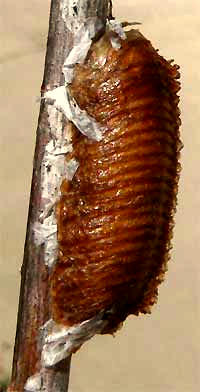 At the right you see the egg case of a mantid -- a "Praying Mantis." It's about 1¼-inch long (3cm). Each of the many layers, which look like slender ribs in the picture, is associated with an egg inside the case. When the mother mantid deposited the case on a weed stem, at first the material comprising the case was soft and frothy, but soon it hardened and became capable of protecting the fragile eggs inside it. Once spring comes and it's warm enough for the baby mantids to survive, they'll emerge from their case, often at approximately same time. If you're very lucky, you'll find the vicinity of such egg cases just crawling with baby mantids. Since mantids prey on many insects that are harmful to gardens, some companies sell mantid cases similar to the one in the picture. Just hang the egg case someplace in the garden and next summer your mantids will be working with you to keep your garden healthy! The egg case at the right was photographed in California. Mantids from other parts of the world produce cases looking slightly different.
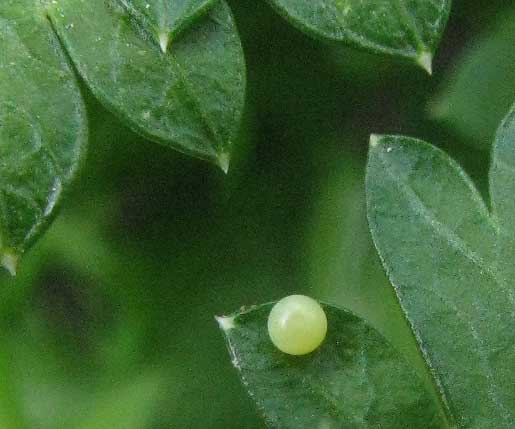
So far, the eggs we've looked at have been deposited in clusters. That's not always the case, as the photo at the right shows. That's the egg of an Eastern Black Swallowtail butterfly, Papilio polyxenes, on a Parsley leaf.
The pictures on this page tell us two important things about insect eggs:
- Insect eggs are typically small and are found in obscure places
- When you do find them, they are often very interesting!