BLOSSOM ARRANGEMENT
(inflorescence types)
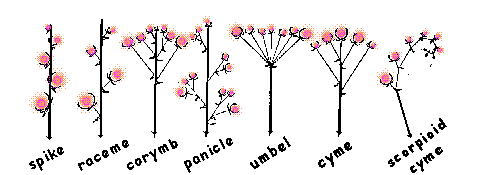
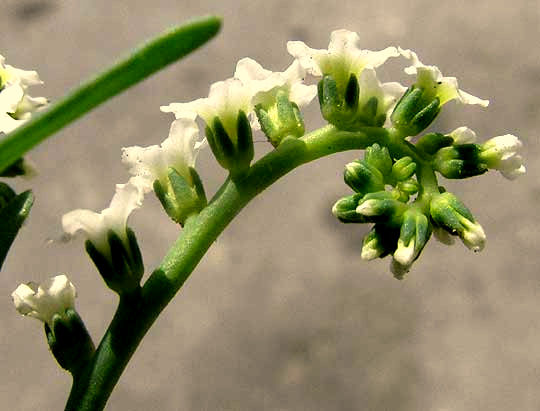
Just by looking at the above chart, already you have the idea: Flowers have several distinct ways of being organized into groupings called inflorescences, and the various inflorescence types have names. The inflorescence at the right, of the Salt Heliotropoe, Heliotropium curassavicum, according to the chart is... what?
Beyond that, you should know that recognizing the various kinds of inflorescence is important if you plan to do anything serious with plants, such as identify and use them, because each plant species has its own preferred inflorescence. Inflorescence type is one of the first things you notice when you're identifying a plant. Let's practice with this inflorescence-type business.
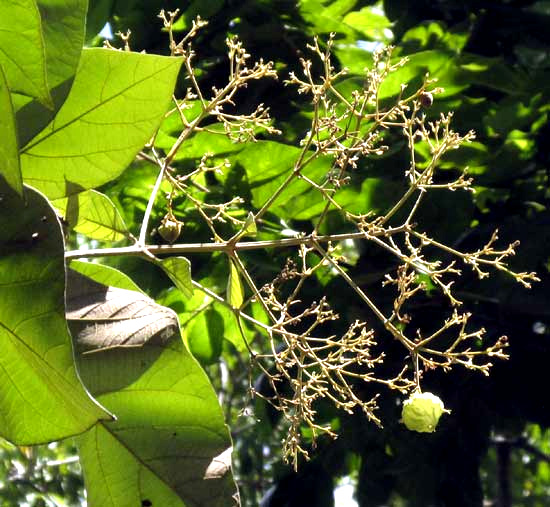
The inflorescence type shown at the left, of the Teak Tree, Tectona grandis, famous for its wood, may be the most frequently encountered inflorescence type. The plant's main central stem within the inflorescence, the rachis, branches and then those branches branch, and maybe there's more branching beyond those. It's a panicle-type inflorescence.
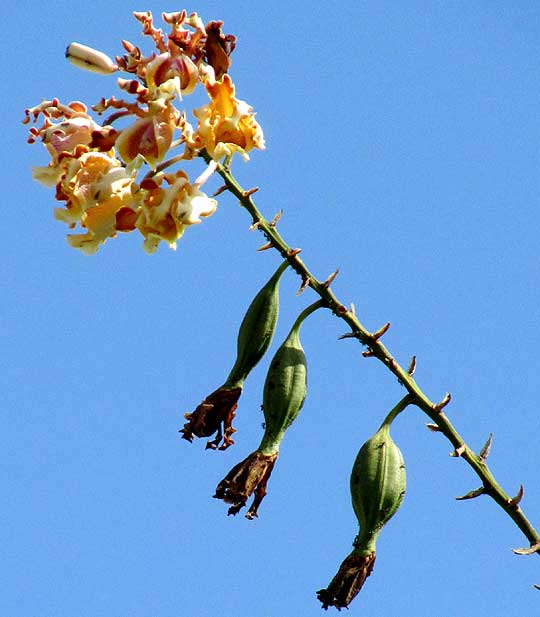
At the right, at first glance you may think that you're seeing a spike-type inflorescence, but note that each flower and fruit is attached to the main stem, the rachis, by a short stalk, the pedicel. That pedicel makes the inflorescence a raceme, not a spike. The picture shows flowers and immature fruits of the tropical orchid Myrmecophila christinae.
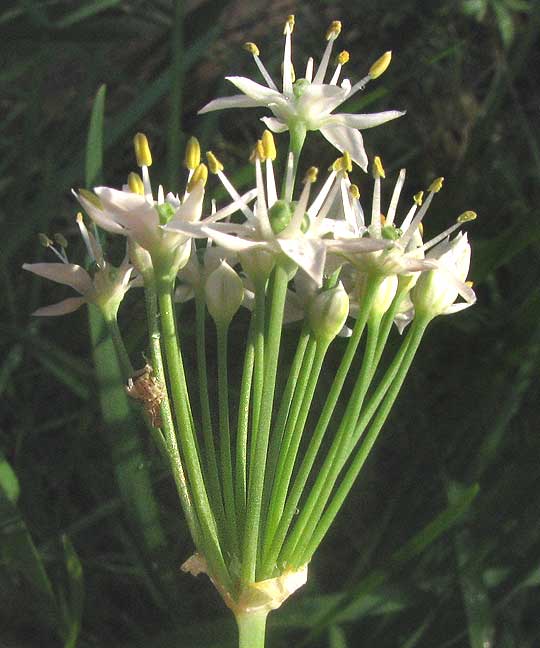
At the left, that's an umbel of the Garlic Chives, Allium tuberosum. In an umbel, flowers form a flat-topped inflorescence, while at the same time all the flowers' pedicels are attached at the same point of the stem below. Of course in our picture there's that one flower in the bunch who is out of order, but Nature doesn't always have to fit every detail into all our human-made categories. It's up to humans to determine which details are critical to fulfill, and which are just random natural variations not meaning much. What's important here is the general flat-toppedness and all the pedicels attaching at the same spot atop the stem.
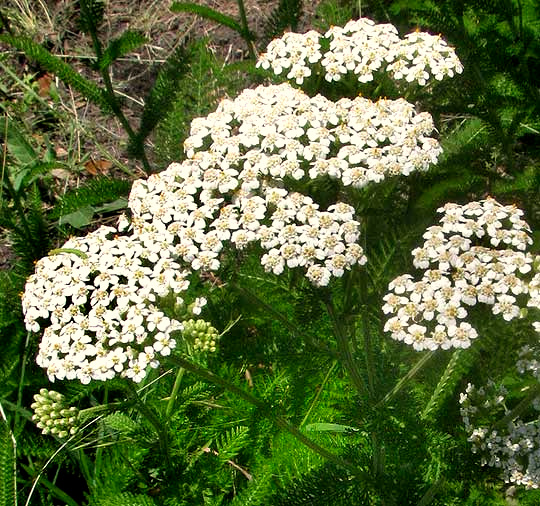
Speaking of flexible definitions, let's consider the common weed called Yarrow, Achillea millefolium, shown at the right. The authoritative Flora of North America refers to its inflorescences as "simple or compound, corymbiform arrays." The suffix "-form" in the term "corymbiform" means "-like" or "in the form of," so the term "corymbiform" isn't as precise as "corymb," which is one of the inflorescence types in our chart. A corymb is a flat-topped inflorescence in which flowers attached lower on the rachis have much longer pedicels than the upper ones, with the youngest flowers appearing at the end of the main axis, or rachis. Compare our chart's corymb with the umbel, which is also flat-topped. On our chart there's yet another flat-topped inflorescence in which the lower flowers have much longer pedicels than the upper ones, and that's the cyme. A cyme is a flat-topped inflorescence with oldest flowers at the end of the rachis.
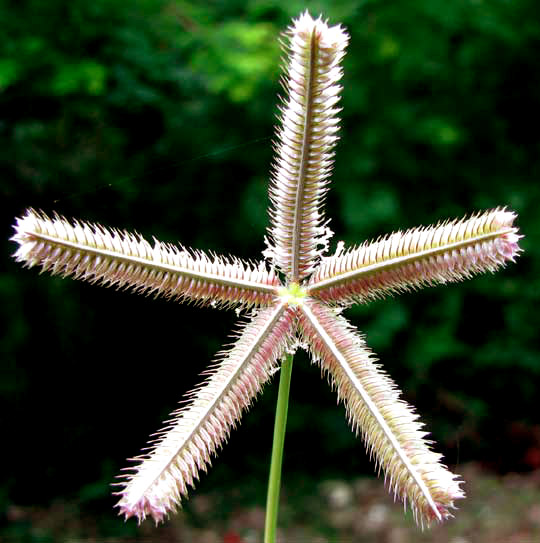
Sometimes simple-looking flowering heads pose interesting problems, as with the inflorescence of the common weed Egyptian Crowfoot Grass, Dactyloctenium aegyptium, shown at the left. Do you consider the whole thing an inflorescence, or is each of the five "arms" an inflorescence, thus maybe making them five spike-type inflorescences? The Flora of North America considers the star-shaped arrangement a panicle, thus each "arm" is a branch of the inflorescence, plus if you look very closely you'll see that each spikelet has a short stalk, its pedicel, so that's yet another division. Notice the enormous difference in general appearance between this panicle and that of the big, diffuse one of the Teak tree we saw earlier. The lesson is to not decide on the inflorescence type until the details are noted.
That's OK, though. Paying attention to details lies at the heart of really getting to know the things of Nature.