
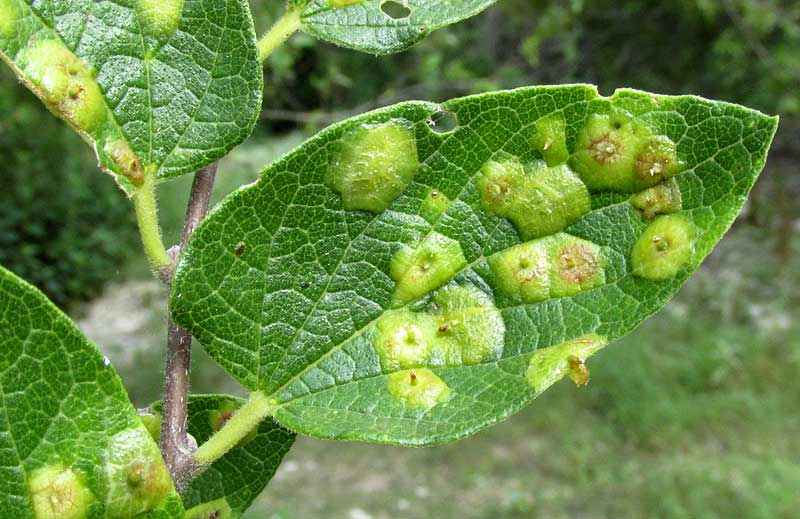
Sometimes on a plant you find a growth or clusters of growths that may be of almost any shape or color, and located almost anyplace on the plant. They may look randomly placed, and you suspect that the host plant didn't encourage their presence. We're talking about galls, here, and a typical example is shown at the right.
In that picture the leaf is of Netleaf Hackberry, Celtis reticulata, and the blister-like items are galls. These particular galls were caused by an aphid-size insect looking like a tiny cicada sometimes called the Jumping Plant Louse. It's Pachypsylla celtidisvesicula. Here's how the plant louse and the gall go together:
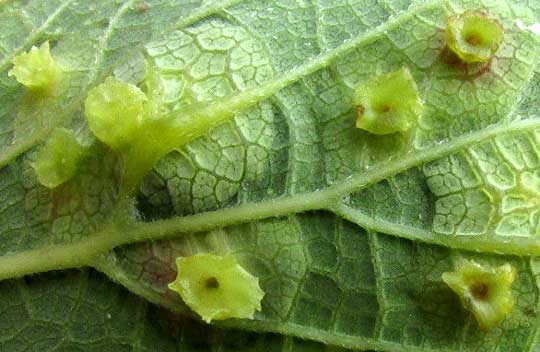
After adult Jumping Plant Lice mate in the spring, the females lay eggs on the undersides of expanding hackberry leaves. Nymphs, which are juvenile stages of insects undergoing incomplete metamorphosis, hatch in about 10 days and begin feeding on their leaf. This causes tumor-like growths among the leaf cells immediately around the feeding nymphs. At the left you see the growths on the leaf's underside.
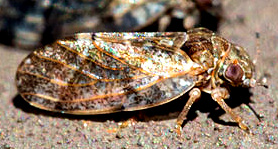 Hackberry Nipplegall Maker; image courtesy of C. William Newsom, via Wikimedia Commons
Each growth ultimately forms a gall around the nymph. Eating the gall tissue, the nymph grows until just after the leaf falls to the ground in the fall. Then the fully grown nymph, about half an hour before it metamorphoses into an adult, slits open its gall and emerges. The adult is similar to what's shown at the right. There's more to the plant louse's life cycle, but at this point it's finished with its gall.
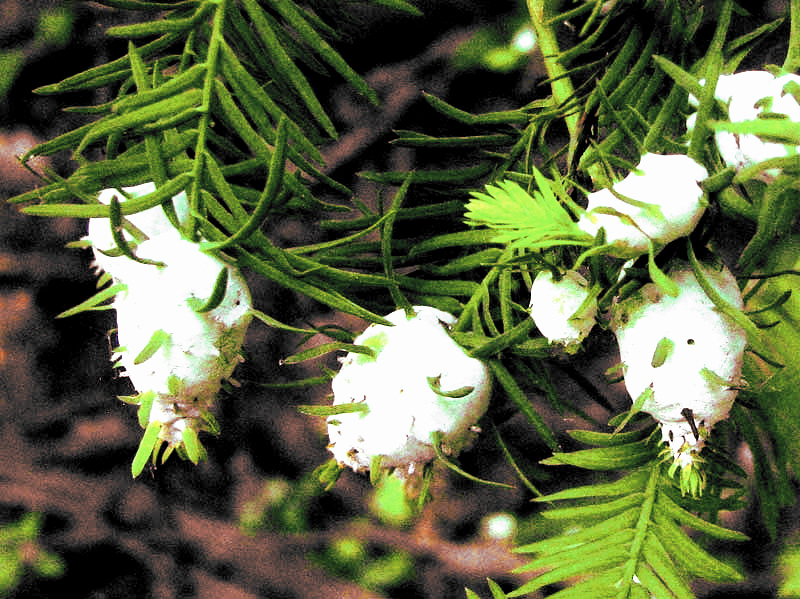
The above story is typical of galls, though the details are endlessly varied. Usually galls are formed by insects, but also mites, viruses, fungi, bacteria, nematodes and even other plants can cause them. The very different looking galls at the left -- caused by Twig Gall Midges, Taxodiomyia cupressiananassa, on Baldcypress trees, Taxodium distichum -- remind us of their amazingly diverse appearances and manners of forming.
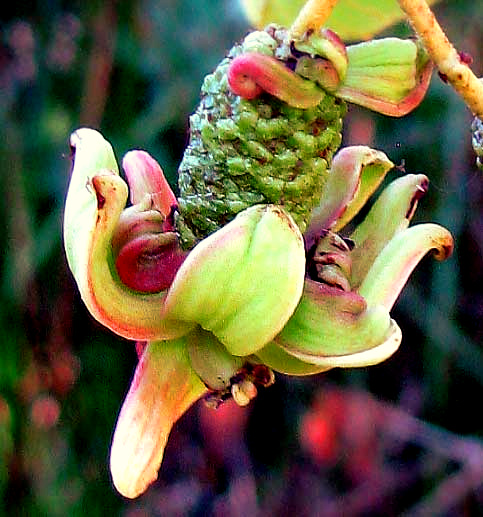
Galls occur almost everywhere on a plant, and they can do much more than provide immature insects juicy gall tissue to eat, and a snug, protective home in which to grow up. At the right you see Alder Tongue Galls, on a cone of the White Alder, Alnus incana, caused by the fungus Taphrina amentorum. The fungus infects the tree's immature catkin scales, and later the fungus's spore-producing fruiting bodies appear on the galls' surfaces. Each of those pale, purplish to greenish-white items is a fungus-caused gall.
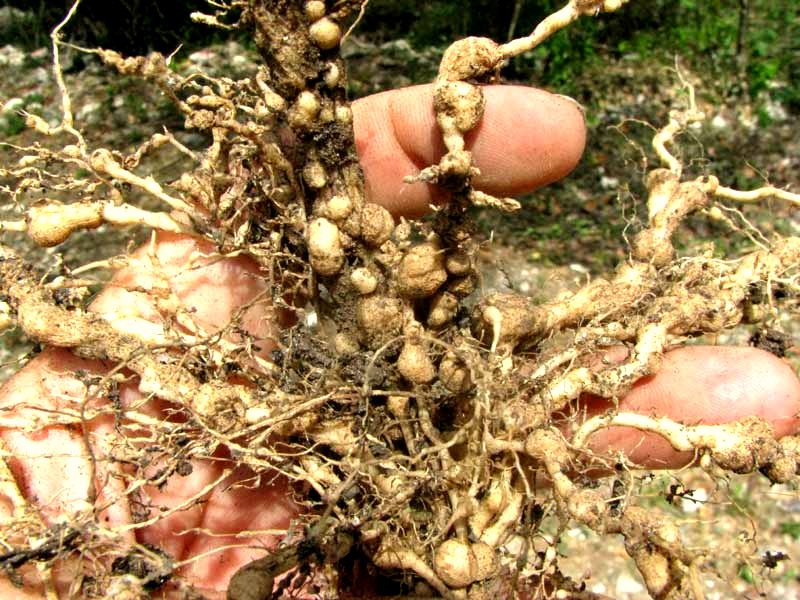
Galls even occur on roots. At the left you see spherical, brown galls on roots of a dying tomato plant. The galls are caused by nematodes, which are very small to microscopic roundworms belonging to the phylum Nematoda. Nematodes are among the most abundant animals on Earth. They occur as parasites in animals and plants, and as free-living organisms in any number of the Earth's ecosystems, and some of them form root galls.
The study of plant galls is known as cecidology. We backyard naturalists can have a lot of fun being amateur cecidologists. We see a gall, then either use a book or more likely the "image search" feature of an Internet search engine, searching on such keywords as "gall tomato plant roots." When the thumbnails of galls known to affect tomato plant roots pop up, maybe you'll see an identified image of your gall. Once you have the name of whatever causes the gall, look up that organism's life history, which is likely to be fairly amazing.
We'll end with another sample, typical gall story:
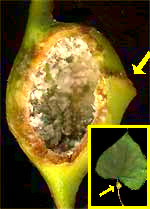
On leaf petioles of Eastern Cottonwood trees, Populus deltoides, often you see the kind of gall appearing at the right. The inset of the picture at the right shows how it looks on the petiole. The large arrow points to a natural slit across the gall, but this slit often is too narrow to see through. If you open up one of these galls, inside you find many tiny, woolly-white aphids clinging to the galls' interior walls, as seen in the larger image.
This gall is appropriately known as the Poplar Petiole Gall, and it's caused by the Poplar Petiole Gall Aphid, Pemphigus populitransversus. Here's its life cycle:
The aphids overwinter as eggs on the cottonwood's leafless twigs. The eggs hatch in the spring as the leaves develop. When the newly hatched nymphs feed on leaf petioles, they cause galls to form and the small, dark-colored aphids move inside, where they secrete a white, waxy material which coats their bodies. After two weeks, the females bear live young who mature into winged females. These females leave the gall and find plants in the mustard family, where they bear more female, mustard-eating aphids. In the fall, winged forms appear on the mustards, and these fly back to the cottonwoods, where a male and female generation is produced. Then each female lays eggs on the cottonwood's bark, the eggs overwinter, and the life cycle begins again next spring.
You may enjoy seeing and reading about certain galls documented in the gall pages of Naturalist Jim Conrad's Naturalist Newsletters.
Here's the good thing: When a backyard cecidologist can look at a gall and visualize details of the life histories of all the organisms involved, it feels good.