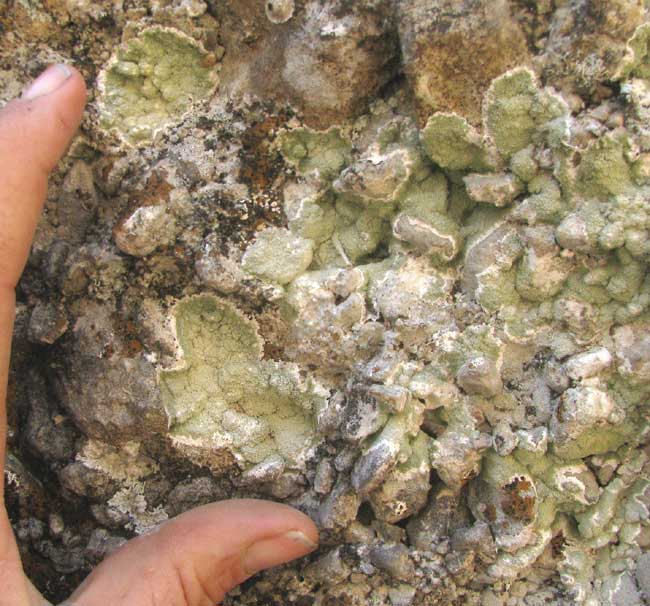
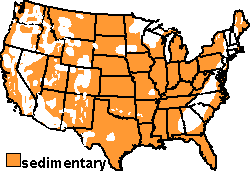
Sedimentary rocks develop from mineral or organic particles gathered as sediment by erosion or weathering, and cemented into rock. Unlike igneous and metamorphic rocks, sedimentary rocks form at the Earth's surface, and sometimes they bear fossils. The map indicates that in the US sedimentary rocks are the mostly commonly outcropping kind.
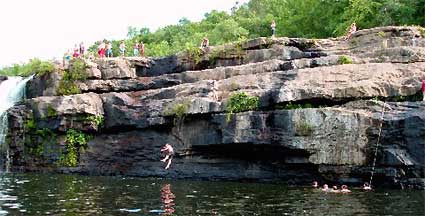
Because sedimentation often takes occurs erratically -- as during floods, dust storms, changes in ocean current -- the resulting accumulation often is layered, as shown above.
"CLASTIC," BIOLOGICAL & CHEMICAL SEDIMENT
Three types of sedimentary rock are recognized, and the most abundantly occurring type, despite its unfamiliar name, is "clastic" in origin.
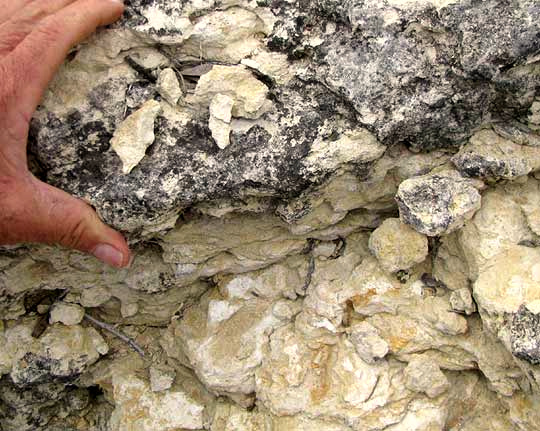
Clastic rock is composed of pre-existing rock fragments. The mudrock shown at the left is clastic, mostly consisting of silt- and clay-size fragments. Mudrock accounts for over half of all known sedimentary rocks. However, the term "mudrock" is a general one, embracing shale, slate, siltstone, claystone, mudstone and more. Still, "mudrock" is a handy concept because all the mentioned mudrock types grade into one another, plus there's disagreement on how to define the various mudrock kinds. What's shown in the picture is like shale with a lot of carbonate in it, though one thinks of shale as being more layered. With such doubts, our picture shows good old ambiguous "mudrock."
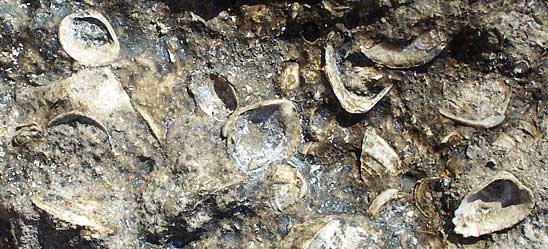
Biological sedimentary rock forms when dead organisms -- notably organisms with shells in the oceans -- pile up and become cemented together. Biological rocks include commonly encountered limestone, chert and coal. The accompanying photo shows seashells compacted into soft limestone. With magnification you'd see that even the stone between the obvious shells consists of more shells of tiny, even microscopic organisms who lived in the water along with larger mollusks.
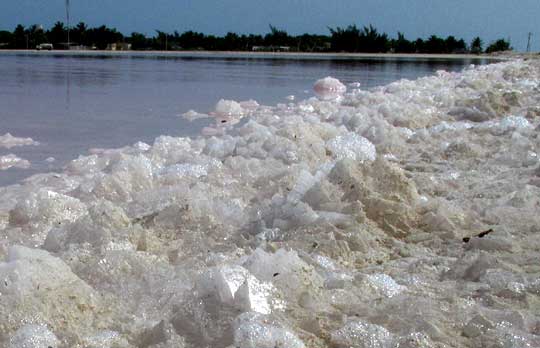
Chemical sedimentary rock forms when minerals in solution become so concentrated (supersaturated) that they precipitate (form solid matter). Gypsum may be the best known chemical sedimentary rock, but also there's rock salt (halite), certain kinds of limestone, baryte and sylvite. At the left you see rock salt precipitated along a salt pond's edge, where seawater is allowed to evaporate so the salt can be sold commercially.
Above we've spoken of particles being cemented together. In geology, cementation occurs when mineral matter is precipitated in the spaces between lose particles, "gluing" them together. The sedimentary-rock-forming process typically is accompanied both by cementation and compaction of the sediment -- squeezing the particles together. The entire process of forming rock from loose matter is referred to as lithification.
FEATURES TO LOOK FOR
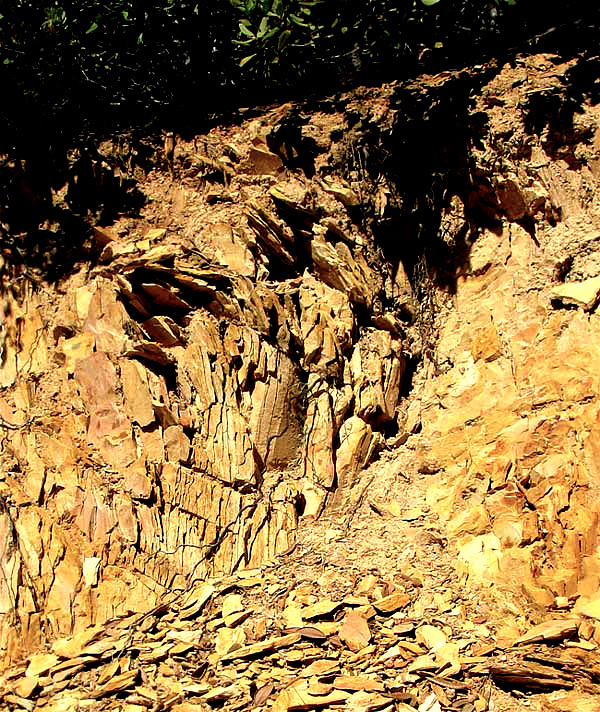
Especially because sedimentary rocks often are layered, frequently -- especially in roadcuts -- you see features disrupting the layering, as shown at the right. That's siltstone which has undergone some violent treatment.
Notice that a fracture zone cuts across the picture from top-right, to bottom-center. On the fracture's right side, layers, or strata, dip downward toward the left. However, on the left side, the strata are curved. The fracture is a fault. Faults are fracture zones between two blocks of rock, typically with one side being repositioned higher or lower than the other, or to the right or left, as during an earthquake. In the picture, strata on the left appear to have been ground downward as the block of rock on the right pushed beneath the block on the left. Wikipedia's Fault page does a good job showing and explaining various fault types.
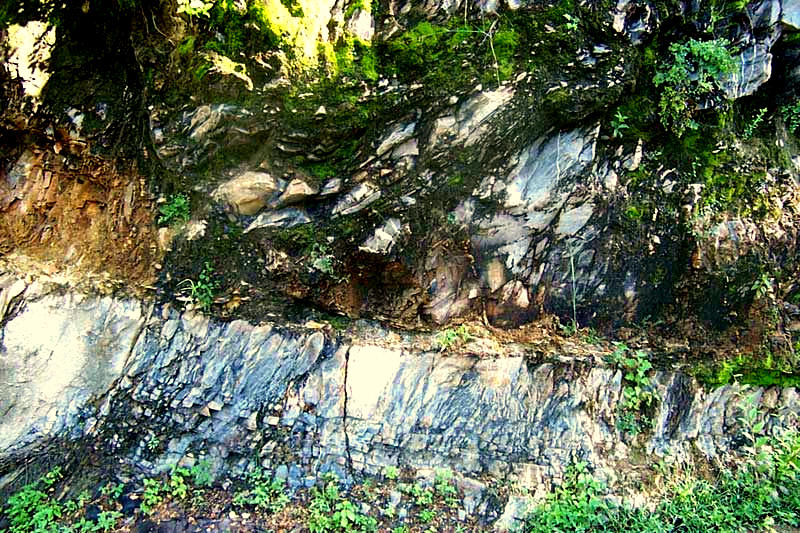
At the right the most conspicuous boundary separates the lower rock from newer rock above. This boundary, instead of cutting across layers, indicates a break in time in an otherwise continuous rock record. Such boundaries are known as unconformities. In the picture, it's clear that the newer rock above the unconformity underwent some kind of violent disruption which the lower rock didn't.
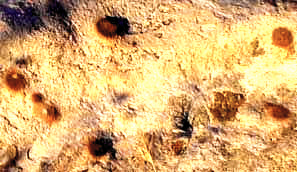
Concretions, such as the dark bodies shown at the left, are hard, compact masses of matter usually harder than the surrounding rock. They're formed when minerals in solution concentrate at certain spots in the sediment, and precipitate into a kind of mineral cement which "glues" the particles together. From the rusty color of the concretions in the picture, a good guess is that iron serves as the glue.
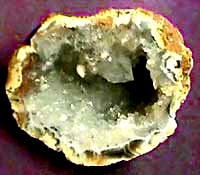
Geodes are a little like concretions in that they end up surrounded by rock different from what's around them. Sometimes the surrounding rock erodes away, leaving them lying about. Unlike concretions, geodes are hollow, and typically are lined inside with inwardly projecting crystals, as shown at the left. A typical geode is about baseball size, but they can range from an inch or less to much more than a foot in diameter. It's thought that geodes form from empty spaces in igneous and sedimentary rock. Mineral-rich water enters the spaces, and over thousands of years or longer, the mineral solution evaporates, leaving crystals -- just as drying-out saltwater leaves salt crystals behind.
KINDS OF SEDIMENTARY ROCKS
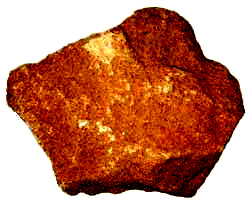
- Sandstone: basically sand grains cemented together, which may have been deposited as sand dunes, sand bars and beaches, or as sediment washed into the sea or other water bodies. About a quarter of all sedimentary rocks are sandstone, and that's a genuine sandstone rock at the right
- Shale: composed mostly of tiny clay particles of the kind found in mud. Such particles are much smaller than sand particles, so shale is smoother than sandstone
- Conglomerate: composed mostly of rounded, water-worn, cemented-together, gravel-size pebbles. Between the pebbles typically smaller particles of sand, silt, and/or clay fills the openings, as shown at the right
- Coal: composed of the remains of plants and animals living millions of years ago. Often you can find fossils in coal. Coal, especially that mined in the eastern US, contains so much sulfur that when burned the smoke forms sulfuric acid, which, unless removed by scrubbers at the power plant, contributes greatly to acid rain. Three general categories of coal are recognized. From softest to hardest, they are: lignite; bituminous, and; anthracite.
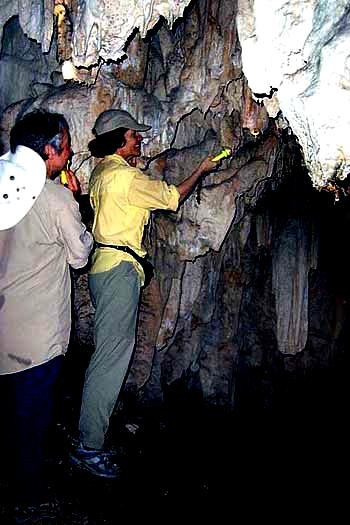
- Limestone: composed of calcium carbonate (calcite), which usually has been chemically precipitated in the sea or else deposited by living organisms in the sea. Limestone dissolves along fractures, causing solution features such as the cave at the right
- Dolomite: the same as limestone, except that it contains more magnesium.