If you're unfamiliar with terms such as calyx, corolla and ovary, you may want to review our Standard Blossom page. And then there's this:
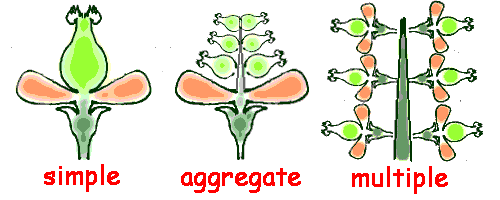
Above, the flower diagram for "multiple" shows several individual simple flowers -- each flower with its own calyx, corolla and ovary -- with all the flowers closely arranged at the tip of some kind of stalk or stem. The ovaries of two or more of those individual flowers combine to make a multiple fruit. Several simple fruits = one multiple fruit.
EXAMPLE 1: NONI FRUITS
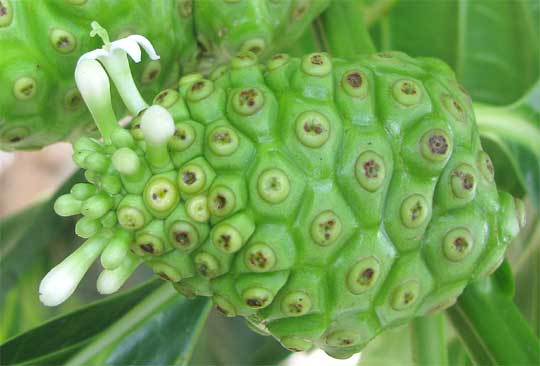
The picture at the right, of an immature fruit of the medicinal Noni tree, Morinda citrifolia, shows an example of what the making of a multiple fruit looks like in Nature. The white items are corollas of individual flowers. Once pollinated, the corollas fall off, leaving inferior ovaries to develop into individual fruits. But those ovaries are so closely crammed together that as they grow they fuse with one another, forming the larger, cone-like green item, the multiple fruit.
EXAMPLE 2: MULBERRIES
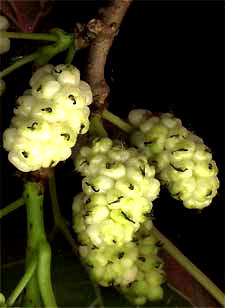
Multiple fruits of the White Mulberry tree, Morus alba, are shown at the right. Notice the little black, squiggly things atop the individual white, fleshy ovaries. The squiggly things are the former flowers' withering branched styles.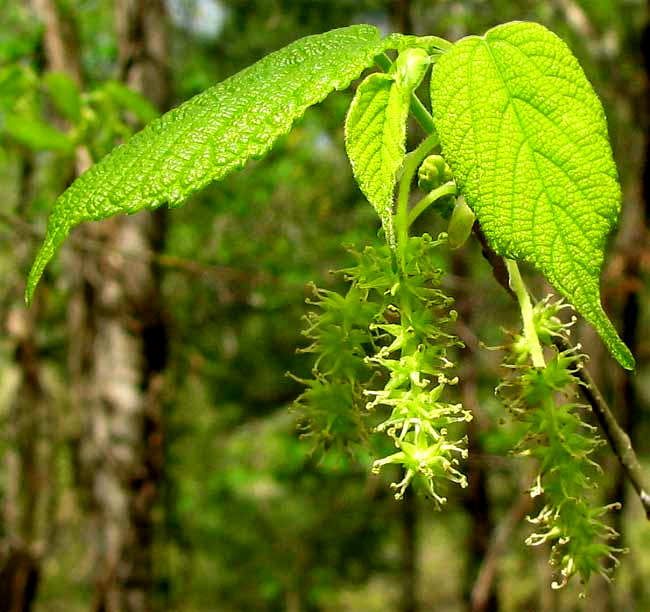 So far, this is similar to the Noni fruit above. The big difference is indicated at the left. There we see male Red Mulberry flowers arranged in dangling "catkins." The female catkins are similar but considerably shorter. The message here is that ovaries forming multiple fruits can originate in unisexual female flowers.
EXAMPLE 3: FIGS
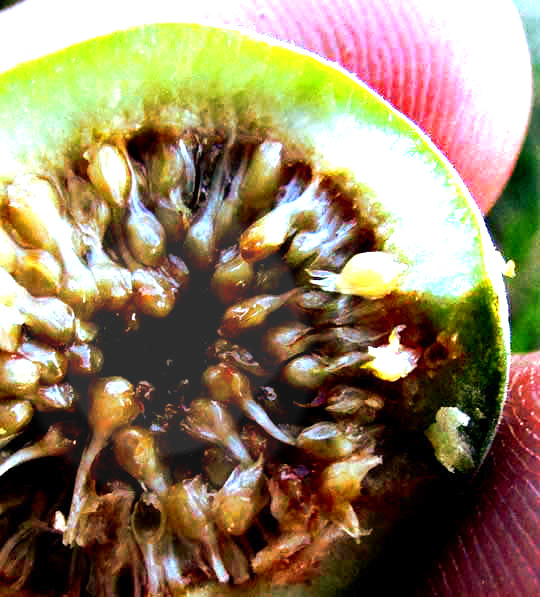
Multiple fruits can get plain weird. For example, at the right you see a fig from the tropical American Ficus obtusifolia tree. The fig fruit, which is a multiple fruit, is spherical, with a tiny entry hole for pollinators at one end. In the picture, you see inside the fruit many unisexual flowers, of both sexes. When you eat a fig, you eat the whole multiple fruit. The fig fruit's thick covering is a much modified tip of a peduncle, a peduncle being the stalk of a grouping of flowers, the inflorescence. Fig-forming peduncle tips spread out and upward, then back in, forming the spherical fig, with flowers growing from the inner walls. When you eat a fig, you eat all that, and it tastes good.