THE BOTANICAL DEFINITION OF "FRUIT"
a): In general, any
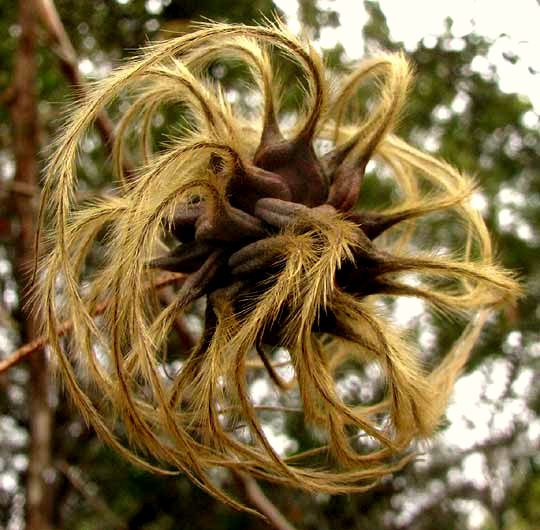
product of fertilization with its modified envelopes (skin of banana) or appendages
("parachute" of dandelion fruit).
b): Specifically, the ripened
ovary of a seed plant, and its contents, as the pod of a pea, a nut, grain,
berry, etc. |
Above you can see the story
of a fruit. Of course the thing on the right of the picture is a pea pod full of peas, and
usually we don't think of peas as fruits. However, here we're using the botanical
definition of fruit, given at the right, not the supermarket's. Here's the story:
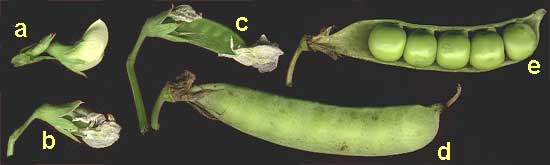
At "a" in the above picture we have a side view
of a pea flower from my garden. At "b" the flower's petals are
shriveling up as the newly fertilized ovary in the blossom's center begins enlarging. At "c"
the pod has expanded a lot, and you can see newly forming seeds (the peas)
bulging inside the pod. The old, dried-up corolla is stuck on the pea's nose. At "d"
you see the ripened pea pod, the mature fruit. Now the corolla has fallen off and the
calyx is beginning to dry up. In "e" I have removed the side of
a pea pod so you can see the peas inside it. All that's needed now is to shell
the peas, cook them with some dumplings, and eat them!
Now
let's go at the fruit topic from a different angle. At the left you see the immature
fruit of the Mayapple, Podophyllum peltatum, a common wildflower in eastern North
America forests. In the picture the white-petaled blossom, which was about 2 inches (5 cm)
across, has already been pollinated and the petals and sepals have fallen away. The
stamens are now brown and dried up, and beginning to fall off. You can see four of the
many original stamens in the picture. The flower's pistil is now beginning to expand and
eventually it will become a fruit. You can see the dark stigma atop the ovary. Before long
the stamens will be gone and the stigma will be hardly noticeable atop the 3-inch-across
fruit, and that fruit will be filled with seeds, from which new Mayapples will germinate
and grow.
At the right you see images from a very
different kind of plant, this time the English Walnut tree, Juglans regia. Walnut
trees are monoecious, which means that there are male flowers and female flowers,
each being found on every adult Walnut tree. The three fuzzy, roundish items in the
picture are female flowers, so you might guess that those dark, curly things are stigmas.
The roundish items are immature walnuts immature fruits, according to the botanical
definition of "fruit.". Over the summer they will indeed grow and become regular
walnut fruits. The caterpillar-like thing shown in the photograph at the top left, with a
yellow frame, is a catkin composed of many male flowers, each flower of which is
composed of a kind of a calyx and several stamens. Notice how the immature walnuts look a
lot like our Standard Blossom, except that all the male parts, the calyx and the corolla
are missing!
By now you should see that in order to understand fruits, really you need to know the
basics about flowers. If you're lost with those terms like "stamen" and
"pistil, before slogging on any further you may want to review our Standard Blossom section .
The picture at the left also might help
you get a fix on what fruits are. It shows a Red Delicious Apple just like anyone can find
in the local supermarket. Here I've cut the apple down the middle and the neat thing to
notice is that you can just barely see the original apple-flower's stamens at the top of
the picture. First there was an apple flower, and once it was pollinated its pistil
enlarged into an apple fruit, and this picture shows the whole story, for those stamens
are part of the old flower. The next time you eat an apple, look for those dried-up
stamens!
Admittedly, nowadays most folks accept as "fruits" whatever is displayed in
the supermarket's fruit section, and they lump the rest of plant produce into the
"vegetable" category. Therefore...
Are strawberries and blackberries, which start out as knotty little green things in a
flower's center, "fruits"? And what about tomatoes, pumpkins and squash, ears of
corn, and even oak-tree acorns, and those hard, red, pea-sized things that come onto
Flowering Dogwood trees in the fall... ?
All these things begin life as pistils in flowers, so, in a technical sense, they are
all fruits. Even ears of corn and walnuts!. This is just one of those cases where the
popular usage of a word is very different from its more precise scientific usage. If
you're speaking with your biology teacher, tomatoes and pumpkins are fruits, but if you're
speaking with your grandmother and she says that they're vegetables, then don't debate the
issue.
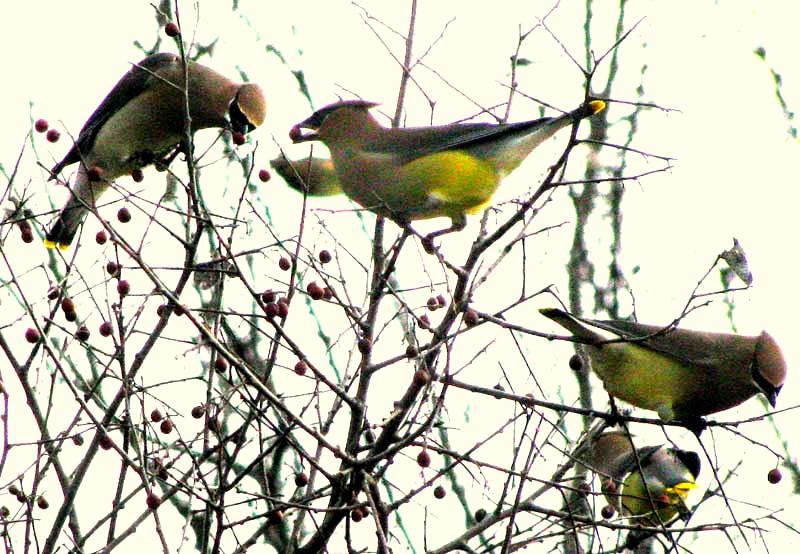
Finally, let's answer the question, "Why bother thinking about
fruits?" Of course the answer is that they're so colorful, come in so many colors,
odors and tastes, and show so many weird adaptations that they're simply fun to wrap the
mind around.
For instance, in the yellow-sided box at the lower right in the picture at the right
you see the conelike fruit of a magnolia tree growing near my trailer. That's an aggregate fruit in which the cluster of matured simple pistils
have split open and the red, berry-like seeds have tumbled out to be held dangling by very
slender threads. In the enlarged picture you can see the thread at the top of the red
seed. In real life that seed is about half an inch high (15 mm). What's happening here is
that the magnolia fruit is doing two things to help its seeds reach new areas where they
might germinate and make new trees.
- The seed's red covering makes it more visible to critters such as birds who may eat it
for its succulent covering, then carry the woody seed center in their gut and finally
"plant" the seed when the animal deposits its feces elsewhere
- The seed is even more visible to possible "dissemination agents" because it's
hanging by a thread outside the fruiting body
So, each time you see a fruit, just ask yourself:
What is that fruit doing to help its seeds get where
they need to be so they can germinate and make new plants?
|