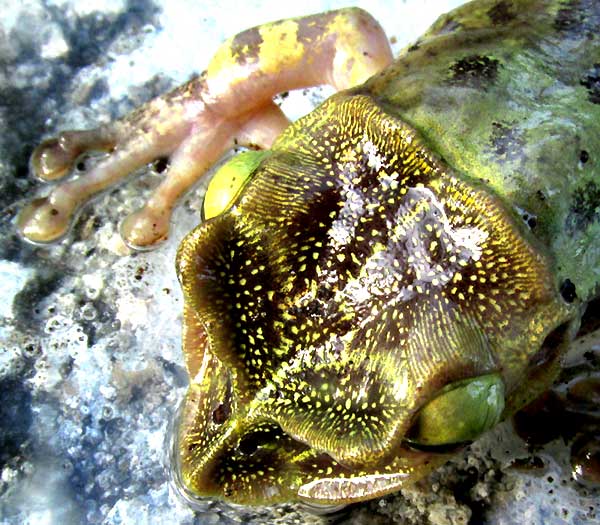
 For English speakers, toads are especially warty frogs tending to be better adapted for dry land than most other frogs. Toads are a kind of frog, then, yet some frogs are fairly warty, and some toads often occur in or around water. Moreover, several frog families exist whose species don't neatly fit into the frog-or-toad concept. If you found a froggy creature with a head like that shown at the right, would you say it's a frog or a toad? (It's a Yucatan Casqueheaded Treefrog, Triprion petasatus). Fact is, the terms "frog" and "toad" have no scientific basis.
However, at least in North America, if we ignore species in the less-encountered frog families, we can say that members of the "True Frog Family" are truly frogs, while members of the Toad Family are truly toads. The chart below explains:
- True Frog Family -- Ranidae: throughout
- Toad Family -- Bufonidae: throughout
- Treefrog Family -- Hylidae: throughout, except parts of the West
UNCOMMONLY ENCOUNTERED FAMILIES
- Narrow-mouthed Frog Family -- Microhylidae: mostly southern US
- Burrowing Toad Family -- Rhinophrynidae: southern Texas
- Spadefoot Toad Family -- Pelobatidae: most of US
- Leptodactylid Frog Family -- Leptodactylidae: Florida & Texas US
- Tongueless Frog Family -- Pipidae: introduced in southern California
- Tailed Frog Family -- Ascaphidae: in northwestern US & southwestern Canada
TRUE FROGS
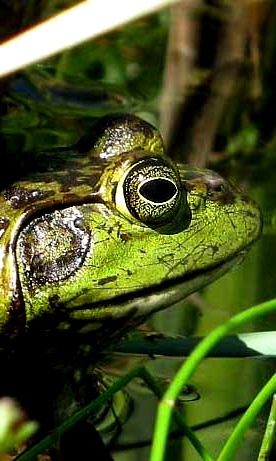
If you look at a list of all frogs listed for a typical US state -- Kentucky, for example, the True Frog Family will be represented by about eight "true frog" species of which some species are the most common and conspicuous of all frogs. For example, there's the famous Bullfrog (shown at the right), the abundant Green Frog, and two species of the well known Leopard Frog. "True frogs" have smooth skin, webbed toes, and occur in many environments. In the minds of most people, "True frogs" are what they visualize when they think "frog."
TOADS
Kentucky has eight "true frog" species, but only three members of the Toad Family, the Bufonidae, and one of those species is rarely encountered. Still, toads are known so well by everyone because they're better adapted to dry neighborhoods than most other frog kinds.
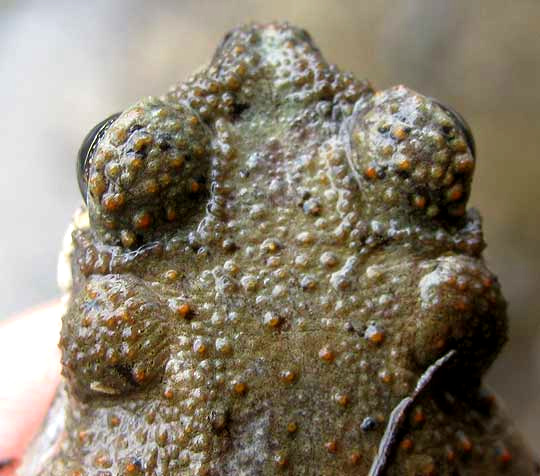
Toads are thought of as warty, and with curious "growths" immediately behind the eyes, nicely shown on the head of the Red-spotted Toad, bufo punctatus, shown at the left.
Those "growths" are parotoid glands. They secrete a viscous, white poison which smears into the mouth of any animal unwise enough to try to eat a toad. Depending on the animal and its size, this poison can inflame the mouth and throat, cause nausea and irregular heartbeat, and sometimes even kill the animal!
There's more about toads on our Toad Page.
TREEFROGS
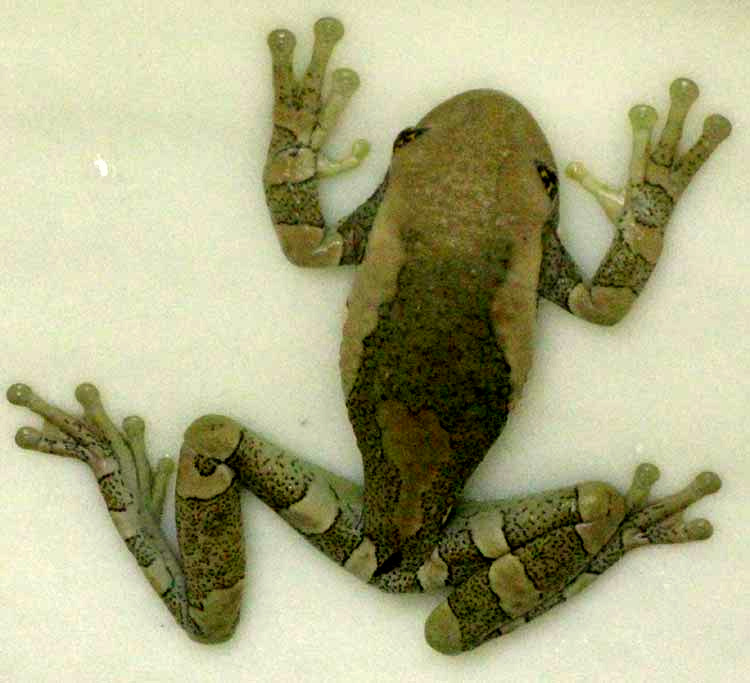
Treefrogs of the Treefrog Family, the Hylidae, are represented by more species in our "average state" of Kentucky than any other frog family, nine species to the "true frogs'" eight. Treefrogs may be less well known than "true frogs" because treefrogs on the average need more water. In general, treefrogs are small and have toes tipped with round adhesive pads enabling them to stick to tree leaves and other regular surfaces. The Mexican Treefrog, Smilisca baudinii, at the right has nice pads.
OTHER FROG TYPES
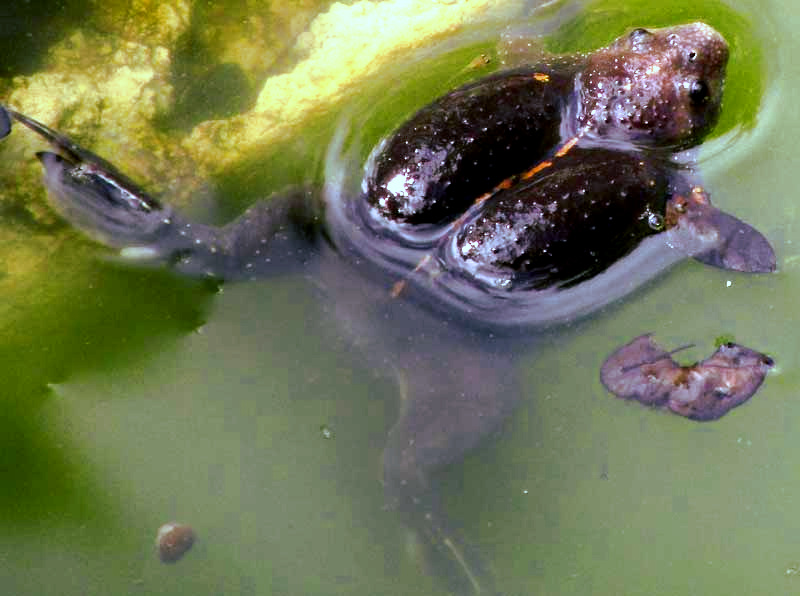
Depending on how it's divided up, the Frog Order Anura embraces about 21 families. In our sample state of Kentucky just three of those families, those of the "true frog," toads and treefrog families, provide nearly all the kinds of frogs an average Kentuckian is likely to see in an average lifetime. However, individuals who snoop around a little and are lucky might someday see members of at least two other families: The Spadefoot Toad Family, the Pelobatidae, and; the Narrow-mouth Frog Family, the Microhylidae. The Sheep Frog, Hypopachus variolosus, shown at the left is a member of the latter family, though of a different species than the one in Kentucky.
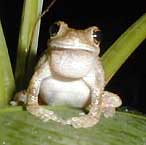
In other words, once you attain a general notion of how the frog world is divided up, you become sensitized to what's common and what's not. When you find something that's little known, and which few others ever see, it's a real buzz. It makes traveling, and simply paying more attention, a lot more fun.