THE TEN-PENNY ANSWER:
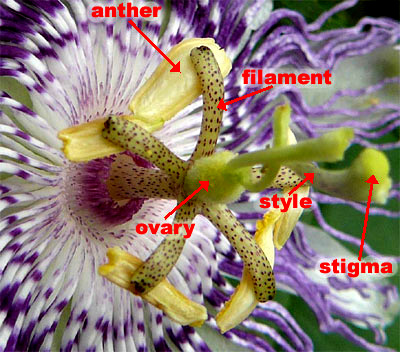
The ten-penny answer is that it's a plant which during some part of its reproductive cycle produces flowers, and the female part of those flowers consist of at least one pistil, inside which reside ovules developing into seeds. If these terms and concepts throw you for a loop, you might want to visit our link dealing with basic flower structure before continuing.
Our ten-penny definition must include the part about pistils and ovules because some plants, such as pine trees and other conifers, bear reproductive structures that produce male stamens producing pollen, like flowering plants, and even have the female part's ovules, but the ovules are borne in cones, not pistils, as with true flowers.
Ferns, mosses, lichens, and fungi have nothing even looking like flowers. Neither do one-celled microorganisms.
FLOWERING PLANTS ABOUND
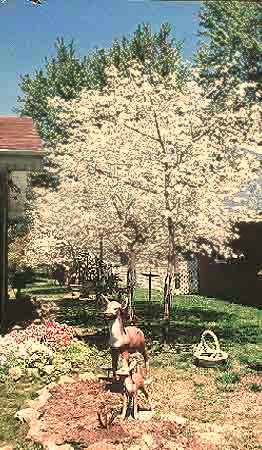
If your backyard is a typical one with lots of grass, some bushes and trees that lose their leaves when winter comes, maybe some garden flowers or vegetable plants, and possibly a few weeds, then most or maybe all the plants you see when you look around will be flowering plants. The most conspicuous backyard plants that are not flowering plants include pine, spruce, and other conifer trees, and yew bushes.
Therefore, plants in most backyards confirm the fact that flowering plants are the most conspicuous, most diverse, and most economically important group of plants on earth today. If flowering plants were suddenly to disappear, life on Earth as we know it would come to a screeching halt. The world's big rain forests, so important for producing oxygen for us to breathe, would vanish; soil erosion from denuded slopes would choke our rivers with silt; the landscape would become barren and sterile. Nearly all our food comes from flowering plants, or animals who eat flowering plants.
These are scary insights when you reflect that a large percentage of flowering plants require animals, particularly insects, to pollinate them, and these animals are very sensitive to insecticides and other toxic chemicals mankind unceasingly pumps into the environment.
FLOWERING PLANTS ARE ANGIOSPERMS
The 300,000 or so species of flowering plants are known as angiosperms. Currently angiosperms are classified in a single phylum, the Anthophyta. The Anthophyta usually are divided into two two groups based on the number of cotyledons emerging from the embryo, the monocots and dicots.
However, our concepts are changing fast, there's disagreement on how things should be classified, and really there's no need for us backyard naturalists to worry too much about getting all the taxonomy straight.
Just keep in mind that flowering plants form a natural grouping, and they're wonderful to know and experience.
FLOWERING PLANTS ARE SOMETHING NEW
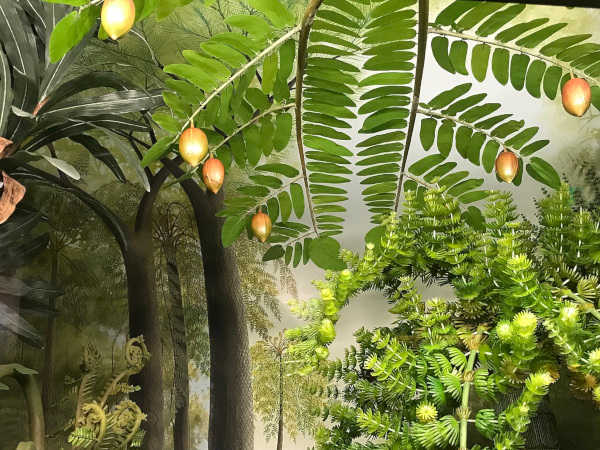 Model of a Carboniferous seed fern, from a diorama at the Museum Mensch und Natur, Munich, Germany; photo by Petter Bøckman
Flowering plants, in terms of the history of evolving life on earth, have arisen relatively recently. Life on earth is thought to have appeared a little over four billion years ago. Microscopic cyanobacteria arose in the oceans around 3.5 billion years ago. Algae as well as ferns, fungi, mosses and other non-flowering plants gradually evolved and ultimately, during the Silurian Period between 443 and 417 million years ago, plants arose with adaptations enabling them to live on dry land. Many millions of years passed, and then only about 375 million years ago did the first forests appear -- forests with no flowering plants in them. The picture above shows what extinct, non-flowering seed ferns looked like in a landscape between 299 and 359 million years ago.
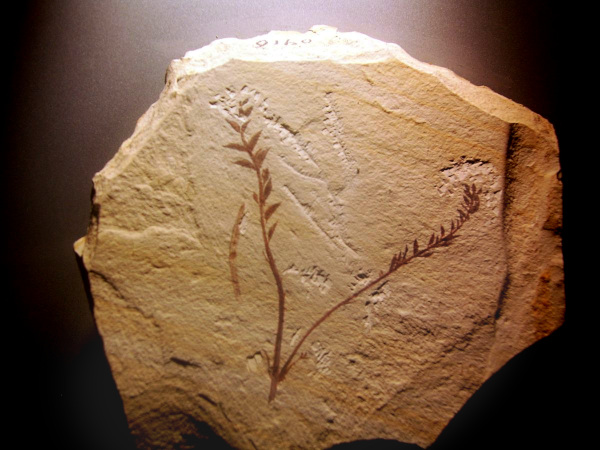 Fossil Archaefructus liaoningensis, possibly the earliest flowering plant discovered so far. On display in Beijing Natural History Museum; photo courtesy of "Shizhao" and Wikimedia Commons
And even then, there were no flowering plants. The first forests consisted of ferns and fern-like plants. Conifer trees, non-flowering ancestors of pines and spruces, developed approximately 285 million years ago. Finally, it was only long after the first mammals and the first birds began gracing the landscape that the first flowering plants came into existence -- only about 135 million years ago -- (remember, the earliest life appeared about 4,000 million years ago). The fossil picture shows a plant of early Cretaceous age, about 125 million years old. There's disagreement about how to interpet it, as would be expected of a species at the very emergence of flowering plants.
THE FLOWERING PLANT EXPLOSION
By 80-90 million years ago, already flowering plants were starting to dominate the landscape. There was an explosion of flowering species. The new flower/fruit/seed manner of reproduction was much more flexible and effective than the old ways. Evolution sped up as flowering plants began occupying niches that hitherto had remained vacant. A dozen seeds produced by these new species of flowering plants might produce more offspring than a million fern or fungus spores falling onto the same ground!