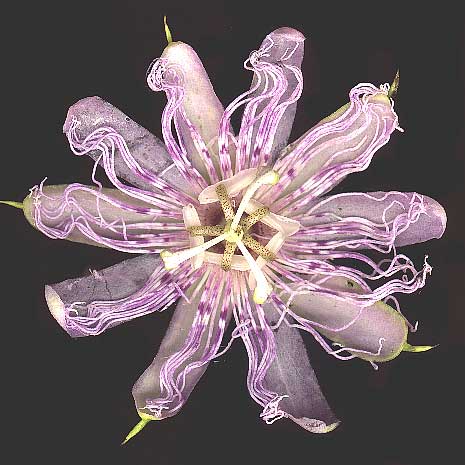
THE PASSIONFLOWER
Passionflower blossoms like that at the right look very different from our Standard Blossom, sketched below, but in both instances a flower's main parts are similar or the same. 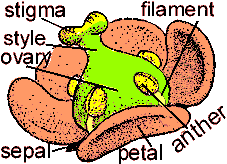 Discovering hidden similarities is fun, and finding features in real flowers we meet not even suggested by the Standard Blossom, is even more fun. Here's how it works:
The above passionflower blossom seems to bear many more than the Standard Blossom's five petals. However, note that in the passionflower picture every other "petal" has at its tip a short, spiny "tooth." The five petal-like items bearing spiny teeth are sepals modified to look like petals, while the un-toothed ones are real petals. Definitely this is a peculiarity of our passionflower blossom, and we've discovered something to remember.
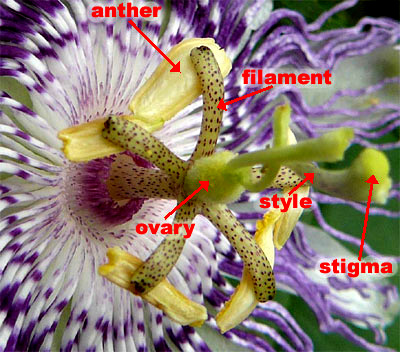
At the right the passionflower blossom bears five stamens consisting of pollen-producing anthers at the tip of slender filaments, exactly as in the Standard Blossom, though they look different. Of the female parts, the pistil consists of an egg-shaped ovary, also as in the Standard Blossom, but instead of just one style atop the ovary, there are three. However each of the three styles bears at its tip a knobby stigma. So far, all the passionflower's sexual parts, male and female, are basically the same as in our Standard Blossom, except for those three styles instead of one.
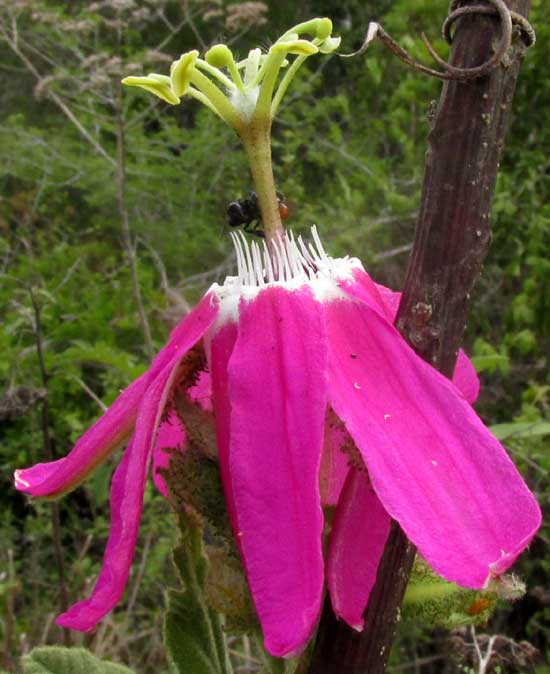
However, in the above picture, note that the Passionflower's ovary stands atop a kind of stalk. In the Standard Blossom there's no hint of a stalk, so this is something very special. The stalk is called an androgynophore, defined as a stalk bearing both stamens and pistil above the calyx and corolla. At the left you see another passionflower species with an especially long androgynophore.
The next big difference between the Standard Blossom and both of the passionflower species we're looking at relates to those long, slender filaments radiating from near the base of each species' androgynophore. They're much more developed in the species shown in our first, larger picture than in the second, where they're just white, fingerlike things pointing upward instead of horizontally. These filaments are slender subdivisions of the flower's corona, which is a feature our Standard Blossom simply doesn't have. Other flowers, such as Daffodils and Milkweeds, also bear coronas, but those coronas normally are not divided into fine filaments like these.
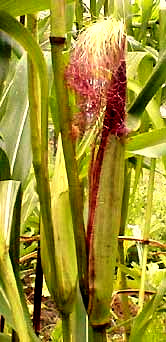 An ear of corn (maize); each long, hairlike "silk"is a style with a stigmatic region at the outside tip, and a connection to the immature corn kernal -- the ovary -- on the corn cob inside the corn shucks...
BEYOND PASSIONFLOWERS
Here are important points to note about the flower-examining process just conducted:
- Basic flower parts change in appearance, number and disposition from one species to another
- Sometimes important parts of the Standard Blossom are completely missing in flowers we find (as above was the case with a very different-looking calyx)
- Sometimes the flowers we find bear parts completely missing in the Standard Blossom (as with the passionflowers' androgynophore and slender corona filaments)
Let's take a look at some commonly encountered flowers carrying the above manners of diverging from our Standard Blossom to extremes.
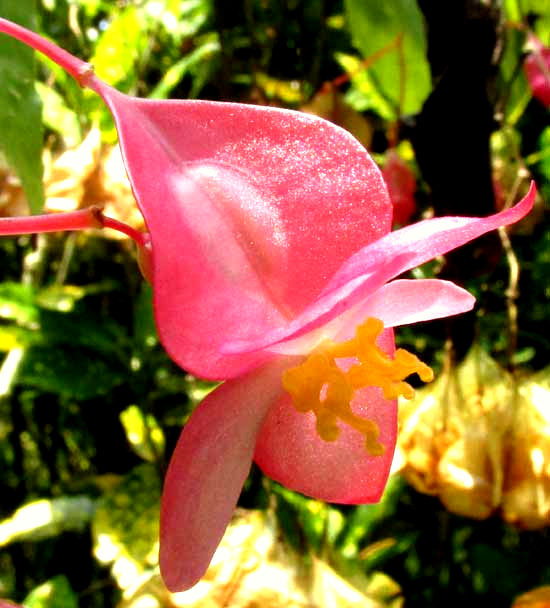
At the left, this flower of an Angelwing Begonia, Begonia coccinea, not only has an inferior ovary -- petal- and/or sepal-like parts arising above the ovary instead of at its base as in the Standard Blossom -- but also its petals/sepals are indistinguishable, so collectively they're called "tepals." Maybe most different from the Standard Blossom, however, is that this a female flower, so male parts are missing.
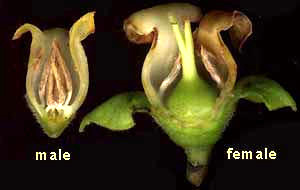
About 10% of all kinds of flowers are unisexual. Sometimes male and female flowers occur on the same plant, sometimes on different plants of the same species. At the right, in unisexual flowers of the American Persimmon, Diospyros virginiana, the male blossom is filled with pollen-producing stamens, with no trace of a pistil. The female flower has a very healthy looking pistil with stigmas, branched styles and ovary, plus vestigial, sterile stamens.
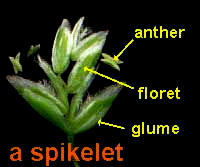
At the left, a typical grass flower of the Annual Bluegrass, Poa annua, produces much reduced and modified flowers called florets, as does the huge Aster or Composite Family, though the florets are different and differently arranged. Florets in both families usually but not always contain both male and female parts. In grasses, florets are arranged in flowering heads called spikelets. Still, the florets/flowers of members of both the Grass and the Aster families produce recognizable stamens with anthers on filaments, and pistils with ovaries and various style/stigma combinations.