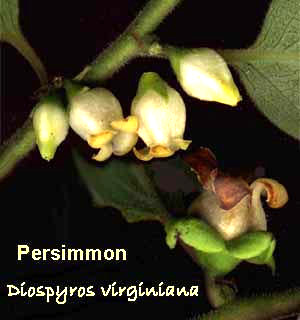
Persimmon trees are members of the genus Diospyros, of which 400-500 species are recognized worldwide. Several Diospyros species are famous for their sturdy, dark ebony wood. The name persimmon is applied to the edible fruits of several Diospyros species. Worldwide, probably the most famous persimmon is that of Diospyros kaki, the Oriental Persimmon. The flowers at the right belong to Diospyros virginiana, the American Persimmon, common trees throughout the eastern US south of a line from about southern New York to eastern Kansas.
Typically Persimmon trees are either male or female, and of course only the females bear fruit. The above photo shows a cluster of male flowers at the top, and a single female flower at the bottom, right, all typical of Diospyros flowers. The larger female flower is 7/16 inch high (1 cm)
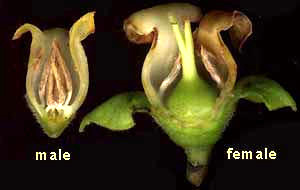
As the left, one side of each flower has been removed. Here you can see that, besides persimmon trees having separate male and female flowers, they differ from our Standard Blossom by producing urn-shaped corollas with small lobes that curl backwards. Of course the long items inside the male corolla are pollen producing stamens. In the female flower, those items leaning over the spherical, green ovary at the flower's bottom also are stamens, but usually they're sterile.
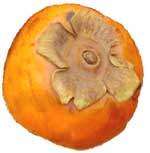
Also notice that the male flowers have typical calyces, but the female's calyx is very large and thick. As the pistil grows and matures into a persimmon fruit, the calyx enlarges tremendously and becomes semi-woody, as shown on the American Persimmon fruit at the right. In typical flowers, the calyx shrivels up or remains small and inconspicuous.