POLLINATION STRATEGIES
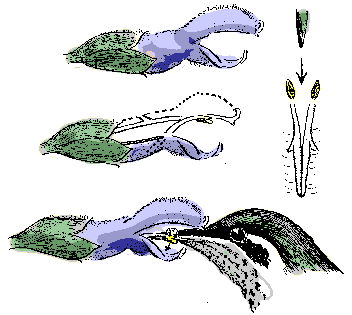
Every flower has a pollination strategy, and whenever a new-to-you flower comes along, it's always interesting to try to figure out what that strategy is.
For example, At the right you see a good one, a salvia flower being pollinated by a hummingbird. The strategy includes the flower providing nectar deep inside the tubular corolla, into which the hummingbird's long beak must be inserted. As the beak enters, it pushes on two levered stamens in such a way that they douse the beak with pollen, while at the same time the flower's stigma-bearing style receives pollen already on the beak, put there by other flowers.
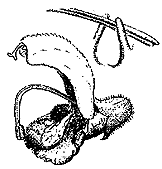
Some salvia species adapted for bee pollination have their levered stamens a little differently configured, resulting in what's sketched at the left.
Other blossoms use an entirely different system of pollinator-activating stamens to accomplish pollination. For example, below, a flower of the tropical bean vine Vigna candida has part of its corolla formed into a curled tube that most of the time hides and protects the stamens and style, as shown at the picture's left. However, when one of the side petals is pressed, the style pushes from the tube, as shown on the picture's right side:
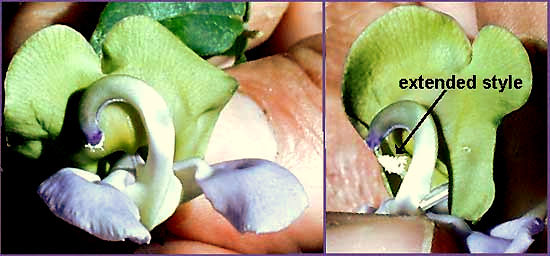
An interesting feature is that below the style's stigma there are sterile hairs covered with the flowers own pollen. Pollinators, therefore, by brushing against the style that pops out, both deposit pollen from other flowers and gather the visited flower's pollen. It's unclear how self-pollination is avoided, but in some species the stigma is receptive at one time and the pollen is shed at another. More about this curious pollination strategy is described in a 2013 study by Hoc and Fabiana.
THINGS TO LOOK FOR
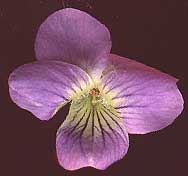
Most flower pollination strategies are less complex than described above, but quite a few are even more involved. At the right you see a common feature helping flying pollinators find the nectar's exact location. In that flower of a violet, the pollinator is attracted to the corolla tube's white entrance, plus lines converge toward the exact spot where nectar is available. The lines are nectar guides.
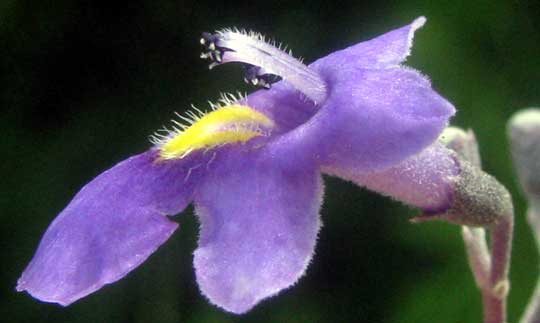
At the left, the flower of the Fiddlewood tree, Vitex gaumeri, provides a spacious pollinator landing pad. Having landed, the pollinator scrambles over the yellow stigmas, thus depositing pollen from other flowers. After taking the nectar, the pollinator brushes against the dark anthers held above the stigmas, receiving a new load of pollen for the next flower.
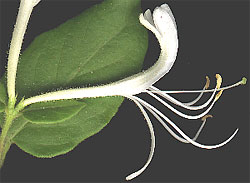
The Japanese Honeysuckle flower at the left, Lonicera japonica, is pollinated by night-flying sphinxmoths. The flowers' white color shows up at night, and the very narrow corolla tube accommodates the sphinxmoth's long, straw-like proboscis. The flower's main attraction, though, isn't seen: its very sweet, heavy fragrance. In that picture you can see that the first thing touched by the arriving hawkmoth is the stigma held beyond the stamens on a long style. The stamens' anthers face upward in a way that the moth's body will scrape over them.
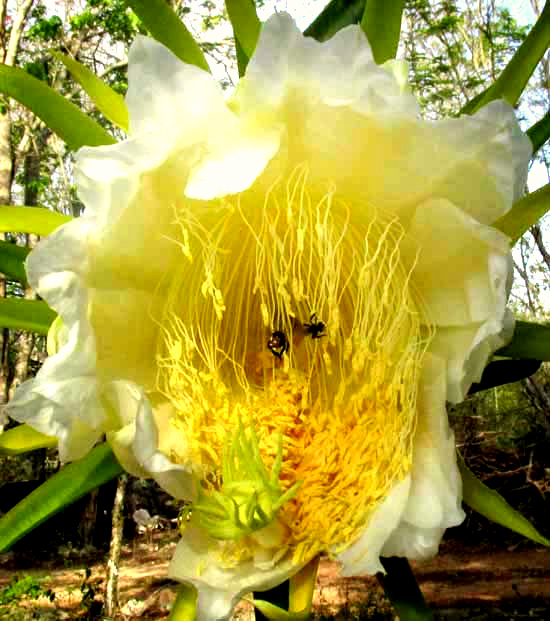
Attracting pollinators by offering nectar is just one strategy available to flowers. At the left, the cantaloupe-size blossom of a Night-blooming Cereus, Hylocereus undatus, with its large size, brilliantly white blossoms that open at night and close in early mornings attracts night-flying sphinx moths, ants, bees and wasps who gather pollen. Apparently nectar isn't produced by this species. Pollinators enter the maze of dangling stamens and more or less randomly wander about gathering pollen, while depositing pollen from other flowers on the large, blossom-like, light green stigma, seen at the flower's bottom. Pollen often is fed to the pollinators' developing larvae.
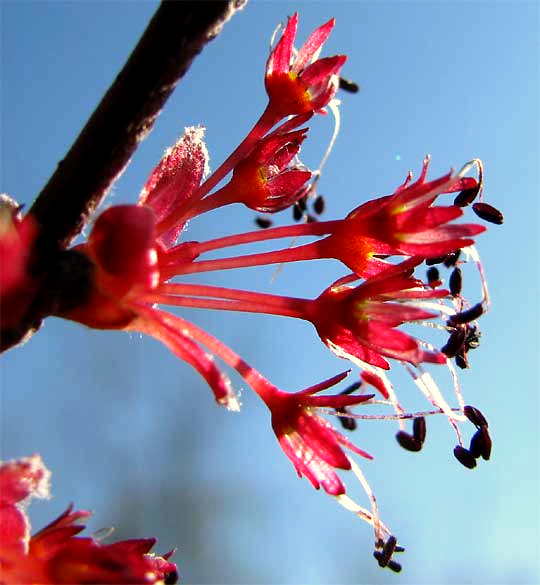
Also, about 12% of all kinds of flowers are wind pollinated, such as Red Maple, Acer rubrum, shown at the right. There you see unisexual male flowers with anthers dangling in the wind, which is typical for wind-pollinated flowers.
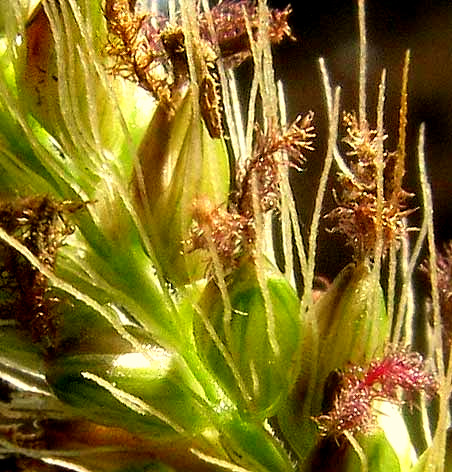
All grasses are wind pollinated. At the left, emerging from each floret of a Marsh Bristlegrass, Setaria parviflora, two style branches with feathery stigmatic tips filter breezes for wind-borne pollen. Feathery stigmatic styles also are typical for wind-pollinated flowers.
In fact, flowers use many kinds of adaptations that enhance their ability to be pollinated. Often it's hard to figure out how a blossom encourages its pollination, and the best was to learn is just to sit quietly and watch what happens. But don't forget about the night-pollinated ones, and the water-pollinated ones...