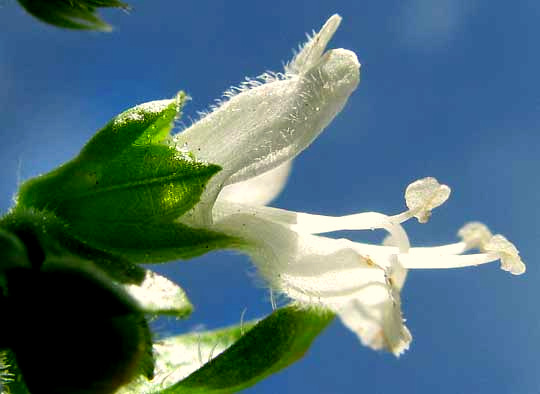
The Mint Family, the Lamiaceae, is a big one with about 3500 species distributed through around 220 genera, and found worldwide. Most mint species are easy to recognize as mints. The garden Basil flower at the right is typical of the family. The family's most conspicuous features include:
- often they are strong-smelling herbs
- two leaves instead of one arise at every node (they're described as opposite)
- the stem is square in cross-section
- the flowers are usually irregularly shaped, displaying bilateral symmetry (right side mirrors left side)
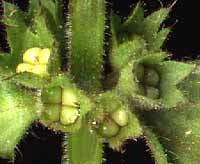
- the ovary usuallly is divided into four nutlets with the style arising from amidst them. In the picture at the right the nutlets are clearly visible nestled inside the calyxes after the corolla and style have fallen away, This is a Hedge Nettle, Stachys arvensis. Also note the squarish stem
In herb gardens, Mint Family members include rosemary, horehound, lavender, catnip, sage, savory, marjoram, thyme, basil, peppermint, and spearmint. Mints often grown as ornamentals include coleus, snapdragons, and scarlet sage. There are even some weedy mints, among the most common being ground ivy, bugleweed, heal-all, henbit, pennyroyal, purple dead-nettle, and hedge nettle.
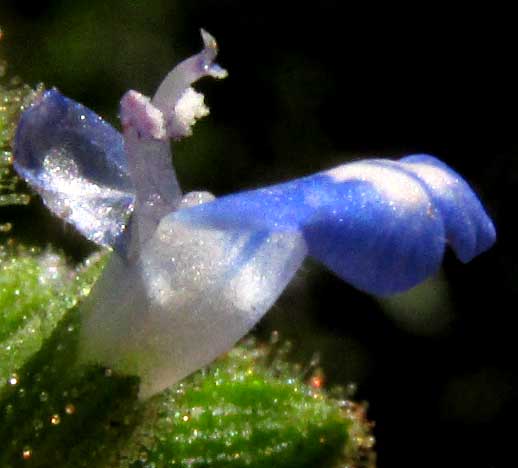
In mint flowers the sexual parts often are positioned in various ingenious ways ensuring that pollinators successfully pollinate, and leave the flower with pollen from them, for other flowers. For instance, flowers of the Tropical Sage, Salvia misella, as shown at the right, provide a nice landing pad for arriving pollinators, with white lines (nectar guides) leading into the corolla's throat and to the nectar.
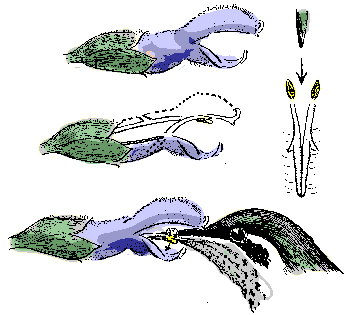
The above Tropical Sage flower appears to be bee-pollinated but other sage species (genus salvia) are pollinated by hummingbirds, as sketched at the left. Note the appendages on the stamen filaments at the drawing's middle-right. These constitute a "lever mechanism" causing the pollen-covered anthers to move down to press on the bird as the beak is inserted into the flower's throat.
We've noted the Mint Family's main features. It must be said that as the genes of more and more species are sequenced, the question of what's a mint is more and more uncertain than in the past. Especially, the boundary between members of the Mint Family and the Verbena or Vervain Family aren't clear at all. Recently numerous entire genera of the Verbena family have been shifted into the Mint Family, and other genera were sent to other families, or new families were erected just for them. Wikipedia provides a section listing these changes.
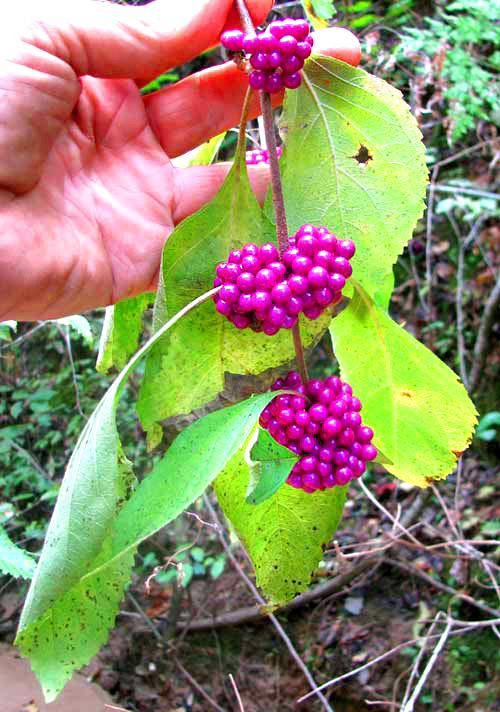
One genus shifted from the Verbena to the Mint Family is that of the beautyberries, genus Callicarpa, of which the American Beautyberry, Callicarpa americana, shown here, is a member. Those pretty fruits don't look much like the tiny four nutlets that shake from a mature Basil calyx, do they? Nor does its crushed leaves smell at all "minty." But their genes say that beautyberry species belong to the Mint Family.