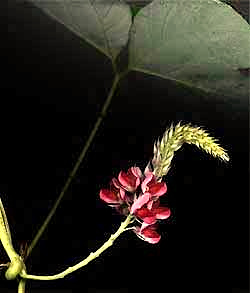
As the picture at the right shows, Kudzu flowers occur in spike-like clusters called racemes, and flowering begins at the raceme's bottom. The Kudzu vine's compound leaves are divided into threes, like clover's, but they are much larger. The ones in the picture are about a foot across. A single Kudzu flower is up to ¾-inch long (19mm).
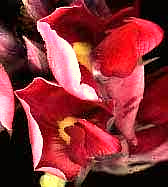
The close-up at the left shows two flowers. Each Kudzu flower displays the typical papilionaceous configuration described on our Bean-flower Page, plus each flower bears a yellow spot at the base of its large upper petal, the standard. This yellow spot helps pollinators find nectar, and thus facilitates pollination.
That picture also displays one feature distinguishing Kudzu flowers from the blossoms of "average" Bean Family members: The flower's keel -- the two bottom petals grown together along their common margin to form a scoop-like pouch -- is strongly up-curved at the end. It snugly shelters the pistil and stamens inside its fold. Compared to the broadly flaring standard, the keel is narrow and smallish.
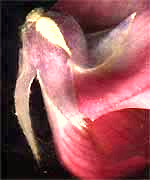
The picture at the right shows another distinguishing feature: The Kudzu flower's sepals are especially long. In the picture you can see three rather long, narrow, pale-purple sepals arising at the corolla's base, which is at the picture's top, left corner.
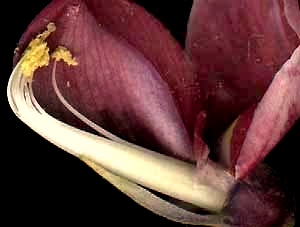
At the left, one wing and one side of the keel have been removed to show how the white filaments of the flower's ten stamens grow together to form a cylinder around the female pistil, but with one stamen growing apart. This is typical in the Bean Family. When stamen filaments display this 9 + 1 arrangement, they're said to be diadelphous.
It's unclear why so many Bean Family flowers do this strange thing, they just do. Of course, the yellow, powdery stuff at the top left in the picture is pollen being released from mature anthers.