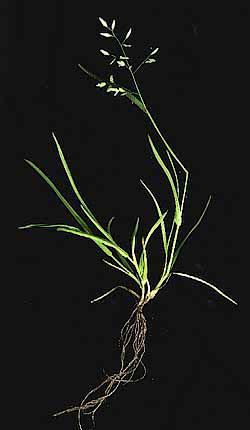
 If magnolia flowers are lush, emotional symphonies, then grass flowers are elegant, crystalline Bach fugues. Grass flowers are among Nature's most understated, exquisitely designed expressions. With the Grass Family, the Poaceae, embracing about 700 genera and 11,000 species, each grass flower we meet is a fugue-like variation on a grass-flower theme.
At the right, Annual Bluegrass, Poa annua, occurs in lawns and other habitats throughout most of North America and much of the rest of the world. With roots, leaf blades, and stems topped with an inflorescence of flowers, it's a typical grass. We might think of Annual Bluegrass as our "Standard Grass," and whenever we meet another species, consider how that species differs from our bluegrass. Those differences will be what's special about those other species.
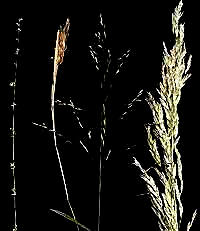
The bluegrass's particular, somewhat diffuse inflorescence type is a panicle, but other kinds of grasses produce their flowers in racemes, spikes or spike-like branches. At the left, from left to right, you see the inflorescences of Uniola (Uniola sessiliflora), Virginia Wild Rye (Elymus virginicus), Purpletop (Triodia flavus) and, Johnson Grass (Sorghum halepense). This diversity of inflorescence types just offers a hint of what's to come of the variations-on-a-grass-flower theme.
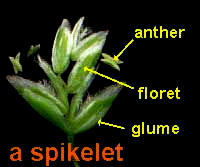
Annual Bluegrass's inflorescences comprise many spikelets such as the one shown at the right. The concept of "spikelet" isn't mentioned on our Standard Blossom page, because spikelets are a feature only of the Grass and Sedge Families, and a few other grass-like plants. Grass spikelets are somewhat analogous to flowering heads found in the Composite/Aster Family. The spikelet's glumes are like the showy, petal-like ray florets surrounding a daisy's composite-flowering head, and the grass's floret is like the composite flower's florets. Florets are the "real flowers." Our bluegrass's spikelet contains about five florets, but the spikelets of many grass species contain many more, or as few as one.
Let's end this section by looking at a tiny part of the rainbow of diverse kinds of grass species you'll encounter, once you start paying attention.
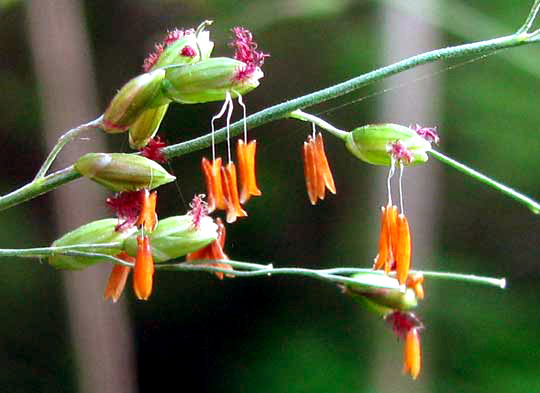
Guinea Grass, Megathyrsus maximus, has beautiful orange anthers which dangle on threadlike filaments from spikelets with feathery, purple style branches issuing from them.
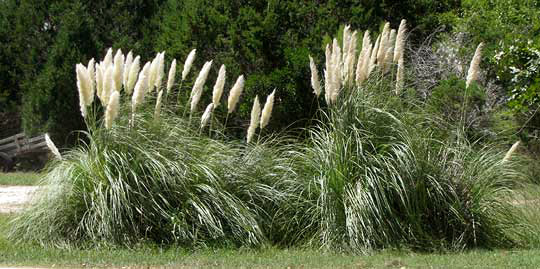
At the right, ornamental Pampas Grass, Cortaderia selloana is planted around homes and produces big feather-duster inflorescences.
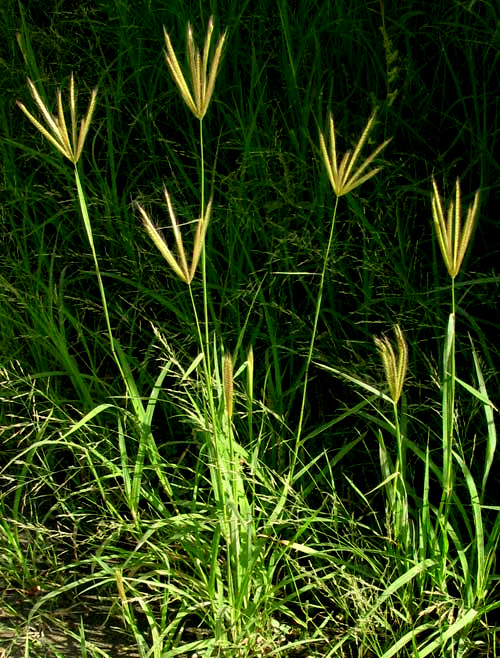
At the left, cutely named Feather finger-grass, Chloris virgata, reaches skyward with slender-fingered inflorescences.
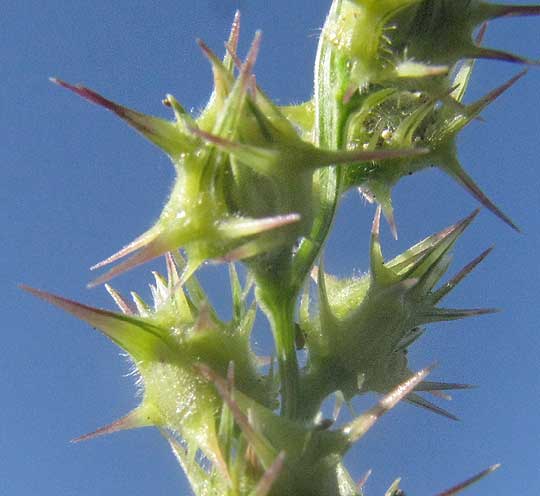
At the right, spiny Coastal Sandbur, Cenchrus spinifex, has its sexual parts protected by sharp, hard spines which can be awful to step on barefooted.
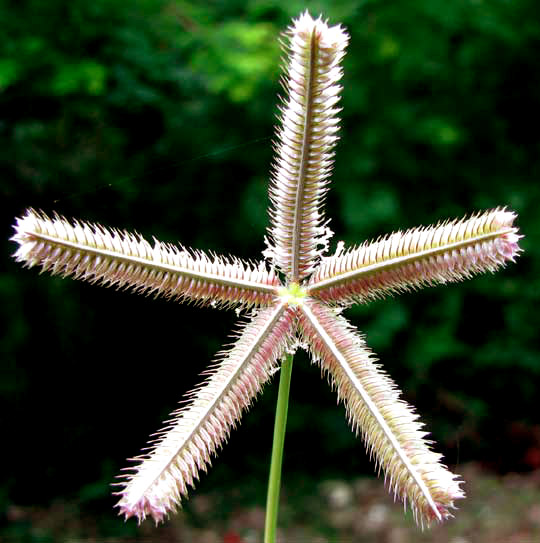
At the right, Egyptian Crowfoot Grass, Dactyloctenium aegyptium, growing along a sidewalk, makes a star with its stiff, compact inflorescences.
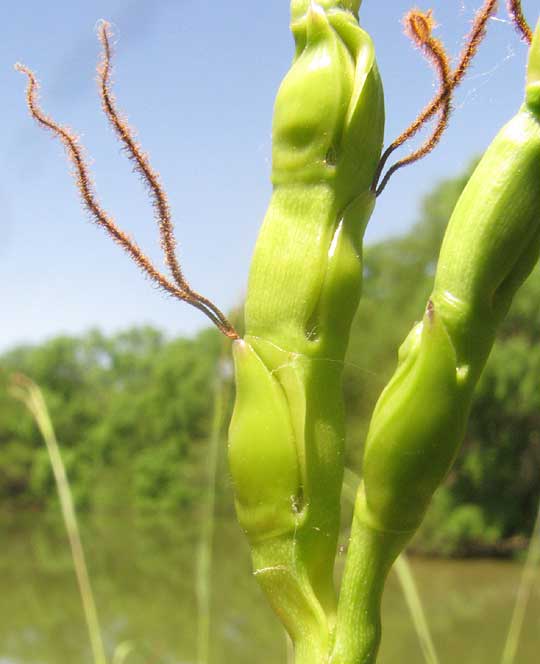
At the left, Eastern Gamagrass, Tripsacum dactyloides, has its spikelets buried in a thick stem, or rachis. Slender style branches with stigmatic fuzz emerge from atop hidden ovaries.
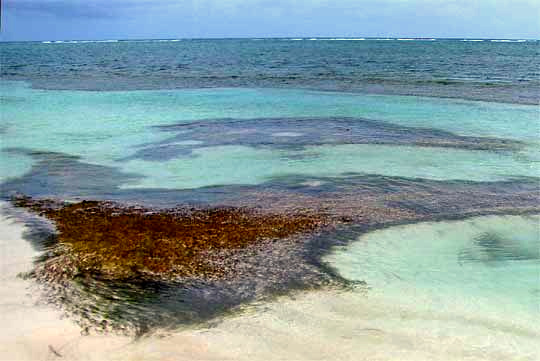
At the right, along the Caribbean coast of Mexico, Manatee-grass, Syringodium filiforme, finds its niche in shallow water along the beach.
You may enjoy seeing and reading about many other grasses documented in Naturalist Jim Conrad's Field Notes.