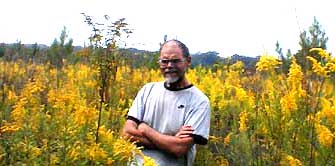
Above the author stands in a big field in southern Mississippi, surrounded by millions of Canada Goldenrods, Solidago canadensis. In the fall, few wildflowers and weeds put on such a brilliant show as goldenrods.
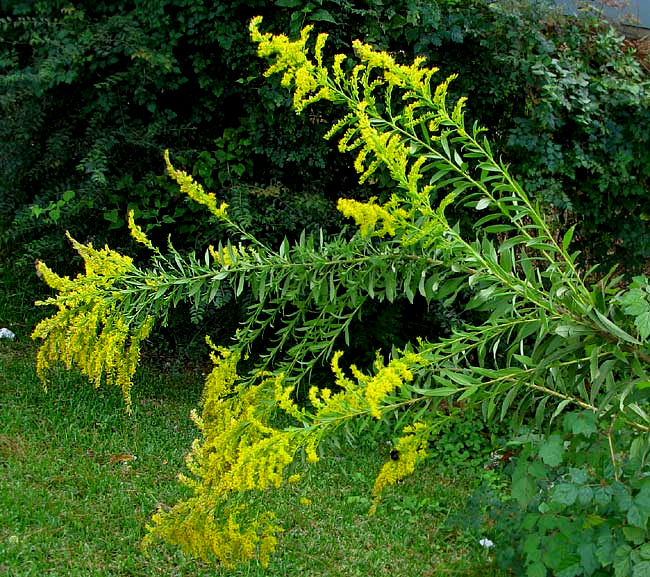
Traditionally, all goldenrods are regarded as members of the genus Solidago, but there's debate as to whether that genus should be broken up. As of 2021, the Flora of North America , recognizes about 100 Solidago species, with 77 listed for North America. At the right, the special way that many goldenrods distribute their flowering heads at the ends of often-recurving branches is shown on a Tall Goldenrod, Solidago altissima.
Goldenrods are members of the huge Composite Family, so they display a floral structure very different from that described on our Standard Blossom page. If you run across a goldenrod, notice the following special goldenrod features.
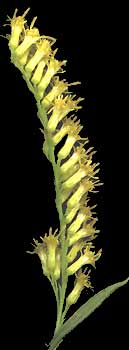
Notice at the left how goldenrod flowering heads, the capitulas, may arrange themselves along one side of an inflorescence branch. Each head consists of several flowers.
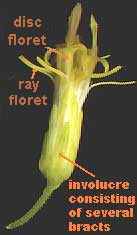
At the right you see a much-magnified head. If you don't know about ray and disc florets, check out our Composite Family page. The outwardly flaring items that in other blossoms we might call petals are actually ray florets. Inside the head the tops of several disc florets are visible. A couple of the disc florets have anthers rising above them. This whole collection of ray and disc florets is held together in a slender, greenish-yellow, cuplike structure known as the involucre. If you were holding the head in your hand, you could separate the longish, flattish, tongue-like involucral bracts from one another.
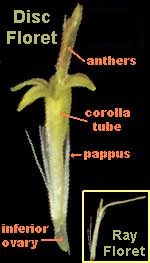
At the right you see a much-much magnified disc floret, with a less-magnified ray floret shown in the yellow-framed inset at the lower right. Notice that the cylindrical disc corolla bears five petal-like lobes. The entire disc floret measures only about 3/16ths of an inch long (4 mm). The pappus consists of stiff bristles atop the inferior ovary. When the ovary matures into a one-seeded, cypsela-type fruit, everything above the attachment of the corolla with the fruit will wither and fall off. The pappus will develop into a kind of "parachute" that will help the achene travel to a new location on the wind.