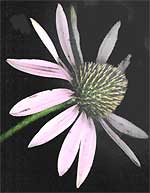
Echinacea blossoms such as the one at the left are typical members of the Composite Family, as described on our Composite Flower Page. However, certain features do distinguish them from all other Composites.
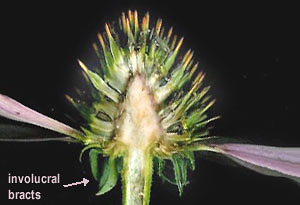
For example, at the right you can see that Echinacea's central ray flowers are distributed over a hill-like receptacle, making the cluster of ray flowers look a little like a porcupine. Most composite blossoms have flat or only slightly elevated receptacles. Also in that picture notice that the phyllaries, or involucral bracts as labeled in the picture, are long and slender, green, stiff, and pointed downward. A botanist would say that they're reflexed. The phyllaries of most composite blossoms are more triangular, closer packed with one another, and pointed upward, not downward.
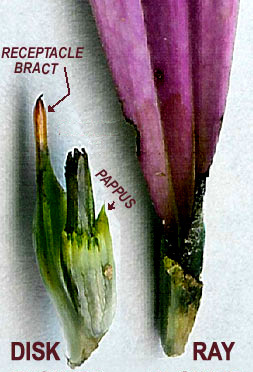
More special features of Echinacea florets are seen at the left. First, notice that the ray floret bears no stigma. That's because in Echinacea the ray florets are sterile. They don't have functional female parts and therefore the item at the base of the flower does not develop into a seed-like, cypsela-type fruit. In Echinacea the ray floret is strictly for drawing attention to the flower by pollinators. Ray flowers of many composite blossoms do produce viable fruits, and thus do have conspicuous stigmas.
Echinacea disk florets display two unusual features. First, in the picture, notice the large, stiff, orange-tipped, scoop-shaped receptacle bract partially folding around the disc floret. Many composite blossoms have no receptacle bract at all, and the vast majority of bracts in other species are much smaller, softer, and pale to transparent. In fact, when you look at an Echinacea blossom's center, the pointed things you think must be the disk florets are actually bracts, which are modified leaves.
On our Composite Flower Page it's mentioned that many kinds of pappus exist, maybe the most common type being very small, slender, white hairs that, once the achene is mature, reside atop the achene and serve as a parachute for wind dispersal. Echinacea's pappus consists of a thick crown, toothed at the angles. In the above picture an arrow points to a large pappus tooth.