
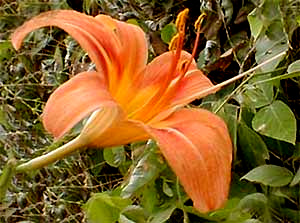
 The blossom at the right belongs to an Orange Daylily, Hemerocallis fulva, and the plant isn't growing in a garden, but rather along a weedy roadside in Mississippi. The species originated in Asia but is planted throughout the world, and in many places has escaped to become a particularly handsome weed.
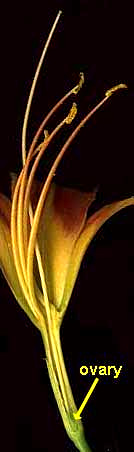
In the above picture's top, right quarter, the slender, straight, white object is the style, with a tiny stigma at its tip. At the style's left, the slender, upward-curved items are stamens, of which the flower has six. At the stamens' tips, large, banana-shaped anthers are releasing pollen.
In the picture at the left, of a flower with one side removed, you can see all this better. Also in that picture note that the stamens arise from atop the flower's cylindrical "throat," or "perianth tube," where the tube starts expanding to form the corolla. The long style passes through the tube to connect with the ovary at the bottom.
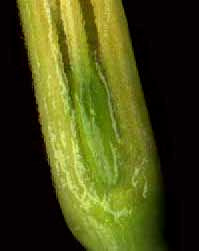
At the right you see a close-up of the ovary. It's glistening with wetness because it's immersed in sweet nectar. Seeing this, you can imagine a moth or butterfly inserting its long, straw-like proboscis down through the tube, to the nectar at the very bottom.
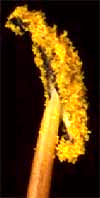
Of course, that's what the flower "wants," for the pollinator may brush against one or more of the stamens' anthers, such as the one at the left loaded with grainy, yellow pollen. The pollinator then carries this pollen to the next flower, and deposits it on the first thing it touches, which is the stigma at the tip of the long style projecting from the flower.
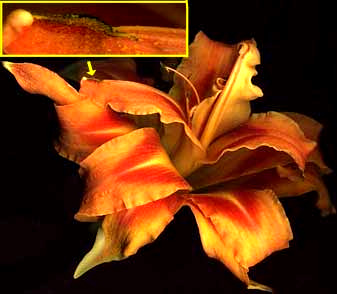
Many fancy cultivated forms of daylily, such as the "double-flowered" one at the right, have been developed from the eight or so horticultural species of the genus Hemerocallis. In that picture, the inset at the top left shows something interesting.
Double-flowered forms can arise when two or more species or varieties are hybridized. During hybridization, some or all of the stamens in a flower may be replaced by petals. The root cause is that much of the genetic information directing the formation of corolla parts is the same as for forming stamens, so sometimes you get something that is part flower petal, and part stamen. The picture's inset shows the edge of a flower petal (in lilies called "tepals") with part of a stamen's anther and style attached.
The American Hemerocallis Society has a FAQ page telling a great deal about daylilies.