
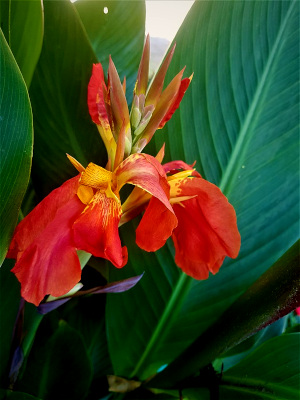
 Orange Canna Lily; image courtesy of Sabina Bajracharya of Kathmandu, Nepal, and Wikimedia Commons
Cannas, sometimes called canna lilies, are not lilies. Cannas belong to their own family, the Cannaceae, and their own genus, which is the only genus in the Family, the genus Canna. Within that genus, 10 species are recognized, all from the Americas. From these few species, hundreds if not thousands of named cultivars have been developed. However, they all share the same basic, very curious structure.
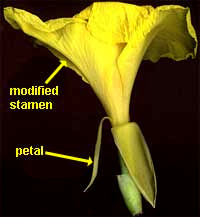
If you don't understand terms like sepal and stamen, you may want to consult our Standard Blossom Page as you read the following.
In canna flowers the bright "petals" are actually stamens modified to look like petals. Such modified stamens technically are known as staminodia, or staminodes. Usually the staminodia number three, though sometimes there are one or four occur. The staminodia arise from atop a roundish or oval ovary at the flower's base, as do three small, usually green sepals, visible in the next picture. There are also three inconspicuous, bract-like petals, which can be green or colored.
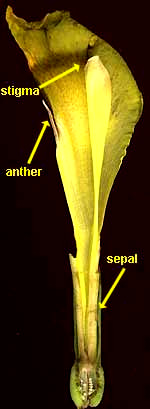
Of the three petal-like staminodia, one is narrower than the others and curls back to form the flower's "lip." The last modified stamen is still narrower, and bears one fertile anther (the pollen-producing part of the stamen) on its side, thus proving that this petal-like thing really is a modified stamen. At the right the larger staminodia have been removed, leaving only this narrow one with its pollen-producing anther. The sepals are also more clearly visible in this photo.
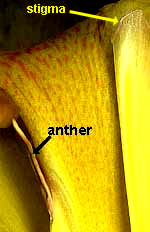
Notice that the anther-bearing staminode at the right is accompanied by the pistil's style, at the top of which you can barely see the stigma. The style is the ovary's "neck." In some canna flowers the style instead of being flat is club-shaped. Whatever the style's shape, pollen lands on the stigma, sending tubes carrying the male sex germ down through the style, to the ovary at the bottom (it's a classic inferior ovary). At the left is a close-up so you can see the anther and stigma better.
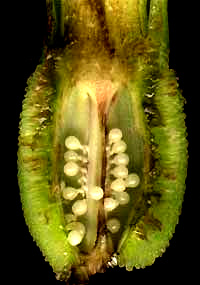
Despite such a surreal arrangement of petals, stamens and the rest, at the bottom of each fertile canna flower resides a fairly normal ovary like the one appearing at the right. There, one side of the ovary has been removed to reveal the neat arrangement of the ovules (the future seeds). The ovules of most garden canna cultivars never mature into viable seeds, however, though some with the least genetic manipulation -- ones "closest to their wild ancestors" -- may produce them.
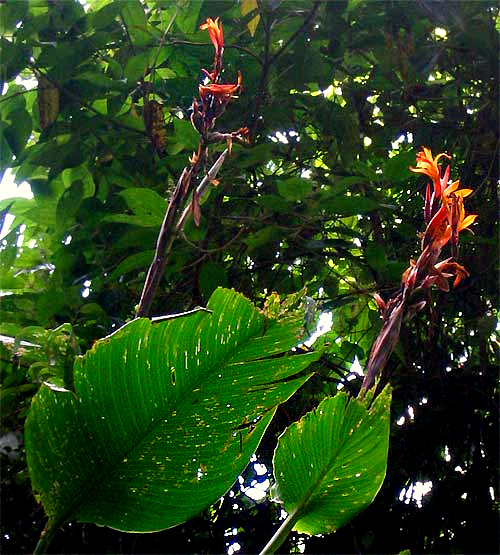
Speaking of wild cannas, at the right is an unidentified species found in a cloud forest in the mountains of Chiapas, southern Mexico.