THE EASY ANSWER:
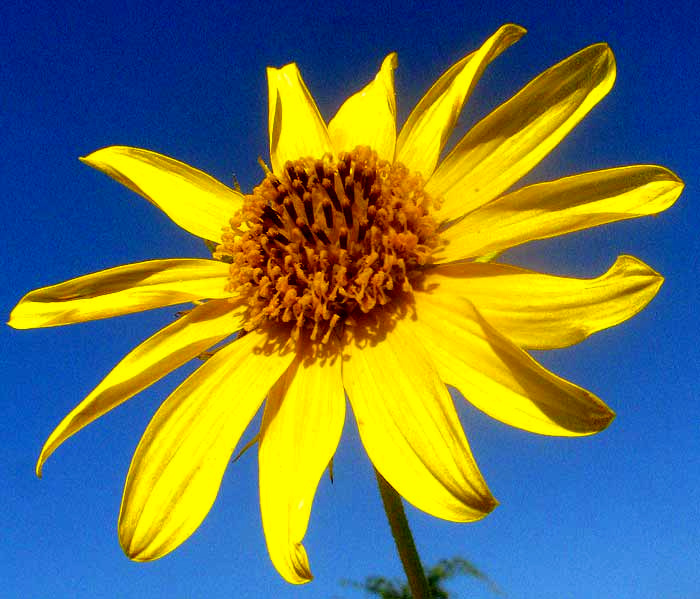
We humans like bright colors, weird shapes, elegant designs, and cleverness. Once we're sensitized to flower structure and design, our minds get pulled into the perfumy little worlds inside blossoms where hues and textures, novelty, elegance, and cleverness everywhere simply bowl us over.
Also, in general it's true that knowing about and experiencing Nature enlarges and roots us as individuals. Nature imparts insights and feelings that ground us in reality, helping us deal with life's general problems. Paying attention to flowers is a kind of soothing, peace-making, wisdom-bestowing meditation.
BLOSSOMS OPEN DOORS TO US
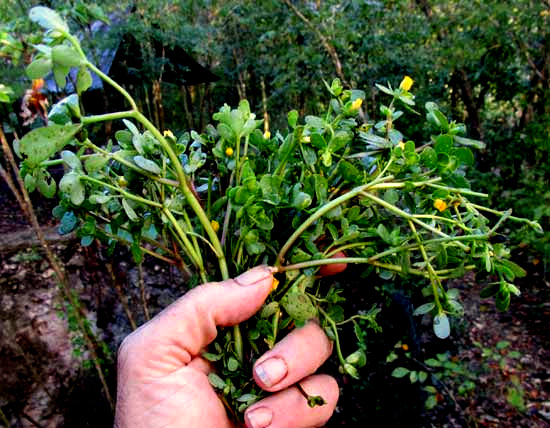
At the left, that's the common weed called Purslane, Portulaca oleraceae. Purslane is edible. In fact, its fresh leaves contain more omega-3 fatty acids than any other herb, reducing the risk of heart disease, stroke and other diseases. It's one of the most important sources for Vitamin-A, and a powerful natural antioxidant. Also, it tastes great when sauteed with fried eggs, onion, tomato and jalapeño pepper, spritzed with lime juice right from the lime.
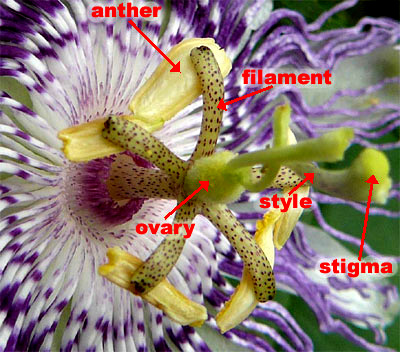
However, Purslane is just one of 100-125 species in the genus Portulaca, and lots of plants outside that genus can be confused with it. If you want to eat wild Purslane or use it medicinally, you absolutely must be sure that you have the right species, Portulaca oleraceae. At the right, that's the flower of the Maypop, Passiflora incarnata, a vine whose mature fruits make a sweet snack when encountered dangling from bushes at woodland edges.
In plant identification, nothing is more important than taking into account the structure and appearance of the flowers. A species may have leaves, stems and roots similar to hundreds of other species, but always among the species there are differences in flower structure.
Therefore, understanding what you're seeing when you pay attention to flowers is essential for entering the doors into the world of edible and medicinal plants.
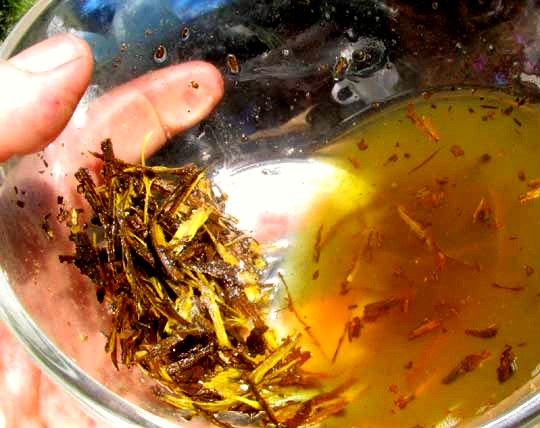
The same is true if you want to experiment with wild plants from which natural dyes, glues, organic insecticides, perfume ingredients, or leather tanning agents can be derived, or if you want to name all the trees, bushes, vines, wildflowers, grasses, sedges, or reeds growing in your neighborhood -- or any other place in the whole wide world: You absolutely must be able to identify your plant with certainty, and that means that you must understand what you're seeing when you look at a plant's flowers.
The above picture shows yellow dye extracted from woodchips of Agarita, Berberis trifoliolata, a shrub of the arid US Southwest and northern Mexico. To find the shrub, you must know which of the many southwestern US shrubs is Agarita. Similar bushes don't produce that dye. The name of the thing is the key to it all, and flowers are the key to having that name.