
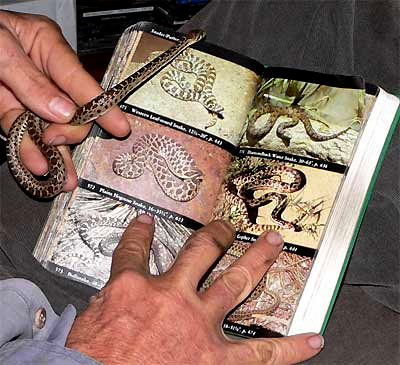
At the left, the Audubon Field Guide North American Reptiles and Amphibians is used to identify a snake found in a garden. It's the Pacific Gopher Snake, Pituophis melanoleucus ssp. catenifer. Here you see how field guides function, though seldom do you have such cooperative species to work with.
In this particular field guide, pictures of snakes are separated into groups based on color patterns -- plain, two-toned, striped, patterned -- except that the venomous pit-vipers have their own section. The gopher snake was "patterned," and it took only about 30 seconds to thumb through the "patterned pages" to find a match. In the picture, the matching illustration appears on the page's right side, just above the hand's two middle fingers.
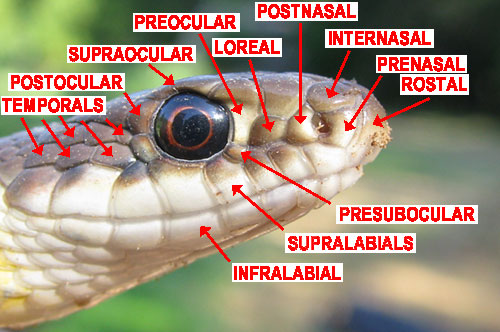
Once a good match was made, the identification was confirmed by referring to notes in the accompanying text where, among other things, descriptions of the various scales on the snake's head were provided. At the left, on the head of a Freminville's Scorpion-hunter, Stenorrhina freminvillii, you can see that on snakes each head scale has a name, a definite shape, and a definite relationship with surrounding scales.
HOW FIELD GUIDES ARE ORGANIZED
Field guides are organized so that we can skip most pages when looking for a matching illustration. They're organized in three main ways:
 |
 |
| photos courtesy of Dan Sudia | |
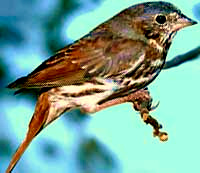
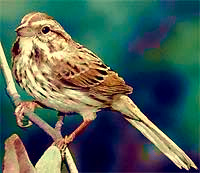
- According to physical traits. For instance, a field guide to the trees might group its species according to whether leaves are attached to twigs singly, in pairs, or in threes. Within these groups, further subdivisions might take into account whether the leaves are composed of single blades or divided into leaflets. This is especially helpful when distinguishing similar species such as the Fox Sparrow and the Song Sparrow shown above, which might appear on a "sparrows with streaked breasts" page.
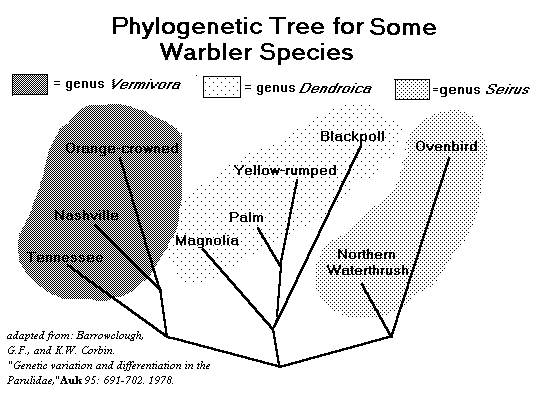
- According to what's related to what -- by "taxonomic relationships." For example, bird field guides nearly always group together birds belonging to the same order (the duck order, the owl order, the perching-bird order...), and then within each order all birds belonging to the same family are placed together (within the perching-bird order there's the nuthatch family, the wren family, the warbler family...) The above "Phylogenetic Tree" indicates that Ovenbirds and Northern Waterthrushes are very closely related. In most field guides those two species appear on the same page.
- According to both the above criteria. A field guide to wildflowers might first group its species according to flower color, then within each of these groups, according to plant family. Thus all red- flowered members of the Aster/Composite Family may appear in one place, then next to them all red-flowered members of the Milkweed Family.
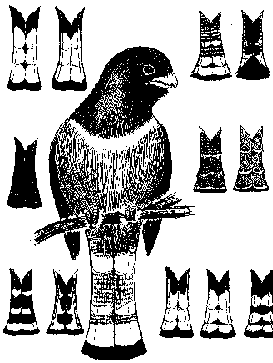
Often differences between species are so subtle that general photos of each species are inadequate. In such cases many field guides provide aids such as shown at the left. The bird in the drawing is one of several species of Mexican trogons. It happens that several trogon species are so similar that to distinguish them it's helpful to see the "bar coding" on the undersides of their tails. In such cases, drawings can be more helpful than photos.
This is an important point to keep in mind because certain field guides are photography based, while others are hand illustrated.