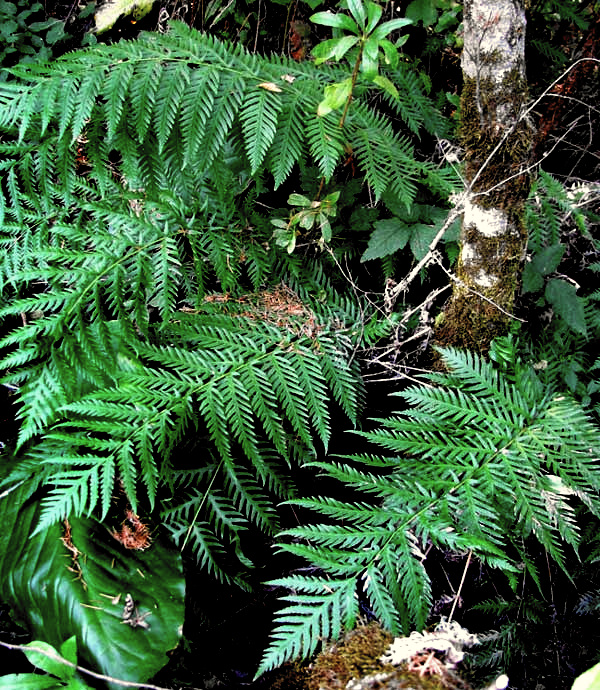
When we think "ferns," usually we visualize something like the Giant Chain Fern, Woodwardia fimbriata, pictured at the right. It's a frilly frond growing in a moist, deeply shaded cove somewhere out of the way in Oregon's Siskiyou Mountains. Lushness, coolness, moistness, gracefulness... That's "ferniness."
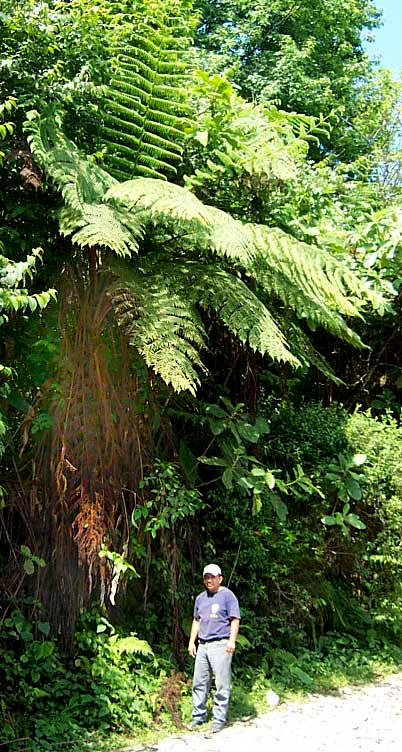
But, at the left, that's also a fern. It's a Tree Fern, Lophosoria quadripinnata, growing like a weed along a very hot gravel road in the mountains of central Mexico. Its fronds look "ferny," but everything else about it jolts our sense of what a fern is.
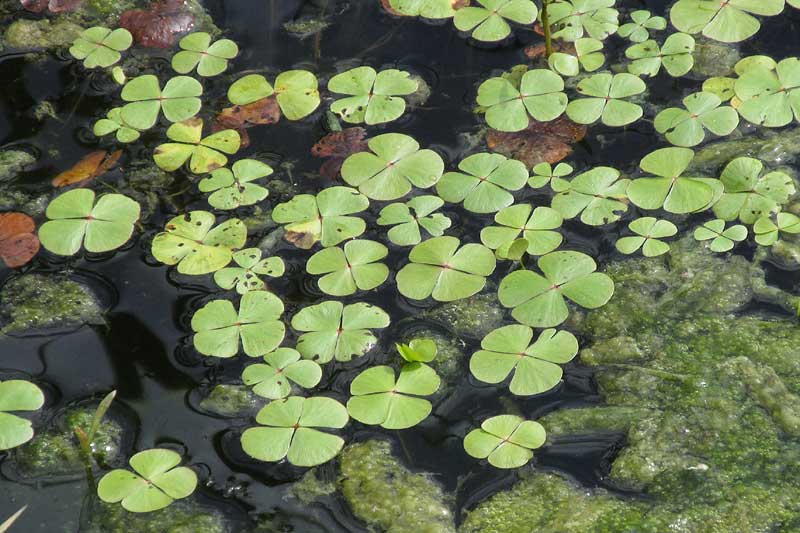
And if a tree-like fern doesn't impress you, what about the aquatic Hairy Water Clover, Marsilea vestita, at the right, which is as much a real fern as any fern anyplace?
The point being made is that of the more than 10,500 known, living species of ferns -- with thousands of other species yet to be discovered -- there's incredible diversity in form and function. "Ferniness" is a whole new world to explore, and to admire.
WHAT'S A FERN?
Ferns are flowerless plants reproducing with spores, whose complex (megaphyll-type) leaves contain a vascular system consisting of more than one vein conducting water and nutrients upward (xylem cells) and photosynthesized food downward (phloem cells)..
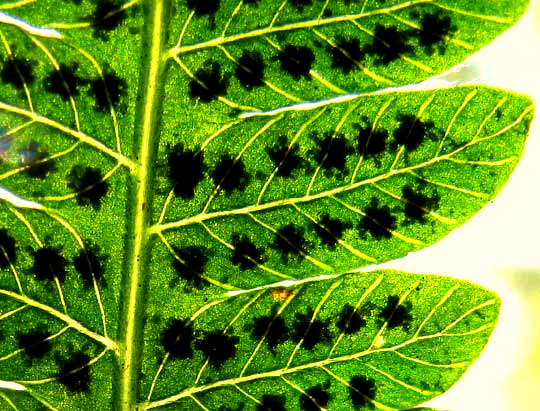
The presence of a vascular system separates ferns from mosses, liverworts and hornworts. The possession of complex, megaphyll-type leaves separates ferns from clubmosses and horsetails, which produce reduced, microphyll-type leaves having only one vein. At the right, branching veins in the frond of a Southern Shield-fern, Thelypteris kunthii, are clearly visible when held against a bright light.
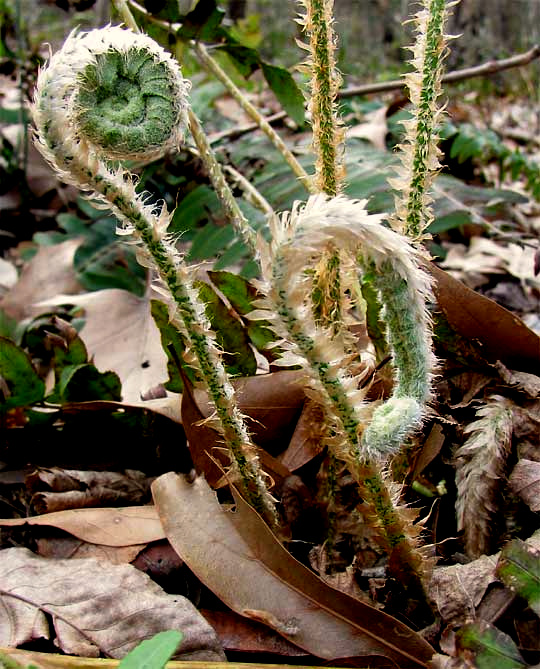
Another conspicuous feature of ferns is that new leaves typically expand by the unrolling of a tight spiral into a fiddlehead, or "crozier," before expanding into a frond. This special kind of leaf unfurling technically is called circinate vernation. At the left, in early spring, fiddleheads of the Christmas Fern, Polystichum acrostichoides, rise from leafy forest floor in Mississippi. Inside the coil atop the tallest fiddlehead you can see individual frond segments, or pinnae, soon to spread out. Why are these fiddleheads so thickly covered with scales? The fiddleheads emerge so early in spring that freezing temperatures still are possible, and the scales certainly protect against that.
FROND TYPES
With reference to fern leaves, sometimes the term "frond" is used. Fern leaves and fern fronds are the same thing, just that traditionally the term "frond" often is used when referring to a leaf of a fern, palm, or similar plants. There's no technical distinction at all.
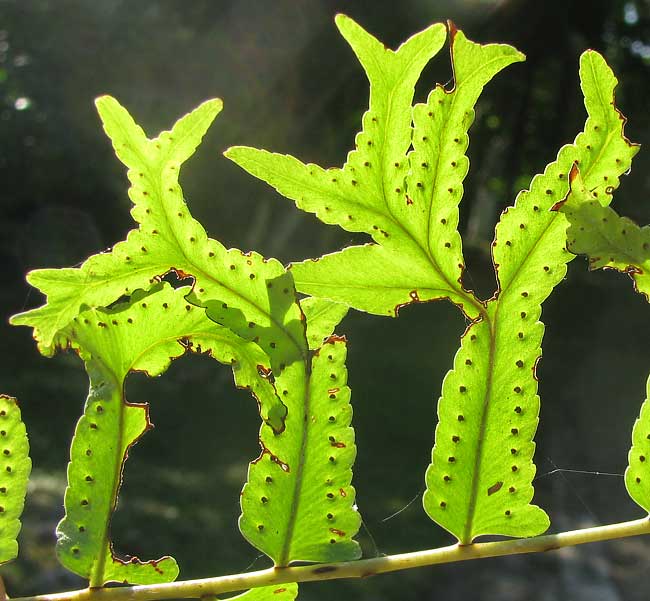
That being understood, we can say that the frond subdivisions, or pinnae at the right, of the Fishtail Swordfern, Nephrolepis falcata, certainly are weird ones. The exact origin of the Fishtail Swordfern is unknown but some experts suppose that it's a mutant cultivar from the Giant Swordfern, Nephrolepis biserrata. It's not known to live in the wild.
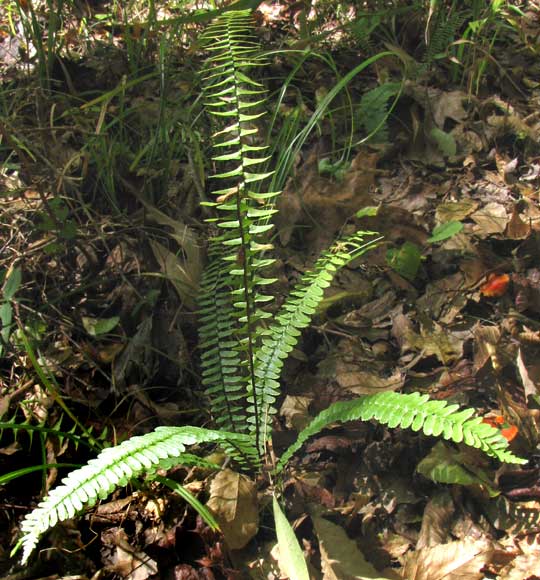
Discounting mutants, despite the tremendous variation in fern frond appearance, frond structure is based on a few basic principles. For example, the pagoda-like fronds of eastern North America's Ebony Spleenwort, Asplenium platyneuron, at the left, are said to be once-pinnate. By that it's understood that the frond is divided just once into subdivisions, resulting in leaflets known as pinnae. The fern in the picture consists of five or so fronds. Each frond is divided into maybe 20-40 pairs of pinnae.
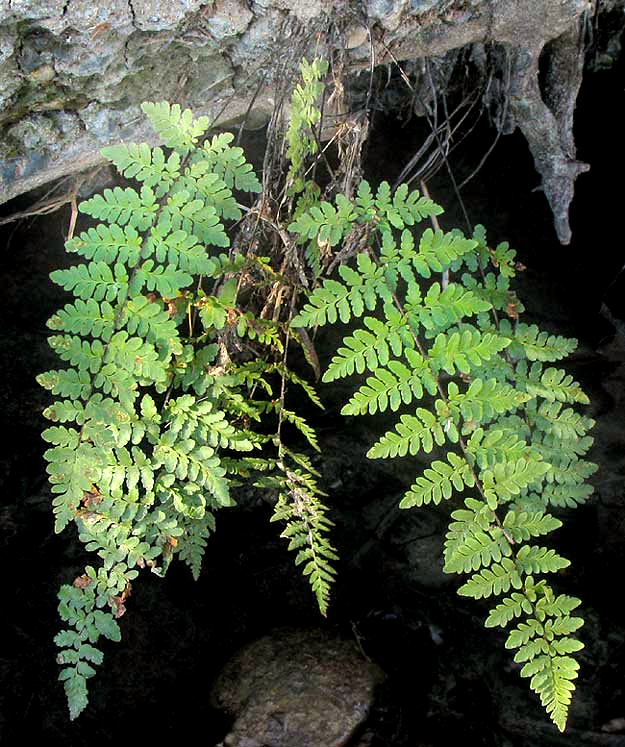
In contrast, at the right, fronds of the Alabama Lipfern, Cheilanthes alabamensis, are twice-pinnate. In this species, pinnae resulting from the first division of the frond, have themselves been subdivided. Instead of calling these new, much smaller subdivisions "pinnae," which are a "primary division," these subdivisions of subdivisions are called pinnules.
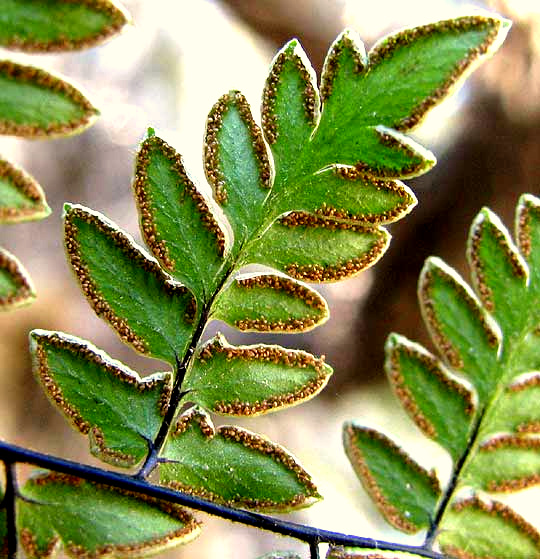
So, pinnules are subdivisions of pinnae, which are subdivisions on the fern frond. The picture at the left, with the frond's black midrib or rachis running across the picture's bottom, shows one pinna subdivided into several pinnules.
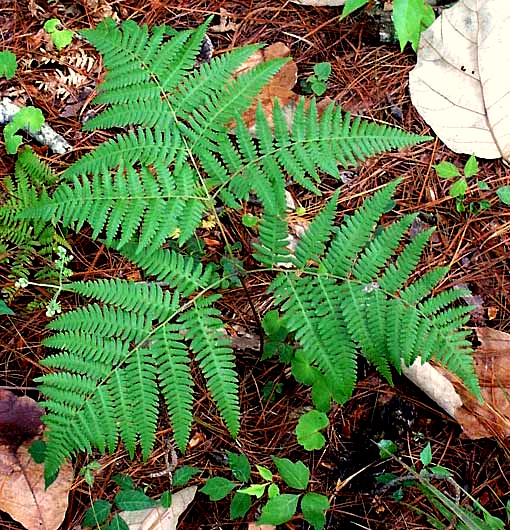
But fern subdivisions of subdivisions can be subdivided again, and maybe again. At the right, the frond of what may be the world's most abundant fern, Bracken, Pteridium aquilinum, may be twice to four times pinnate, depending on how they develop.
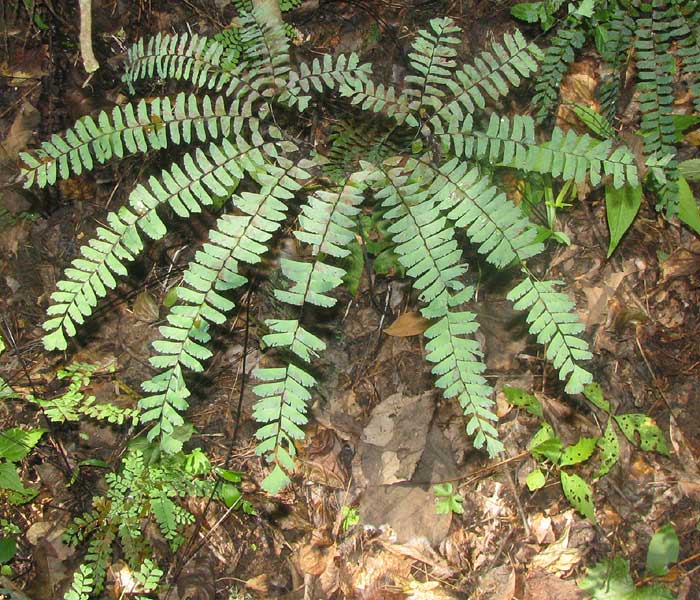
Beyond ways of being subdivided, there are many other options for a frond to express its individuality. At the left, the frond of the Northern Maidenhair, Adiantum pedatum, is described on its Flora of North America page as "...fan-shaped, pseudopedate, 1-pinnate distally... proximal pinnae 3--9-pinnate."
FRUIT DOTS, OR "SORI"
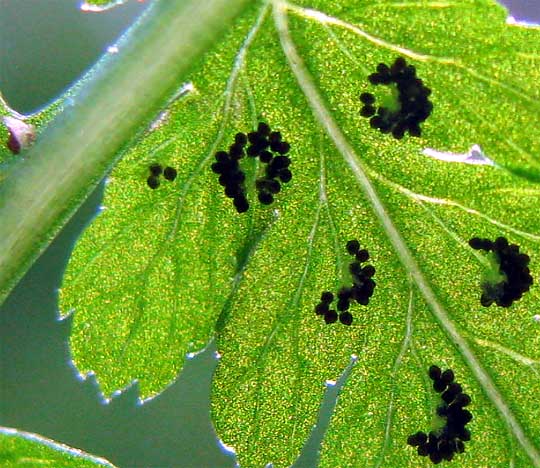
Ferns reproduce with spores. Most ferns release their spores from odd-shaped structures on their fronds' undersides, and those easy-to-see structures may be called "fruit dots" or, more technically, sori (singular sorus). At the right, the five dark spots consisting of clusters of tiny spherical items are typical sori of the Lady Fern, Athyrium filix-femina.
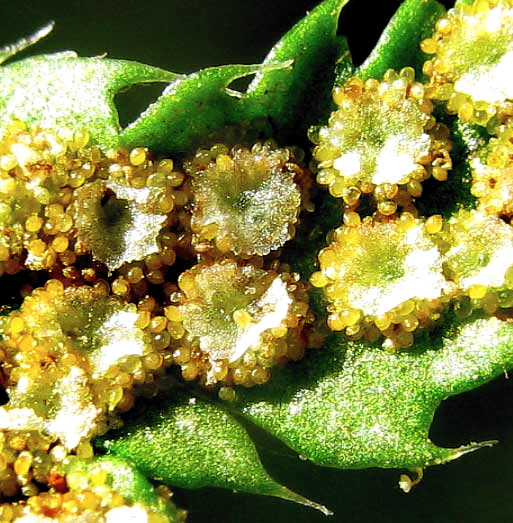
Sori come in many sizes, shapes and dispositions, and thus are important to notice during the identification process. At the left, the Christmas Fern's sori obviously are very different. However, both sori types contain those "tiny sperical items," which are sporangia. Sporangia are important because the ferns spores are produced inside them. In most fern species, each sporangium contains 64 spores. From this fact alone it's clear that fern spores are very small, and easily can be carried by wind for great distances.
Sori of both the Lady Fern and Christmas fern have indusia), though the Lady Fern's indusica are much less conspicuous than the Christmas Fern's. On the Christmas Fern, the indusium is the silvery, umbrella-like structure over each sporangium. Some sori have no indusia, but when they're present, they also come in many forms and are important to notice.
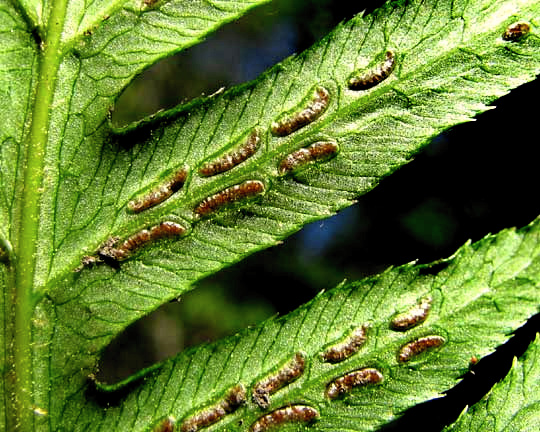
For instance, look how different the sori and indusia are on the Giant Chain Fern, Woodwardia fibriata, at the right. Chain Fern fronds are vaguely similar in shape to those of the Christmas Fern, but once you notice the sori, it's clear you have something very, very different!
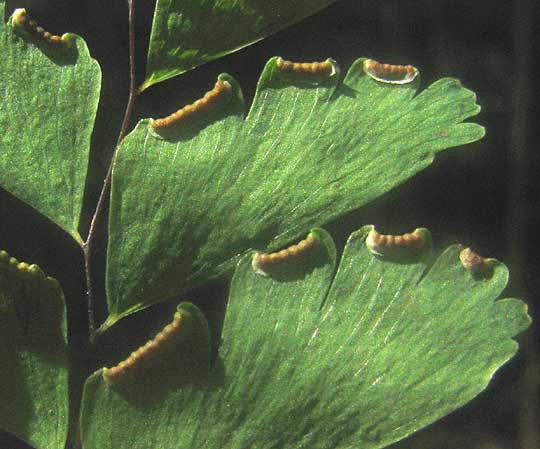
At the left, the Northern Maidenhair Fern's sporangia do something yet completely different from all the above. Its sporangia, instead of being grouped into sori, grow from turned-under pinna margins, sometimes referred to as "false indusia."
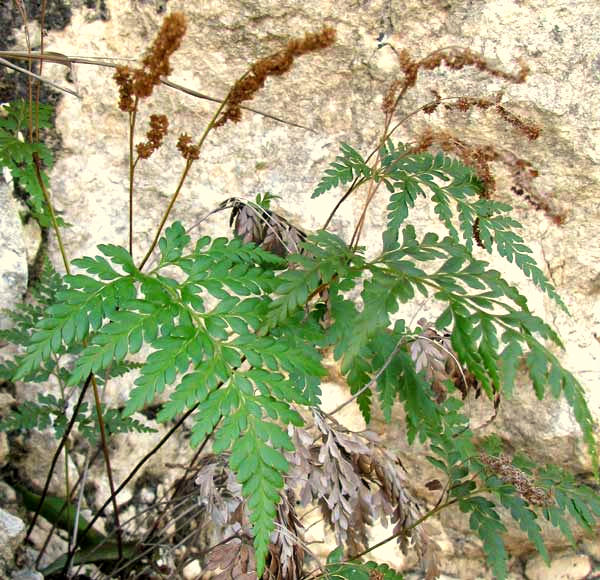
At the right, sporangia don't even appear on the frond, but rather are grouped in clusters atop their own stems rising above the fronds. This is how it's done on the Pine Fern, Anemia adiantifolia.
FERN REPRODUCTION
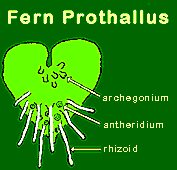
Let's return to the spore. The spore germinates in an environment appropriate for its development, a moist one. What issues from the spore is a green, thread-like item called a protonema. Inside th protonema, cells divide like crazy, but the plant body that develops from the protonema is not the fern we may be expecting! Rather, the resulting object is a tiny, flat prothallus, bearing male parts (antheridia) and female parts (archegonia), sketched above. The antheridia and archegonia mature at different times, so self-fertilization seldom takes place.
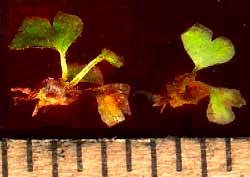
At the right, the ruler marks at the bottom are 1/16th of an inch apart -- about 1.6 mm -- so the objects above the ruler are fairly small. They were collected from the moist surface of a deeply shaded cliff. The brown, shriveled part at the base of each green sprout is what remains of a prothallus, on which an archegonium has been fertilized by sperm from another prothallus' antheridium. The green sprouts are the beginnings of ferns.
Don't let the fact pass unnoticed that male and female parts appear on this modest, seldom-seen-by-humans, little prothallus. The prothallus is thus where sex takes place with the attending mingling of genes so necessary for the evolutionary process. In a sense, the obscure little prothallus is "the main plant" because of this important service. The larger fern body is just a vehicle for spreading genes into new territory, inside windblown spores, more effectively than sperm can manage swimming from one prothallus to another in a thin film of water.
This alternation between a species' two very different forms -- the prothallus and the larger fern body -- is further discussed on Wikipedia's Alternation of generations page.
You may enjoy looking over Jim's Field Notes on Ferns.