(SOURCE: NCBI database)
KINGDOM: Fungi
DIVISION: Basidiomycota
CLASS: Agaricomycetes
ORDER: various orders
Not all mushrooms bear gills beneath their caps. The one shown below obviously has pores, from which spores fall the same as they do from gills on gill fungi.
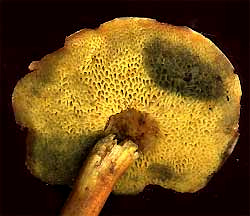
The pore fungus in the picture is a member of a large, common genus worth knowing, that of "the boletes," of the genus Boletus. Reasons to know this genus include that it's commonly occurring, many species in the genus are good to eat, and often they're unusually handsome. This particular bolete, by the way, displays a feature observed with several bolete species: Its flesh "bruises bluish." That dark splotch at the cap's top right is the "bluish bruise." A few seconds before the picture was taken, a thumb was pressed there, causing the yellow flesh to turn color.
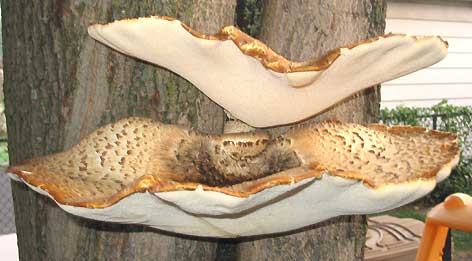
"Polypores," like the above Polyporus squamosus, also are good to know because of the same reasons as above. Polypores are "bracket fungi," meaning that the cap, instead of attaching to a stem in its center, is attached along the side. In the above picture, the pores are too small to see except when very close, but in other polypores the pores are much larger.