FUNGI IN THE BIOSPHERE
One way to grasp the role of fungi in the Earthly biosphere is to consider how fungi feed themselves. Fungi don't photosynthesize, so they must acquire their food in the following ways:
AS SAPROPHYTES:
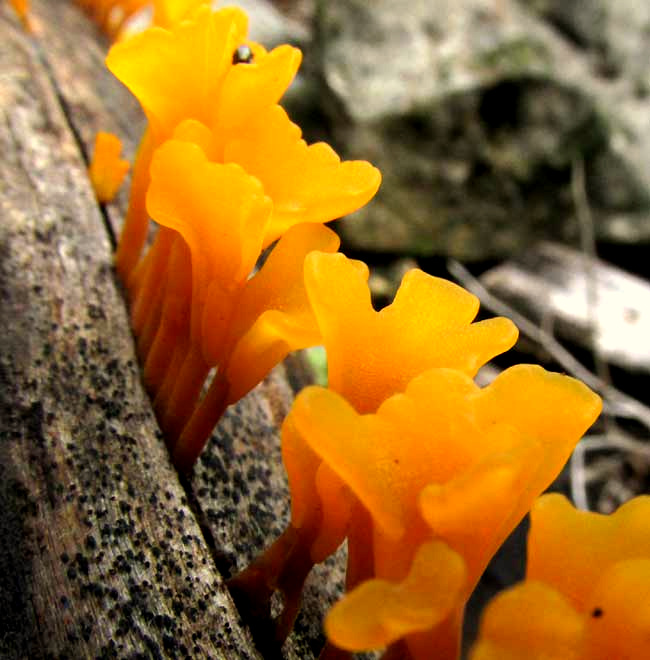
Saprophytes obtain their nutrients directly from dead organic matter or wastes. At the right, the Fan-shaped Jelly Fungus, Dacryopinax spathularia, grows from a split in a decaying tree stem. The fungus's hyphae, creating a cobwebby network inside the stem, secrete enzymes which diffuse through the dead matter, causing it to release nutrients the fungus needs. Often saprophytic fungi occur on nutrient-rich animal excreta, especially in cow pastures.
AS PARASITES:
Parasites live in or on a host organism or species, obtaining their nutrients at the host's expense. Often animals, including humans, suffer from fungal skin diseases such as ringworm, athlete's foot, jock itch, nail fungus, or other such diseases. About 40 different fungus species can cause ringworm, the main genera being Trichophyton, Microsporum, and Epidermophyton (Borman & Summerbell, 2015). All these fungi are "sac fungi," members of the division Ascomycota.
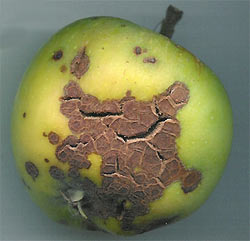
At the right, Apple Scab disease is caused by the parasitic fungus Venturia inaequalis, also a sac fungus. The Apple Scab fungus life cycle is described on our Apple Scab page.
AS SYMBIONTS:
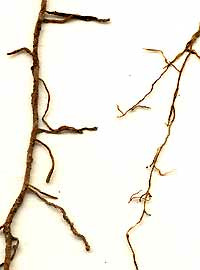
Symbiosis refers to a close and prolonged association between two or more organisms of different species. Among fungi an important example is that of mycorrhiza coating many kinds of plant roots. In the picture, the pine-tree root on the left bears mycorrhiza, while the one on the right doesn't. The mycorrhizal covering helps plants as described on our Mycorrhiza page, while the host plant provides the fungus with nutrients such as photosynthesized sugars.
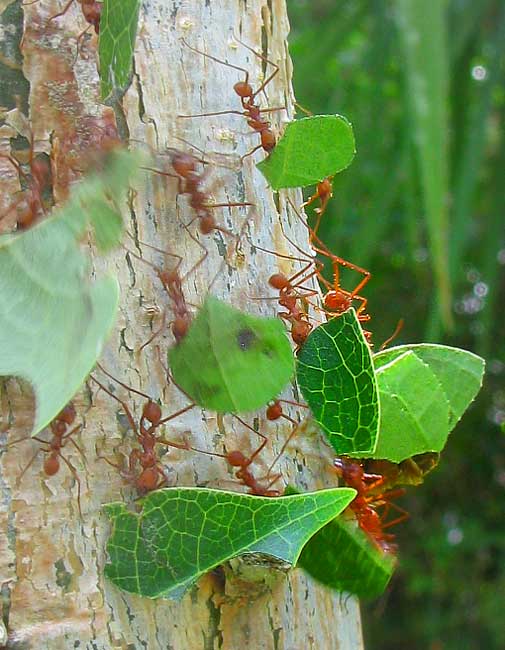
Fungi often are symbiotically associated with animals, such as leaf-cutter ants, shown at the left, who cut leaves into pieces which are then stored underground where a fungus benefits by feeding on the leaves. The ants benefit by eating the fungus, not the leaves.
Symbiosis is a form of mutualism. "Mutualism" is a more general term, however, referring to mutually beneficial interactions between members of the same or different species. It is not restricted to relationships between two different species.
AS COMMENSALS:
Commensalism is an association between two organisms in which one benefits and the other derives neither benefit nor harm. With fungi, it's the fungi who benefit. Nowadays a big feature of health news is the growing awareness of the importance of trillions of bacteria, viruses and fungi in every human body, especially the gut. They help digest food and the evidence is that all the bacteria, viruses and fungi together -- the microbiome -- helps keep the body functioning properly, though often not in ways understood. Since this amounts to helping the host, are these "commensal fungi" really commensalistic and not symbiotic?
Maybe, in the end, there is no true commensalistic relationship. For, if it's true that in Nature everything depends, one way or another, on everything else, no species gains something from others, without in some way helping those others. The help provided may be by simply adding diversity -- and a more extensive gene pool from which evolving organisms may draw -- and therefore contributing stability to present and future biospheres. This is a philosophical/spiritual insight, not a proven scientific one.