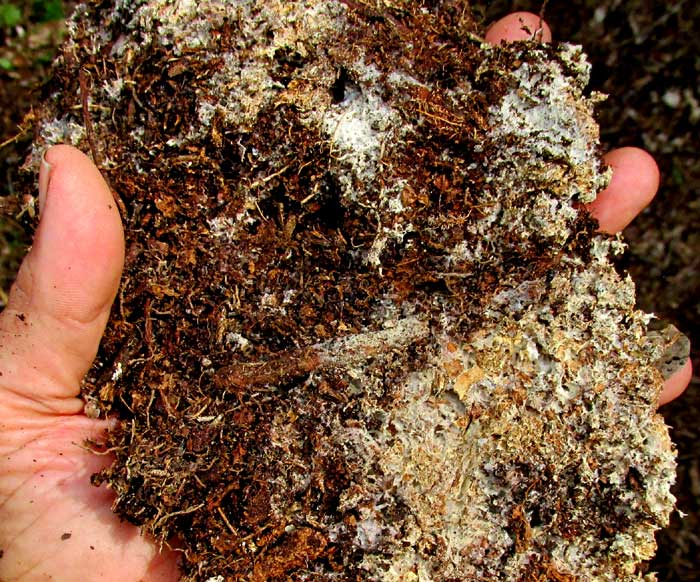
At the right, the white part of a handful of spongy, moldy leaf litter from beneath a tree consists of a network of many threadlike, branching filaments averaging 0.004-0.006mm thick (0.0002 inch). The individual filaments are fungal hyphae. For most fungus species, such filaments constitute the fungus's main "working body," for as the filaments' tips grow forward (the only part that grows), they absorb food and water.
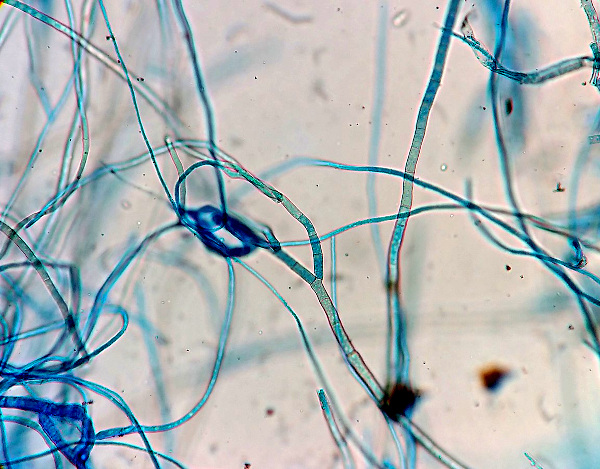 fungal hyphae, microscopic view; image courtesy of 'Microrao' and Wikimedia Commons
At the left you see individual strands of hyphae. Notice that they branch, and consist of individual cylindrical cells connected end to end, separated by cross-walls called septa. Some hyphae have no septa. Networks of clumping fungal hyphae are known as mycelium, and certain mycelium have been in the news lately. Mycelium of the mushroom-producing fungus Armillaria ostoyae, has been found to cover about 9.1km2 (3.5 sq. miles), or 910 ha (2,240 acres), of forest land in Oregon, USA. It may weigh as much as 35,000 tons, earning the claim that it's the Earth's most massive, and possibly the oldest, living organism.
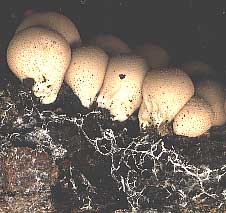
At the right you see hyphae inside a cross section of decaying tree bark. Certain strands of hyphae join at the bark's surface to produce some nicely edible Stump Puffball mushrooms, Lycoperdon pyriforme. Once hyphae attain a certain maturity and if surrounding conditions are right, when compatible hyphae meet they may fuse and begin a very complex procedure leading to mushrooms and other fungal reproductive structures. Wikipedia's Fungus Sexual Reproduction page provides more detailed information.
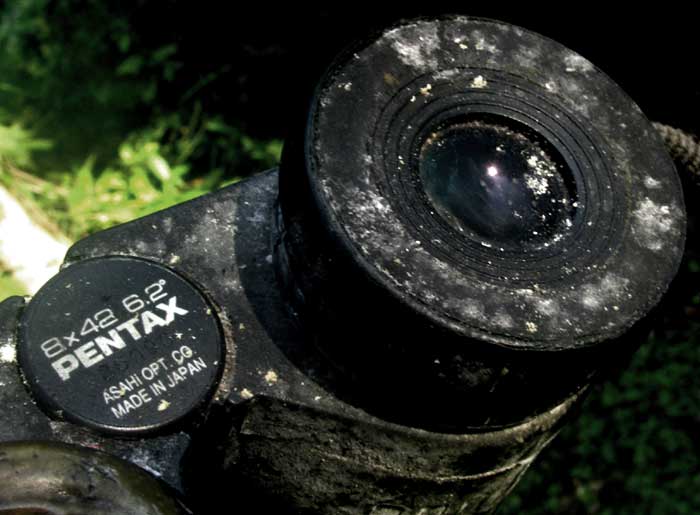
Fungal hyphae deserve our recognition not only because they're vigorous enough sometimes to grow into the world's most massive and possibly oldest living organism, but also because they survive in some of the most surprising places. At the left, hyphae produce "mold" on a pair of binoculars hung for two weeks in a hut during a tropical rainy season. At the end of the current period of human-caused mass extinction of species, the phenomenon of Life on Earth may benefit from such scrappy little forms of life.