(SOURCE: NCBI database)
KINGDOM: Fungi
DIVISION: Mucoromycota
CLASS: Mucoromycota
ORDER: Mucorales
FAMILY: Mucoraceae
GENUS: Rhizopus
SPECIES: stolonifer
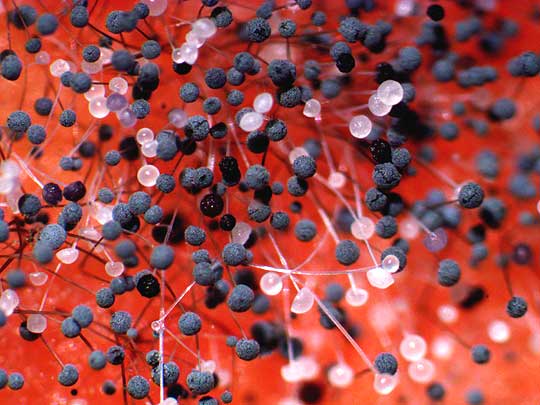
The picture at the left shows one of the most common fungi in the world, the Black Bread Mold fungus, Rhizopus stolonifer. It appeared on a squash stored for too long in a warm, moist basement, so obviously Black Bread Mold Fungus doesn't restrict itself to bread. In the picture, the black spheres are mature, spore-producing sporangia, while the white and transparent ones are immature sporangia. The slender stems holding the sporangia above the squash's surface are sporangiophores.
ASEXUAL REPRODUCTION
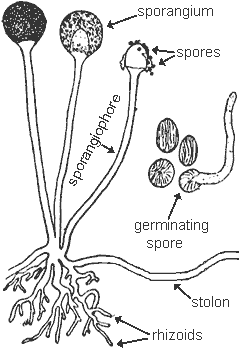
When Black Bread Mold spores are released, wind or other agents carry them away. If the spores land in a warm, moist place, they may germinate to form branching, white filaments called hyphae. All of a fungus's hyphae considered together are known as mycelium. Special strands of hyphae connecting fungal bodies can be called stolons. Branching rhizoids behave as roots, anchoring the fungus into its substrate, releasing digestive enzymes, and absorbing nutrients for the fungus. After the fungus's hyphae grow awhile, when conditions are right, new sporangiophores appear among them, new spores form and are released, the spores germinate, and the whole life cycle repeats, all without sexual reproduction having taken place
SEXUAL REPRODUCTION
Black Bread Mold Fungus is a member of the Mucoromycota, whose species don't form conspicuous, spore-producing fruiting bodies such as mushrooms or cups, plus the hyphae's cells have no cross walls separating cell nuclei from one another. Relative to fungi that normally we notice, in evolutionary terms this indicates a "primitive" condition.

Still, Black Bread Mold Fungus does reproduce sexually. Under certain conditions, when hyphae representing different mating strains come together, they can form sexual structures, gametangia, in which gametes develop, suggestive of male sperm and female ovules. These gametes ultimately produce zygospores, as illustrated above. Zygospores are thick-walled resting cells, which later -- maybe after passing through winter or a severe dry season -- will germinate and produce hyphae.
AN EXPERIMENT
If you want to see just how common bread mold is, a good experiment would be -- wherever you happen to be on Earth -- to slightly moisten a slice of bread, touch the bread to a table top or anything around you, then for two or three days store the bread in a warmish place where it won't dry out, such as in a small sealed container or plastic bag. A good bet is that mold will appear on your bread, and probably it'll be Rhizopus stolonifer. Use wholewheat bread if you can, since the nutrition in white bread is so poor that fungus and everything else does poorly on it.
When you think of the number of bread mold spores that must exist in the whole world for this experiment to succeed, it's mind-boggling. If your bread develops black sporangia, remember that each sporangium produces upwards of 50,000 spores.