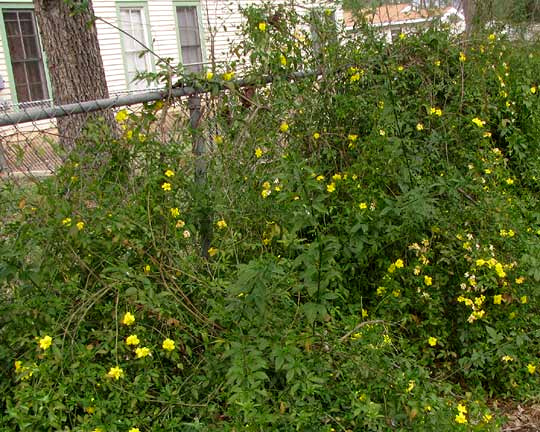
 Japanese Jasmine, Jasminum mesnyi, overgrowing a fence in Uvalde, Texas
When an ecosystem is altered, as by fire or being converted to someone's backyard, it doesn't stop being part of Nature. Biological communities continue to exist where the disruption has occurred, just with different organisms forming different kinds of communities.
Even if a forest and its soil is completely removed, leaving only bedrock, the above is true. Forest organisms will have been exchanged for microorganisms, germinating spores of lichens, pollen grains blown onto the stone which die and become decomposing organic matter fed on by bacteria... Nature and her fundamental processes never go away.
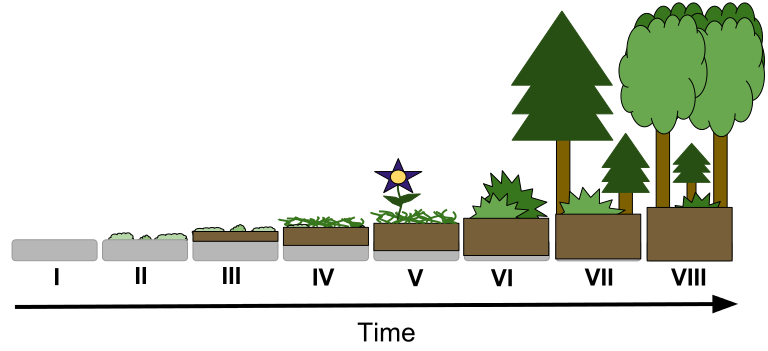 Diagram of one kind of ecological succession; image courtesy of "Joshfn" & Wikimedia Commons
If a forest is completely burned to ashes and left alone, very soon weedy herbs "invade" the new open area. As months and years pass, woody shrubs and small trees appear. Then larger trees, and perhaps in a hundred years or so, unless something stops it or the soil has been damaged too badly, a new forest appears. This step-by-step replacing of one community of organisms by another is called succession.
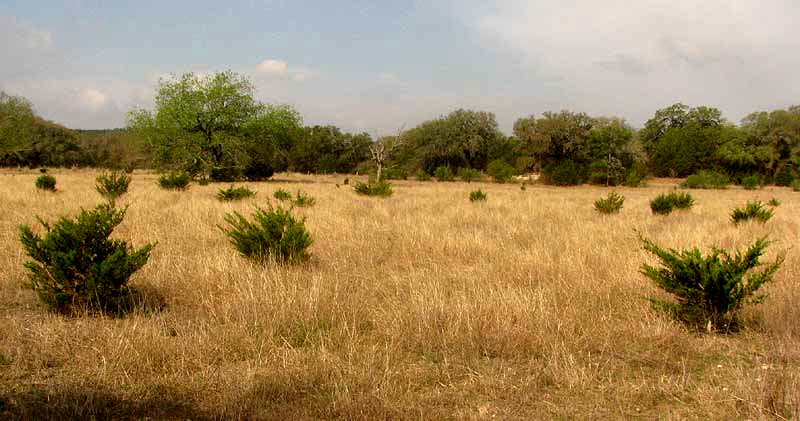
Many kinds of ecological succession are recognized. Every stage of any kind of succession supports its own special combination of organism species. A classic study of succession was published in 1956 by David Johnston and E.P. Odum, entitled "Breeding Bird Populations in Relation to Plant Succession on the Piedmont of Georgia." It documented the succession of plants and birds from old fields to old forests.
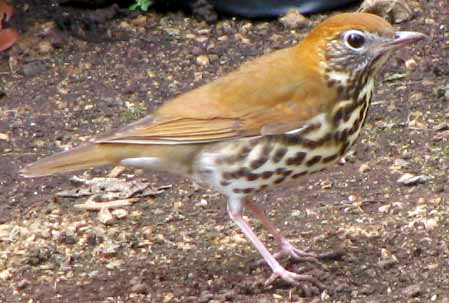 Wood Thrush, Catharus mustelinus, at home in deep shade of older forests in eastern North America"
They found that in the Georgia Piedmont region, during the first two years after agricultural fields were abandoned, Grasshopper Sparrows and Eastern Meadowlarks were the main birds. In fields which had been abandoned for 15 years, where tall grass and woody shrubs dominated, the main bird was the Field Sparrow, along with six other species. Where fields had been abandoned for 35 years and the land now supported young pine forests, the main bird was the Pine Warbler, with nine other species. Where abandonment had taken place 150 to 200 years earlier, the pine forest had been replaced by forests of oaks and hickories, and the main birds were Red-eyed Vireos and Wood Thrushes, along with 17 other bird species.
Notice that not only did communities of speciic combinations of organisms "succeed" one another, but also as time passed the number of bird species always increased. The more "mature" the ecosystem was, the greater was its diversity of species. This impulse toward diversity is a general theme throughout Nature.
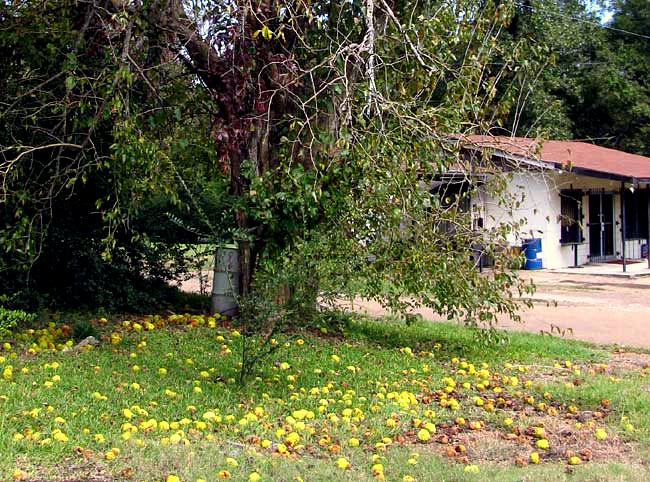 Osage-orange tree, Maclura pomifera, doing its best to reclaim an unattended spot in Natchez, Mississippi
From Nature's point of view, our backyards -- even if they're nothing but concrete-covered alleyways -- are no more than natural areas in an early stage of succession. Nature's goal with a concrete-covered alleyway is to populate it with an ever more diverse community of ever more different kinds of interrelating, mutually helpful organisms.
If the first human settlers in your area encountered forest where your backyard now is, your backyard is constantly in the process of reverting to a forest. If your neighborhood used to be prairie, it's reverting to that. Mowing, weeding, using pesticides and pouring concrete continually set the succession process back.
You might enjoy a Web page called Landscaping to Attract Birds. There you can see how to make your backyard habitat more welcoming to birds, by providing them what they need.