
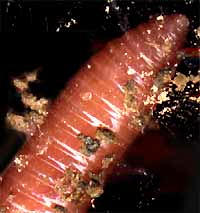
 On our Segmented Worm Page the point is made that if an interplanetary naturalist should visit Earth studying life here, he, she or it might choose annelids, or segmented worms, as "average Earth animals." That's because in terms of animal complexity about half of all animal species on Earth are less complex than segmented worms, while about half are more complex. One point for backyard naturalists to keep in mind is that earthworms are by no means "average Earth annelids." As the picture of an earthworm head (or is it a tail... ?) at the right makes clear, among the annelids, earthworms are special because they are such super-streamlined, stripped-down, no-nonsense critters.
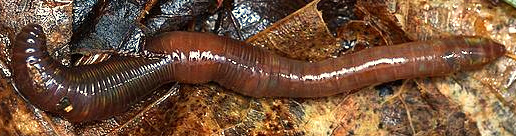
For instance, the front ends of "average annelids" such as those found in the oceans generally bear mouthparts, eyes, and antennae-like structures. On the other end there may be another set of antenna-like projections, and, in between, each segment may bear a pair of foot-like appendages. Earthworms bear none of these typical annelid accessories. In fact, earthworms, at first glance, appear to be no more than long, segmented cylinders tapering to both ends.
ARE EARTHWORMS IMPORTANT?
Certainly what earthworms do isn't simple in ecological terms. The great naturalist Charles Darwin, after making a careful study of them, wrote this:
...it may be doubted if there are any other animals which have played such an important part in the history of the world as these lowly organized creatures
"History of the world," he said!
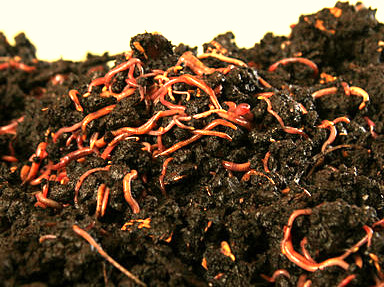 Image by Wolfgang Berger, Hamburg, Germany
Earthworms plow the soil by tunneling through it. Their tunnels provide the soil with passageways through which air and water can circulate, and that's important because soil microorganisms and plant roots need air and water just like we do. Without some kind of plowing, soil becomes compacted, air and water can't circulate, and plant roots can't penetrate it.
One study showed that each year on an acre (0.4 hectare) of average cultivated land, 16,000 pounds (7200 kg) of soil pass through earthworm guts and are deposited atop the soil -- 30,000 pounds (13,500 kg) in really wormy soil! Charles Darwin himself calculated that if all the worm excreta resulting from ten years of worm work on one acre of soil were spread over that acre, it would be two inches thick (5.08 cm).
This is something we should appreciate because earthworm droppings -- called castings when deposited atop the ground -- are rich in nitrogen, calcium, magnesium, and phosphorus, and these are all important nutrients for healthy, prospering ecosystems. In your own backyard you might be able to confirm that grass around earthworm burrows grows taller and greener than grass just inches away.
HOW ARE EARTHWORMS CONSTRUCTED?
Here are some visible and invisible adaptations to admire about earthworm:
- The worm's streamlined body with no conspicuous appendages is an adaptation to living in narrow burrows underground. In those narrow tunnels, antenna and fancy tails would just get in the way.
- Earthworms don't have eyes, but they do have light-sensitive cells scattered in their outer skin. These cells don't enable earthworms to see images, or forms, but they do give their skin the capacity to detect light and changes in light intensity. The worm's skin cells are also sensitive to touch and chemicals
- Earthworms have simple brains which specialize in directing body movement in response to light, and not much else. To show how simple the brain is, if an earthworm's brain is removed, changes in its general behavior are hardly noticeable
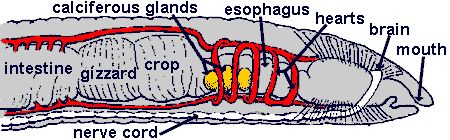
- Earthworms, as the drawing above shows, possess five hearts. The calciferous glands shown between the hearts manage excess calcium in the worm's diet, a problem you may have if you eat a lot of dirt.
- Earthworms have no lungs. Their "breathing" consists of oxygen from the air passively diffusing through the skin into the body. One problem with having such permeable skin is that earthworms dry out easily, but not as easily as mollusks
- Each earthworm carries both male and female reproductive parts --they are, like snails and slugs, hermaphroditic
WHEN CONDITIONS GET ROUGH....
When the soil gets very cold, very hot, very wet or very dry, it's hard on an earthworm. Survival strategies vary from species to species. A typical behavior is to tunnel deeper into the soil, to where conditions aren't so extreme. Some species, especially during hot, dry periods, do what's shown below:
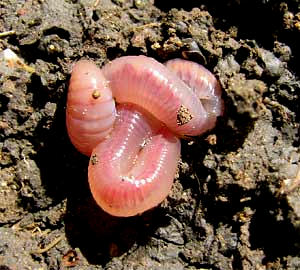
At a fair depth they roll themselves into balls and excrete mucous around themselves, creating a kind of cocoon. In such a state their body functions slow down drastically. They go into a kind of suspended animation, just waiting for soil conditions to improve. When an animal goes into such a state in order to survive summer's hot, dry conditions, it's said that they estivate or "go into estivation." I found the earthworm shown above one day as I worked in the very dry soil of a garden. The earthworm was inside a very hard, dry clod of soil. While the picture was being taken it began moving, so this worm was very much alive, just "resting" until a good rain.
HOW DO EARTHWORMS TRAVEL?
The secret to earthworm travel lies in two things you can't see just by looking.
- Though earthworms have no bones, their complex system of muscles enables them to not only wiggle like crazy but also to very quickly alternate between being stubby and thick, and long and slender
- Earthworms possess tiny, practically invisible bristles, called setae (pronounced SEE-tee; singular form seta, pronounced SEE-tah), which usually are held inside their bodies, but are visible as tiny projections on the image at the right. When earthworms don't want to be pulled from their burrows, they jab their setae into the surrounding dirt, anchoring themselves in place. This comes in handy if a bird nabs a worm's head and tries to pull the worm from its burrow. The setae anchor the worm so firmly that it may break before coming out.
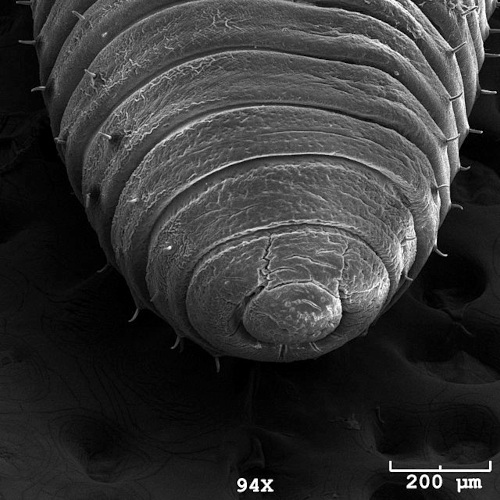 Scanning electron microscope image by Hannah G Watson, Andrew T Ashchi, Glen S Marrs, & Cecil J Saunders of Wake Forest University, North Carolina
Here's how these two features enable earthworms to travel:
When a worm in its burrow wants to move forward, it makes itself long, and anchors the front of its body with its front setae. Now, by making itself short and thick, it pulls its rear end forward. Once the rear end is in place, the front setae are withdrawn from the soil while setae on the rear end are projected, anchoring the rear end. Now the front end is free to shoot forward in the burrow as the worm makes itself long and slender again. Then the whole process is repeated.
HOW DO EARTHWORMS REPRODUCE?
This matter is as complex as it is interesting, so put your mind in low gear and hold on... Here's a drawing -- using the term "chaetae" instead of "setae" -- to help keep oriented:
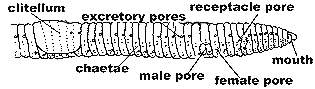
First of all, not every earthworm segment bears sex organs. Counting from the front, where the mouth is, the worm's male sex cells lie in segments 10 and 11. From here the sperm pass through sperm ducts to two male genital openings at the bottom of segment 15. On segments 9 and 10 there are two minuscule sacs called sperm receptacles, or pores, where, during earthworm sex, sperm are deposited. However, this is not where eggs are produced. The egg-producing ovaries reside in segment 13, from which eggs are released through the female pores into egg sacs in segment 14. Finally, there's a rubbery, arm-band-like thing covering the worm's body from segments 31 or 32 to 37, and this is called the clitellum.
Now, when two earthworms mate, they line up next to one another with their "heads" pointing in opposite directions. The clitellum of one worm lies opposite segments 9-11 of the other, which, you'll remember, contain the male parts.
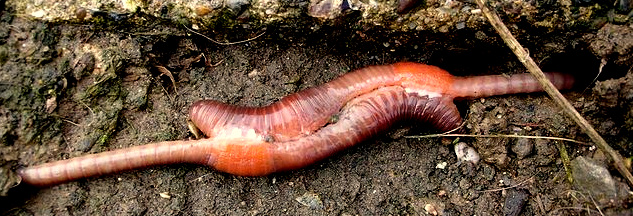
The worms now secrete tremendous amounts of mucus, until each is enclosed in a slime tube extending from segment 9 to the rear end of the clitellum at segment 37. Now sperm are ejaculated from segment 15 and carried backward in tubes formed by grooves in the body touching the slime tube and the sperm pass to the sperm receptacles on segments 9 and 10 of the other worm.
Then the earthworms go their different ways. Sex is done. However, that is not to say that eggs have been fertilized, because they haven't. It's just that now, in each worm's sperm receptacles, there are sperm from the other worm.
The next step in producing baby earthworms comes when the earthworm is by itself. Its clitellum secretes a second mucous ring that slides forward over the worm's body. When the ring passes the openings in segment 14, several ripe eggs leave the body and stick to the ring. The ring keeps moving forward until it passes the sperm receptacles in segments 9 and 10, and here sperm come into contact with eggs. Finally, within the mucous ring, the eggs are fertilized.
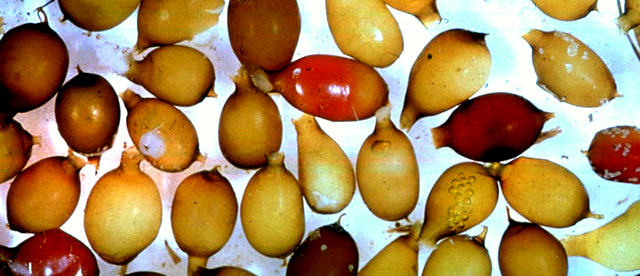
Now the ring containing the fertilized eggs slips off the worm's "head," seals at both ends, and becomes a sort of cocoon, which is left lying in the soil. Coccons may contain a few to dozens of eggs. Ultimately the eggs hatch and tiny worms escape from the mucous ring, into the soil.
A PROBLEM WITH NON-NATIVE EARTHWORMS
The earthworm situation isn't always black and white. When non-native worm species are introduced in an ecosystem they can actually cause big problems.
For example, in Canada about 20 earthworm species are recorded, but 18 of those have been introduced from Europe. It's a similar situation in the US's northern states. In many places, most if not all native earthworm species apparently were killed off during the last ice age.
Without worms, fallen leaves decompose slowly, creating a spongy layer of organic "duff." The duff isn't really soil, but many organisms depend on duff for their survival. Invading earthworms eat the duff. Karen Schik, an ecologist with the environmental group "Friends of the Mississippi River" in Minnesota, writes us:
"Not only are we losing our native woodland flora, but when the earthworms cause their demise and subsequent bare soils (which causes erosion), it opens the door for non-native invasive species such as garlic mustard, buckthorn, honeysuckle and narrowleaf bittercress, leaving little opportunity for the native species to recover, along with the many native wildlife species that rely on them. Our trees have what one researcher refers to as 'tree gingivitis' -- the root crowns are exposed due to the removal of several inches of duff and soil compaction (yes compaction) by earthworms."
More information is available in an online Scientific American article.