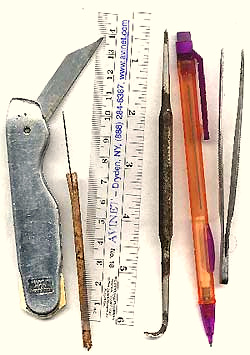
THE FLOWER DISSECTING KIT
In your plant studies, especially when using identification keys, often you'll need to know details of flower anatomy that can only be found out by tearing blossoms apart. Are the stamens "diadelphous" or "monadelphous"? Are the ovules' placentae "parietal" or "basal"? With large blossoms sometimes these details can be easily seen, but with smaller flowers -- the majority of blossoms we're likely to meet -- we may need to dig into them. Here are instruments needed in a simple flower-dissecting kit which can be carried in a small bag or pouch when you're in the field:
- A sharp blade that, when not in use, swivels into its handle.
- A needle-tipped probe, which you can make yourself, for such jobs as flipping a stamen's anther to see whether it empties pollen through slits or pores.
- A ruler. Especially when working with identification keys, often you are often asked whether an item is, for example, "5 mm or less, or 7 mm or more" in length.
- A dental pick, if you can find one. Sometimes the curved, sharp blade is just the thing for slicing corolla tubes or for reaching into hard-to-get-to places.
- Tweezers can pluck a tiny disc flower from the eye of a composite blossom, and remove spines from fingers that have been poked in the wrong places.
- A pencil for all kinds of notes, especially about things you want to look up once you get home.