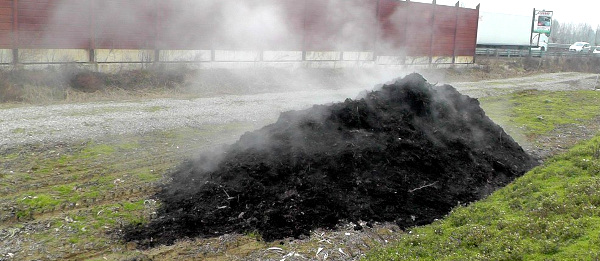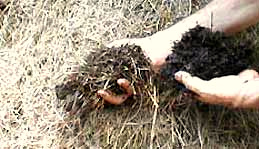
At the right you see three stages of dry grass clippings from a mowed lawn. The first stage is that of the dried-out straw heaped up in the background. The second stage is in the hand at the picture's center. The third stage is in the hand at the picture's right.
In the above picture, notice that at each progressive stage the clippings become darker. You can't see it in the picture, but also each progressive handful is moister, is more compact and heavier, and smells more and more "earthy" or "fungusy." You might guess that the dark handful is high-grade compost, and the middle handful is an intermediate composting stage between dry clippings and great compost.
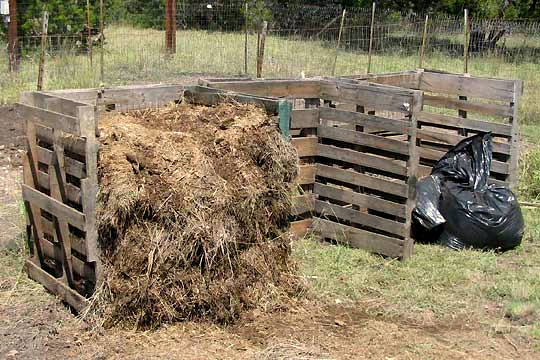
The picture at the left is a composting structure made of wooden pallets a local furniture store was glad to get rid of. In the picture, hay with added cow manure resides in the closest section; When it's time to aerate and water, the mix will be pitchforked into to the second section, then to the next. Once the results looks, feels and smells like the first picture's black soil, it'll be finished.
UNDERLYING FUNDAMENTALS OF COMPOSTING
The above composting structure is just one of many designs for making good compost. In fact, to compost, you don't really need a "design." Nature "wants" to compost, so here's the basic secret to good composting:
Don't get in the way of natural processes. Help them along...
You don't need to buy or build anything, but you DO need to understand what's going on during the composting process, so you can nudge the process along.
One way to understand the matter is chemically. Here's a grossly oversimplified, unbalanced equation worth thinking about:

In other words:
- You have a lot energy-rich carbohydrate (lawn clippings, raked leaves, kitchen waste, etc.) you want to convert to rich soil.
- Decomposition organisms need more than energy, though. They must have nitrogen for the construction of their own bodies.
- Decomposition organisms also need freely available oxygen and water, for the same reasons we all do.
Plus there are micronutrients to think about, the absence of toxic contaminants and other matters, but if you focus on the above, usually the other considerations take care of themselves.
EASY-GOING COMPOSTING
Sometimes this works, sometimes it doesn't. If you have plastic bags of fallen leaves, scoop in a shovel or two of loose garden soil (to inoculate the leaves with composting organisms) and mix the soil with the leaves by rolling the bag around. If you have some dried manure or some other source of nitrogen, you might add some of that, too. Then tear some holes in the bag to let in air. Every few weeks roll the bag around again and moisten the leaves if they dry out, and in a few months you'll have compost, maybe.
Really, most folks nowadays, except maybe for lawn clippings and fallen leaves, just don't have enough surplus organic matter to bother with a composting bin or other kind of structure. There's nothing wrong with just tossing what few vegetable scraps remain after a meal into a shallow trench in the garden, which is covered with soil as it's filled. Eventually the scraps decompose and get worked into the soil.
If kitchen scraps contain animal products they may attract raccoons or other animals, but some people don't mind that. Bones don't belong in a compost heap, anyway.
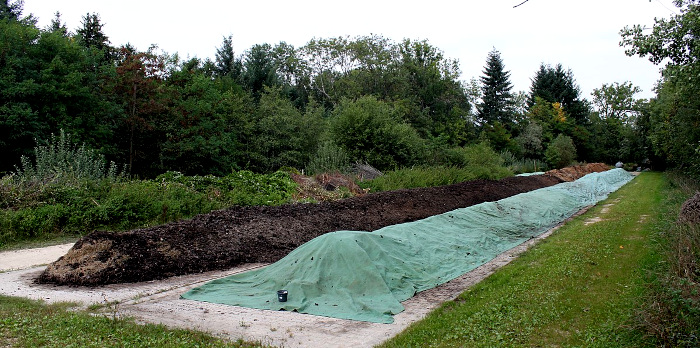
Also you can just pile up your compost in a heap lying on the ground, with no structure at all. The heap needs to be cared for, though: Keep it moist but not wet, and; stir it up every week or so to aerate it. Below is a large-scale example of the concept, one pile being worked on, the covered pile protected from the rain:
WHY IS NITROGEN IMPORTANT?
When you compost, basically you're managing a series of communities of decomposition organisms. Decomposition organisms, whether bacteria, fungi, worms, insects, or whatever, like humans, are made of a good bit of protein. Bacteria are half or more protein. Fungi are maybe 20-30% protein. Insects usually are 35-60% protein.
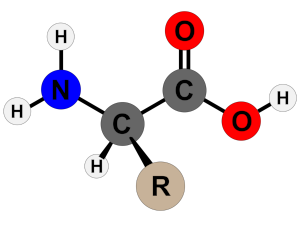 Example of amino acid molecule, the blue N being a nitrogen atom; image courtesy of 'Techguy78' & Wikimedia Commons
Protein is made of amino acids, and every molecule of amino acid needs an atom of nitrogen, as shown by the blue N at the right. In a compost heap, a desirable ratio of nitrogen atoms to carbon atoms (the carbon being in the plant matter being composted) is 25 to 30 atoms of carbon for each one atom of nitrogen.
So, grass clippings, fallen leaves and such provide a lot of carbon but by themselves usually don't contain enough nitrogen to enable the occurrence of all the bodies of all the decomposition organisms you need.
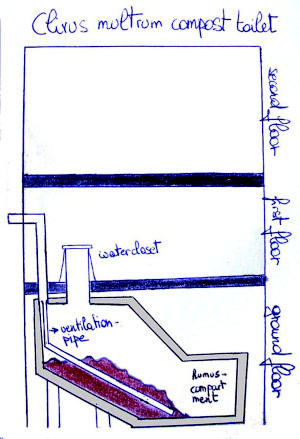 Clivus multrum composting toilet, based on drawing from book Duurzaam en Gezond Bouwen en Wonen by Hugo Vanderstadt; drawing and image courtesy of 'KVDP' & Wikimedia Commons
Wonderful sources of nitrogen are manure and urine -- even from humans, if treated right, as detailed in freely downloadable chapters of the online The Humanure Handbook. If you can clean out a livestock stall where the hay has been mingled with manure and saturated with urine, that's great stuff! Mix it with your grass clippings, leaves -- in the right proportions and keeping it all aerated and moist but not wet -- and you'll get your compost. Chicken manure is great but remember that it has much more nitrogen than livestock manure.
Store-bought nitrogen fertilizer will do, though that stuff is made using lots of energy, so you're sort of defeating the idea of doing something earthy. Some people mix in bagged dog food because usually it contains protein-rich animal parts and soy meal, but also that isn't quite harmonious with the Earth-friendly compost mind set.
Finally, when composting large amounts you need to inoculate your compost with decomposition organisms. You can buy inoculant at garden shops, or just find some rich soil where organic material has been decaying for a long time, dig up a shovelful, and mix it into your heap.
You might enjoy reviewing the US's Environmental Protection Agency's "Composting At Home" page.
WHAT CAN GO WRONG?
- If you put animals products in your compost heap, raccoons and other critters may scatter it about.
- If you let your heap dry out, it will stop composting
- If your heap gets wet, not just moist, its contents may begin rotting instead of composting, and then you'll have a smelly, gooey mess instead of something nice
- If you don't occasionally stir your heap to let in air, particles will stick together and close air channels inside the heap, organisms won't get the oxygen they need, and composting will screech to a halt
- If your heap has too much nitrogen it may start smelling strongly of ammonia
- If your heap has too little nitrogen, microorganism communities will remain underpopulated and you won't get good composting
WHAT CAN BE COMPOSTED?
Some people say never add eggshells and others say they're OK. Probably adding washed eggshells is fine, but if they are sticky with egg remnants, you're inviting animals to dig into your heap. Clean eggshells are little more than calcium carbonate, or limestone, so adding them to your heap is like adding lime, which most gardens need. With time the shells fracture and contribute to the soil's looseness, which is good.
You can compost vegetable and fruit scraps, leaves and grass, straw and such, remembering to avoid things that may be contaminated by pesticides. Don't add animal flesh or bones, wood, plastic, metal, or weeds whose seeds or other reproductive parts such as rhizomes or tubers might survive the composting process and emerge in the garden. Paper and cardboard may have had chemicals added in the form of inks, preservatives, stiffeners or whatever.
THE COMPOSTING MIND-SET
Composting is more than just getting rid of organic matter. It's a gesture, a statement about one's ethical framework and who you are, it's a meditation, and it's something to do good for Life on Earth.