PLANTS | ANIMALS | ECOLOGY | GEOLOGY | GARDENING | TOOLS
MEXICAN PLANTS & ANIMALS HOME

Excerpts from Jim Conrad's
Naturalist Newsletter
from the November 2, 2018 Newsletter issued from Rancho Regensis north of Valladolid, Yucatán, MÉXICO
ARMY ANTS ATTACK TAILLESS WHIP-SCORPION
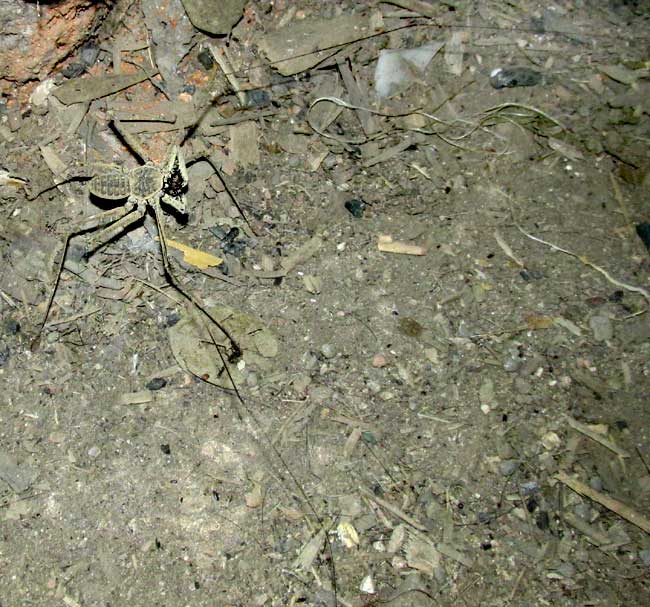
This week just as the sun was setting a roving ink-stain of army ants passed the hut's porch, just grazing the entry area, and I felt lucky. As always, all kinds of insects, spiders and other invertebrates were either frantically fleeing the onslaught, or else being methodically dismembered, with legs, heads and other body parts being carried forward toward the ant-mass's front. The mass's edge did overlap the pillar-like stand made of adobe blocks where I keep a dishpan of water for washing things off, so ants swarmed up the stand and explored my bar of soap, scrub brush, washrag and dishpan.
To my astonishment, they drove from the washing spot something that in the early evening's dim light looked like a very big, heavily built spider, but a spider with spiny front claws like a scorpion, yet having no curled, stinger-tipped tail as scorpions do.
Immediately I knew that it was a tailless whip-scorpion, because several times empty exoskeletons shed by molting ones have turned up {see next section}. However, this was the first time I'd seen a living one. The camera was lying nearby but the critter was moving so fast that I hardly had time to set up the flash and snap the picture at the top of this page.
There the fleeing arachnid is seen crossing an ashy area beside my porch-floor fireplace, so that's why everything is ashy gray. The reason the image include such a large expanse of ashes is that it had to be included to show the animal's remarkably long, slender, antennae-like front legs, technically referred to as "antenniform legs." In the picture, the antenniform legs extend to or beyond the image's left and bottom borders.
These super-long, slender legs are the "whips" in the common name "whip-scorpion," and they're used as if they were antennae, to locate prey. Once prey is located, the claws or pincers, or "pedipalps," take over. Below, an enlarged section of the above picture better showing the whip-scorpion's body reveals that this one's pedipalps are carrying an army ant -- or maybe the ant is trying to dismantle the whip-scorpion's mouthparts:
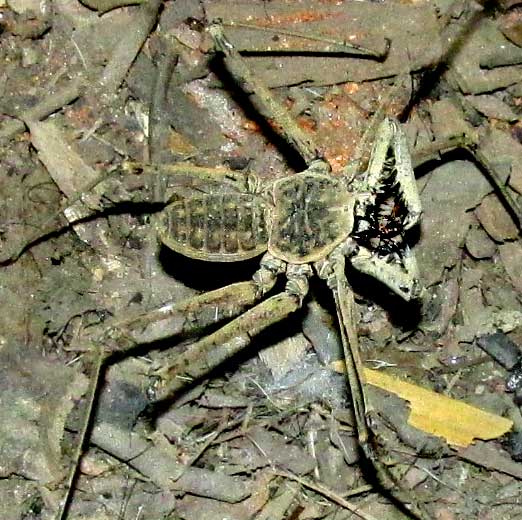
Tailless whip-scorpions occupy tropical and subtropical regions worldwide and mainly are found in warm, humid environments, such as leaf litter, caves and beneath tree bark. They feed mostly on many kinds of small invertebrates and possess no venomous fangs or scorpion-like stingers. They're hard to get to bite a finger, but if you persist in poking at them they might grab a finger with their pedipalps and possibly puncture the skin.
In talking about tailless whip-scorpions, we're not referring to any particular species or even a genus. Tailless whip-scorpions have their own taxonomic order. To put that into perspective, all primates from chimpanzees to humans belong to the Primate Order, while all songbirds from warblers to sparrows belong to the Passerine Order. All species of tailless whip-scorpions belong to the Amblypygi Order. In evolutionary terms, that order is considered an ancient one, fossils of them dating back to the Carboniferous Period -- ±359 to ±299 million years ago, well before the dinosaurs arose.
As of 2016, about 155 species of tailless whip-scorpions had been discovered and described. In the Yucatan Peninsula three species are listed, all in the genus Parraphrynus, and I can't say which species this is. *UPDATE: In 2024 there's enough information on the Internet to be pretty sure that this is the Dusky-handed Tailless Whip Scorpion, PARAPHRYNUS RAPTATOR, occurring mainly in the Yucatan but possibly also spottily in other parts of southeastern Mexico, maybe into Honduras.
from the March 31, 2008 Newsletter written in the community of 28 de Junio, in the Central Valley 8 kms west of Pujiltic, elev. ~700m (2300ft), ~N16.331°, ~W92.472°; southeastern Chiapas state, MÉXICO
TAILLESS-WHIPSCORPION EXOSKELETON
This week I was glad to find what's shown below:
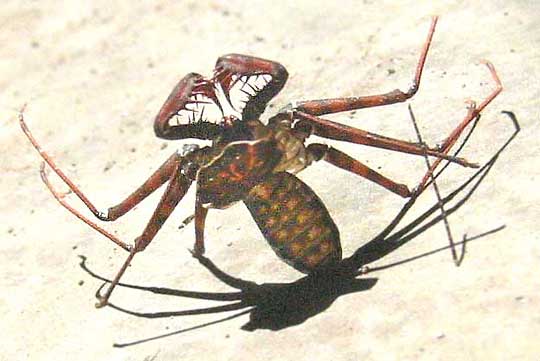
That's not the animal itself, but rather the creature's abandoned exoskeleton, or "skin," the main body being about an inch long. Arthropods are encased in stiff exoskeletons so, as they grow, periodically their old exoskeletons split, the animals emerge from them, and then hide in safe places until their new, larger, but temporarily soft exoskeletons harden. If you look closely at the picture you can see how the body's broad, roundish central part (its carapace) has split along its sides and front, then hinged upward like the lid of a tin can, with the hinge at the back. The animal crawled out of its old exoskeleton through this opening.
On the Phylogenetic Tree of Life,the scorpion order lies near the pseudoscorpion, windscorpion, whipscorpion and tailess whipscorpion orders. I mention the order groupings to make it easier to visualize how closely related the groupings are. Among birds, for instance, we speak of the woodpecker order, the penguin order and the passerine or songbird order. Among arthropod orders there's a similar relationship.
It turns out that the mystery exoskeleton is that of a tailless whipscorpion. Members of the tailless whipscorpion order are distinguished by their first pair of legs being long and whiplike. Unfortunately, the whiplike legs were too fragile to survive my transport, though a slender fragment of one leg is stuck to other legs at the right in the picture.
issued on January 13, 2020 from Tepakán, Yucatán, MÉXICO
TAILLESS-WHIPSCORPION EXOSKELETON, BOTTOM
One of the hut's friendly tailless-whipscorpions sloughed off his exoskeleton this week, leaving it on my floor overnight. While I had it, I photographed up close some of the little critter's bottom architecture, shown below.
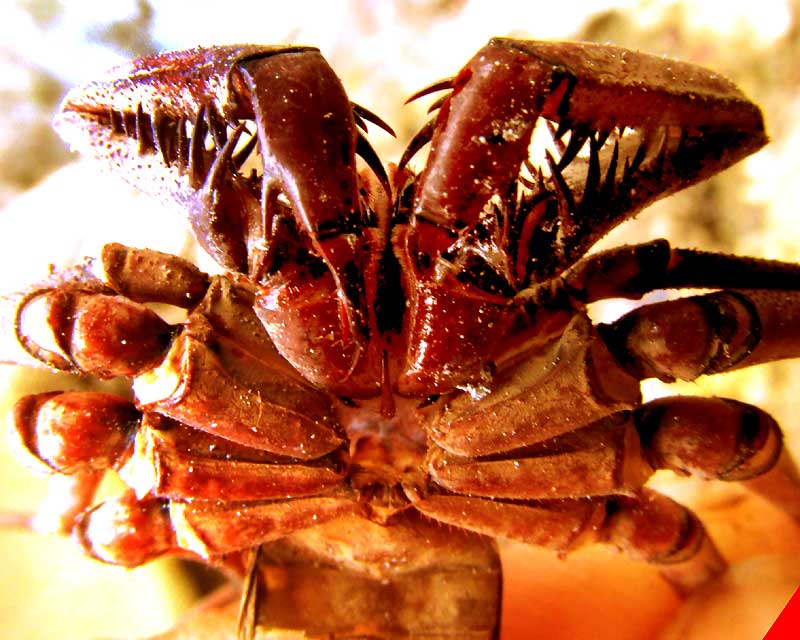
It looks like the claws couldn't be better adapted for grabbing and holding onto prey before cramming it into its "mouth."