PLANTS | ANIMALS | ECOLOGY | GEOLOGY | GARDENING | TOOLS
MEXICAN PLANTS & ANIMALS HOME

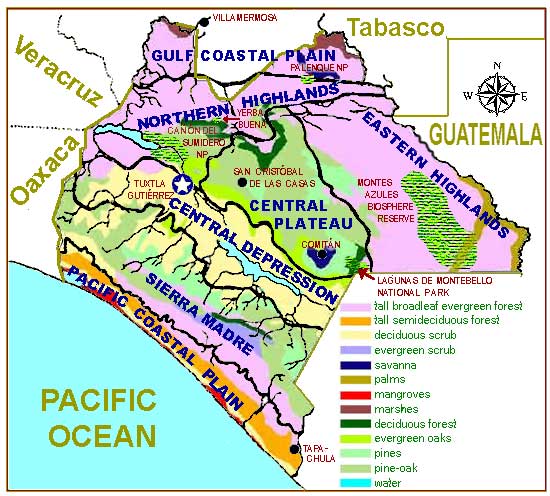
Below is a map showing approximate boundaries of Chiapas's major vegetation zones. Vegetation over large areas has been so impacted by human activities that often what you really see besides plantations,agricultural fields and ranches is wasteland, weedy eroding slopes and part-time, cattle-grazed expanses.
Hot and humid lowlands with marked wet and dry seasons, covering about a third of the state, especially in the north and east.
Originally on the hot, humid lowlands of the the Pacific slope.and some river sides and slopes in the Central Depression, but now mostly an agricultural wasteland. Typical plants of the area are:
Mostly in the Central Depression's hot, somewhat dry lowlands. Typical trees are:
Generally between 1200 and 2300 meters (3900-7500 ft) with abundant rainy-season rainfall and occasional rains even during the dry season. Conspicuous plants include:
Savannas are grasslands with scattered trees and drought-resistang undergrowth. In Chiapas they occur at low elevations in a variety of hot, typically arid situations,. Sometimes in sandy soil but sometimes in soil saturated with water, with little aeration. Noteworthy woody species include:
Spotty occurrence in hot, somewhat arid lowlands. Main palms include:
Along the Pacific Coast, forming very dense, low, woody thickets in shallow water (not over about 2 meters deep (6 ft) next to the ocean, in strips rarely more than 4 kms deep. Important as fish hatcheries and wildlife cover. The main species are:
In Chiapas's hot, rainy northern lowlands along the Usumacinta and Grijalva Rivers. There can be truly aquatic plants such as waterlillies and waterhyacinths, plus thickets of cattails, reeds, semisubmerged grasses, and even elements of spiny scrub forest.
Between about 800 to 2200 meters in elevation (2600-7200 feet) on the highland's northern slopes facing Tabasco, in the Sierra Madres and a bit in the area of Lagos de Montebello, in areas with abundant wet-season rainfall and occasional dry-season rainfall. Conspicuous trees include:
In various locations at elevations between 700 to 2300 meters (2300-7500 ft) with moderate rainfall. The main oaks include:
Covering large areas of Chiapas's chilly highlands up to 4000 meters in elevation (13,100 feet) this forest is predominantly formed of evergreen pines, particularly the following species:
At elevations between 800 to 2200 meters (2600 - 7200 ft) with marked wet and dry seasons. The following trees are most conspicuous: