PLANTS | ANIMALS | ECOLOGY | GEOLOGY | GARDENING | TOOLS
MEXICAN PLANTS & ANIMALS HOME

Excerpts from Jim Conrad's
Naturalist Newsletter
from the January 21, 2008 Newsletter issued from Yerba Buena Clinic just outside Pueblo Nuevo Solistahuacan, Chiapas, MÉXICO
about 1740 meters in elevation, ± LAT. 17° 11' 27"N, LONG. -92° 53' 35"W
POINSETTIA FLOWER ANATOMY
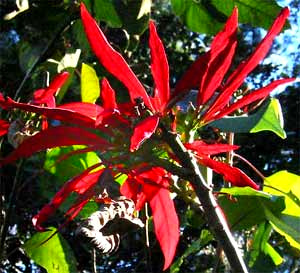 As seen at the right, our native-Mexican Poinsettias, Euphorbia pulcherima, are flowering now. The Poinsettias possibly blooming in your house right now are herbaceous greenhouse productions of what in the wild grows to be a woody shrub ten feet tall and higher. The picture at the right shows the thick, woody, flowering branch-tip of a 10-ft-high tree near my place
Poinsettias belong to the same family as Castor-Beans, the Spurge or Euphorbia Family, in which flowers are unisexual. Besides that, Poinsettia flowers differ in several important way from the "average flower features" outlined on our Standard Blossom.
In Poinsettia flowers the large, red, eye-catching things at the ends of branches are not flower petals but rather modified leaves called bracts. Because actual Poinsettia flowers are small and inconspicuous, the red bracts take over the job of attracting pollinators. Below you can see the "real flowers."
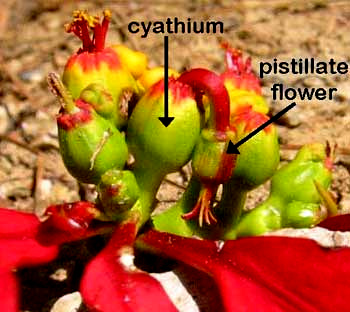
The greenish, cuplike thing labeled "cyathium" is a structure unique to the Poinsettia's genus Euphorbia. In each cyathium usually there are several male flowers but only one female, and that female is attached to the cyathium's center. However, the cyathium is too small to accommodate the males and the much larger female flower, so the female flower does something extraordinary: She sits atop a stemlike pedicel which grows so long that it bears the female ovary completely outside the cyathium, as seen in the picture. There the female flower is labeled "pistillate flower," because she consists of nothing but the pistil (stigma, style & ovary).
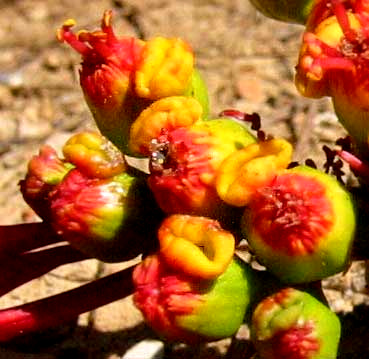
In that picture also you see stamens and immature styles poking from other less-developed cyathia. In the picture at the right you see that the cyathia bear waxy looking, yellow, goblet-like glands. Ants appear to be attracted to them, and one wonders why. Is it because ants would discomfort an herbivore nibbling at the flowers? Or maybe ants help distribute the pollen? This is a good matter for us to be looking at the next time we're beside a Poinsettia with ants on it.