PLANTS | ANIMALS | ECOLOGY | GEOLOGY | GARDENING | TOOLS
MEXICAN PLANTS & ANIMALS HOME

Excerpts from Jim Conrad's
Naturalist Newsletter
from the November 19, 2007 Newsletter issued from Yerba Buena Clinic just outside Pueblo Nuevo Solistahuacan, Chiapas, MÉXICO
about 1740 meters in elevation, ± LAT. 17° 11' 27"N, LONG. -92° 53' 35"W
WHITE-CROWNED PARROTS AT DUSK
 At dusk, shrill, excited screeches shatter the calm as a flock of maybe 30 thick-bodied birds with broad wings held at right angles from their bodies approach from down in the valley. Even though all you can see is black silhouettes you know they can't be anything but parrots or parakeets. My list of upland-Chiapas birds lists two parrot and four parakeet species potentially to be seen here. A quick glance with binoculars shows that these sky-screechers have short, squared tails, so they're one of the two species of parrots, not any of the sharp-tailed parakeets.
Of the two parrot species potentially to be seen here the White-fronted Parrot is a large Amazon type (27 cm long) while the White-crowned Parrot is a smaller (24 cm) member of the genus Pionus. By "Amazon type" I mean a member of the large genus Amazona. Bird fanciers often refer to "Amazon parrots" when they're talking about "typical parrots."
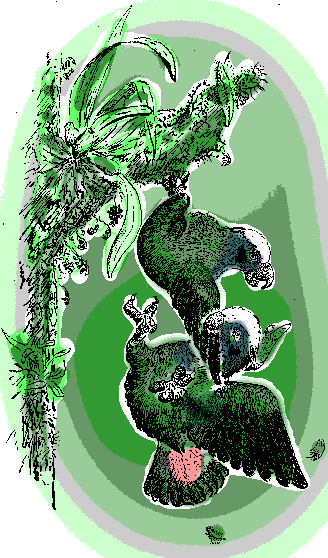
If you've seen lots of flying parrots, the moment our evening flock comes into view you can tell that these are smaller than most species because of their quicker maneuverability. Also, it'd be unusual for such large flocks of the big Amazons to form. Even when all you see is black silhouettes it's clear that, if they're either larger Amazons or smaller White-crowned Parrots, these are the smaller ones, portrayed in my drawing shown above.
These screeching birds inn their tight little flock wheel through the sky right at treetop level until abruptly they vanish into the crown of a tall tree. They screech and screech and you wonder what they could be saying they haven't said a thousand times that same day, but their level of enthusiasm continues at the intensity of kids screaming at a playground. Nothing is more social, more needing of attention of fellow members of the community, than a parrot or parakeet, so when you see how gleefully they interact you feel bad if you've ever kept one alone in a cage. Atop these tall trees they don't let you get too close. You inch closer and closer until maybe you can see their white crowns but then they explode from their treetop, screeching like crazy, and head back into the valley. Only the lucky ever see the birds' amber eyes, bluish chest, red tail coverts and those off-color shoulders.
This is about as high in elevation as White-crowneds get. I can't see this species without recalling my 1996 birding trip when I sketched the fighting birds shown above, in hot, humid, lowland Oaxaca. Here's what I wrote then:
At dusk I steal into an abandoned coffee plantation with security very much on my mind. I am intensely focused on watching for someone following me, on not being seen, of choosing a random spot and camouflaging the tent as best I can. As darkness falls I hear parrots in the "mother tree" above me and stick my head from the tent's door. Two White-crowned Parrots are fighting, one dangling from a Peperomia-covered limb by a single toe while the other attaches itself by the beak to its adversary's wing, and what they're saying is clearly parrot-cussing.
Notes and drawings from my 1996 birding trip can be accessed here.