PLANTS | ANIMALS | ECOLOGY | GEOLOGY | GARDENING | TOOLS
MEXICAN PLANTS & ANIMALS HOME

Excerpts from Jim Conrad's
Naturalist Newsletter
from the January 14, 2007 Newsletter issued from Yerba Buena Clinic just outside Pueblo Nuevo Solistahuacan, Chiapas, MÉXICO
about 1740 meters in elevation, ± LAT. 17° 11' 27"N, LONG. -92° 53' 35"W
"WILD NASTURTIUMS"
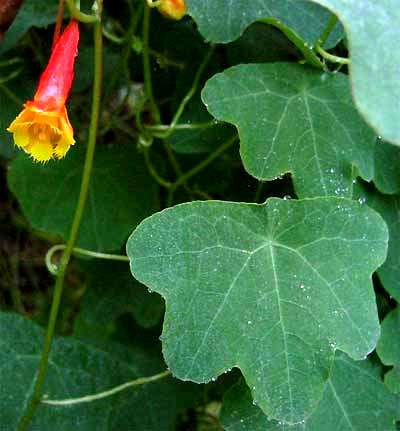
The trail to the cloudforest passes through a hard-to-get-through area that's been deforested and now is growing back with giant grasses, tangled vines and rank weeds fifteen feet high. In one area about the size of a small house this vegetation is overgrown by an exuberant, herbaceous vine that actually is quite pretty right now as it begins issuing the interesting red-orange and yellow blossoms shown bove.
From the first I knew that this was something very close to the Garden Nasturtium, Tropaeolum majus, for members of the Nasturtium or Tropaeolum Family possess some very distinctive features.
For one thing, most members of the Tropaeolum Family climb over other vegetation by means of "coiling petioles." Petioles are leaf stalks, and you can see in the above picture how the leaves' long, slender petioles snake around the vine's stem. In the background you can even see a blurry petiole practically tying itself into a knot.
Many Tropaeolum Family members also produce "peltate leaves," which means that the petiole, instead of attaching to the leaf-blade's bottom edge, attaches to the leaf's undersurface, sometimes even in the blade's center. In the picture you can see where the petiole attaches to the leaf's lower face because of how veins radiate out from a point well within the roundish leaf.
Tropaeolum flowers are unusual, too. Most distinctive is that one calyx section of each blossom -- one of the sepals -- is modified into a long "nectar spur" jutting well behind the flower's face. Also, in most other flowers the calyx is a small, green, cuplike affair positioned inconspicuously below the showy corolla, but in the picture you can see that this flower's fleshy, orange-red calyx is actually its most conspicuous part. The flower's five petals are the yellow, collar-like things arising inside the reddish calyx. In this particular species the petals are fringed with long, sharp teeth (they're "fimbriate"). You can't see it in the picture but the top two petals also possess conspicuous dark spots at their bases.
When nectar gatherers take nectar from deep inside the nectar spur they have to brush past the pollen- producing stamens and the fruit-producing stigma, style and ovary, thus pollinating the flower. In the picture some of the stamens' yellow anthers are visible at the blossom's throat-opening.
Baileys says that the Tropaeolum Family embraces only one genus, Tropaeolum, which contains about 50 species native from Mexico to Chile. The Garden Nasturtium hails from South America. No Tropaeolums are listed for Yerba Buena but Breedlove's Flora of Chiapas lists three species for the state. Besides the Garden Nasturtium there's Tropaeolum emarginatum and T. moritzianum, so maybe the picture shows one of the latter two. {UPDATE: Later it was identified as TROPAEOLUM EMARGINATUM, occurring from Mexico south through Central America to Ecuador in South America.}