PLANTS | ANIMALS | ECOLOGY | GEOLOGY | GARDENING | TOOLS
MEXICAN PLANTS & ANIMALS HOME

From Jim Conrad's Naturalist Newsletter of January 14, 2008 issued from Yerba Buena Clinic just outside Pueblo Nuevo Solistahuacan, Chiapas, MÉXICO
about 1740 meters in elevation, ± LAT. 17° 11' 27"N, LONG. -92° 53' 35"W
YERBA BUENA'S ENDANGERED MAGNOLIAS
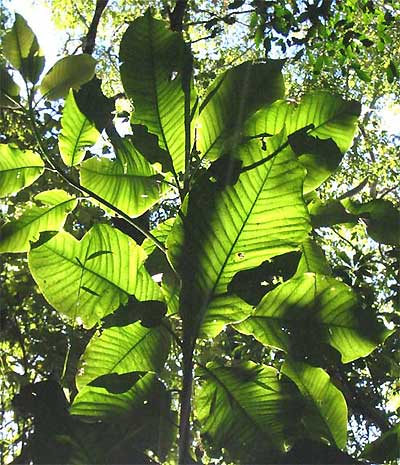
In much of the world if you have a mountaintop cloudflorest you're going to have a magnolia species living there and listed as threatened or endangered. Many magnolia species are mountaintop specialists. From an ecological perspective mountaintops are islands, and unique species tend to evolve in island situations.
Up in Querétaro our cloudforest magnolias were Magnolia dealbata and Magnolia schiedeana. The magnolia listed for Yerba Buena is MAGNOLIA SHARPII, so probably in the above picture that's what's glowing in morning sunlight.
The leaves in that picture are about 15 inches long, so they're smaller than the giant leaves I wrote about for Magnolia dealbata, a picture of which is archived at www.backyardnature.net/n/06/061229mg.jpg.
Several trees in the cloudforest bore large leaves somewhat like the ones in the picture so I had to use a little botany to assure myself that this really was the rare magnolia being searching for. However, only a little botany was needed, for even unflowering magnolia branches can be identified easily by the fact that their twigs are surrounded by little scars called stipular rings (one ring associated with each leaf scar). Also, magnolias buds are "naked," having no scales. Typically they're fuzzy-rusty-brown, the rusty-brown being hairs on the bottoms of the future leaves.
If you see these features and still aren't convinced you have a magnolia you can always crush a fresh leaf and smell the fresh, spicy aroma so distinctive of the species.
Magnolia sharpii is endemic to the highlands of southern Mexico and Guatemala.