PLANTS | ANIMALS | ECOLOGY | GEOLOGY | GARDENING | TOOLS
MEXICAN PLANTS & ANIMALS HOME

From Jim Conrad's Naturalist Newsletter of October 15, 2007 Newsletter issued from Yerba Buena Clinic just outside Pueblo Nuevo Solistahuacan, Chiapas, MÉXICO
about 1740 meters in elevation, ± LAT. 17° 11' 27"N, LONG. -92° 53' 35"W
CHIAPAS MORE GUATEMALAN THAN MEXICAN
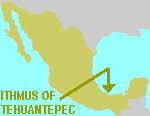 From the biogeographical perspective there's a significant difference between the highlands extending from the US through Mexico all the way south to Oaxaca state south of Mexico City, and the highlands of Chiapas. The difference is caused by the Isthmus of Tehuantepec. As the map at the right shows, the Isthmus is Mexico's narrow neck connecting the "mainland" to the north and west with the Yucatan and Chiapas to the south and east. The Isthmus's landscape is so low that engineers periodically consider cutting a canal across it, from the Gulf of Mexico to the Pacific, thus bypassing the Panama Canal.
To plants and animals adapted for upland environments, the lowland Isthmus constitutes an ecological barrier. Lots of species are found on one side of the Isthmus or the other, but not both sides.
For example, White-breasted Nuthatches occupy highlands from the US to well south of Mexico City, but don't occur in Chiapas. The same is true of American Robins, Bewick's Wren, Western Bluebirds, Horned Larks, Black- headed Grosbeaks, Curve-billed Thrashers, Scrub Jays and others.
By the same token, several species extend from the Central American highlands into Chiapas's highlands, but not to the other side of the Isthmus. For example there's the Bar-winged Oriole, Blue Seedeater, Yellow-throated Brushfinch and the Slender Sheartail Hummingbird.
On the other hand, many species do appear on both sides of the Isthmus, either with a continuous distribution or discontinuously. The Isthmus's lowlands aren't really all that extensive after all. Any bird or airborne seed not making it across such a small distance probably isn't trying too hard.
Still, biologically, Chiapas belongs more to Central America than to Mexico. There's not a Pauraque- whisker's difference between Chiapas and Guatemala.