PLANTS | ANIMALS | ECOLOGY | GEOLOGY | GARDENING | TOOLS
MEXICAN PLANTS & ANIMALS HOME

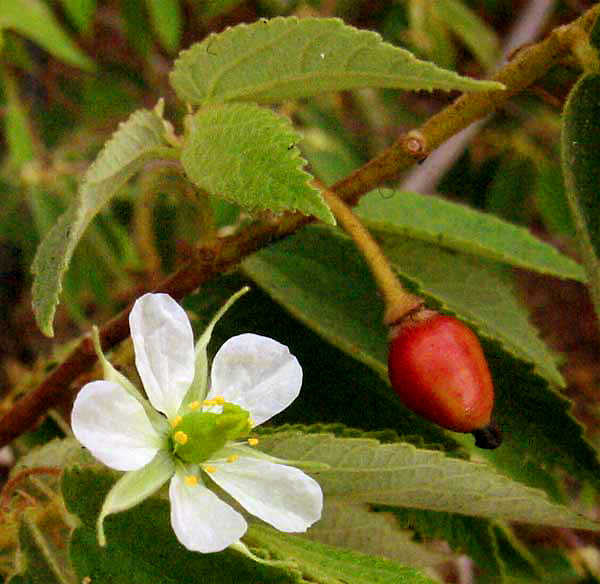
from the March 3, 2008 Newsletter, written in the community of 28 de Junio, in the Central Valley, 8 kms west of Pujiltic, Chiapas, MÉXICO, about 800 meters in elevation, ± LAT. 16° 18'N, LONG. -92° 28'W.
"CAPULÍN"
"Capulín" is in quotation marks because it's a name used for many small, usually unrelated trees throughout Latin America. Basically any tree fruit that's red and cherry-size is called "capulín" (kah- poo-LEEN). The capulín I'm talking about is MUNTINGIA CALABURA, a member of the tropical Flacourtia family, the Flacourtiaceae. I'm bringing up this particular species because its inch-wide, white flowers and red fruits are very conspicuous here nowadays, as shown above.
It's always interesting to meet species with no close relatives up North, because such species always have features not seen up there, or else have the features scrambled in interesting ways. Muntingia calabura takes the scrambled approach.
For, its leaves are three-veined from asymmetrical bases like the North's hackberry leaves, but its flowers and fruits remind you of the Rose Family's cherries and plums. When you break open a fruit, however, you find that its single cell is crammed with tiny seeds enmeshed in paste, as in a fig, so they're not cherry-like at all.
The red fruits look very inviting and in fact they don't taste bad. At first they're sweet but then comes a slightly bitter aftertaste, and that keeps you from gorging on them. Birds gorge, anyway. It's hard to find a mature fruit not mangled by a bird. Especially overwintering Orchard Orioles fill the trees near my campfire each morning.
One reason the small tree is so common here is that it specializes in scrubby, disturbed, often weedy environments, and that's exactly what we have plenty of. The species flowers and fruits most of the year, but there's a definite peak toward the end of the dry season.
from the July 26, 2015 Newsletter, an on-the-road edition, from notes taken in Mahahual, southeastern Quintana Roo state, MÉXICO
BENEATH A CAPULÍN
In later times when I recall the current wandering, one of my most vivid memories will be of time spent below a certain Capulín tree, a MUNTINGIA CALABURA, in an empty, weedy lot in the Casitas sudivision of Mahahual on the Yucatan Peninsula's southeastern coast. Casitas is where people live who work in Mahahual's tourist zone. On my way to Mahahual the previous week, some buses had been so cold with air conditioning that I developed a head cold. For a couple of days I lay in my tent in a kind of fevered mental fog, gazing up through the tent's screen top into the tree's intricate network of branches.
Several tree species with cherry-like fruits are called Capulines, so I slipped into the habit of speaking to my tree using the name Muntingia, a name pretty enough, and exotic enough, to grace such an excellent tree.
A nice breeze always blew off the Caribbean about a kilometer away, so the Muntingia's branches made a never-ending, always changing display of crisscrossing twigs, and quivering leaves. Alternately brilliantly sunlit and darkly shadowed, the leaves and branches created a kind of green fantasia somehow the opposite of, and ministering to, my sweaty malaise.
The tree, about the size of a northern orchard's apple tree, bore both white flowers and pea-sized, red fruits that looked like little cherries. The fruits were sweet and pleasant to taste, the seeds small and soft, so a more congenial little fruit can hardly be imagined. I ate them by the handfuls, when I felt like it.
Birds liked the fruits, especially yellow-and-black Hooded Orioles. A certain Hooded Oriole family visited throughout the days, the fledglings drooping and quivering their wings, piteously begging to be fed, calling with their harsh, adolescent voices -- even though they were perfectly capable of feeding themselves, and sometimes did when the parent wasn't quick enough. When the family got above my tent, I'd yell and thump the ceiling to scare them away, but still after a few days they manged to speckle my tent with poop pretty effectively.
Red fruits littered the ground, sometimes even bouncing off my tent in the middle of the night when the wind hardly stirred. A species of very tiny, fast-moving ant craved the fruits' sweetness, but after many ants had swarmed over a fruit all day, most of the fruit still remained because the ants could take so little.
Leafcutter ants were much larger and made more of an impact, for they gathered every white flower petal that settled to the ground, and carried them, one petal per ant, in slow-moving lines, the petals carried above the ants' heads, past my tent. It was soothing to watch the perpetual little caravan, and good to think of an ant species so fastidious in its taste and needs that with a whole world of rampant green vegetation available it would choose only a certain tree's flower petals, and obsessively gather them home every day. Who knows what essence they aimed to distill from the petals in their subterranean compost dungeons, where a fungus would grow atop the compost, and then the ants would eat the fungus?
The tree itself possessed a central trunk, but it was fairly slender and not much different from trunks of numerous other smaller shoots of the same species all around. It was more Muntingia thicket than one tree growing alone, and I never figured out whether there was just one tree with many shoots sprouting from its roots, or many saplings arising beneath a parent tree.
The Muntingia seemed to make a special effort to hold its stiff, fairly straight and slender branches more or less horizontally, so that the branches made comfortable walkways easy for birds to move along as they went from fruit to fruit. Seen from below, this intersecting system of branches formed a kind of systematic gridwork against the sky. I lay below, wondering if this unusual manner of being for limbs really came about for the mere convenience of fruit-eating birds, and I thought that if that were the case then it was a pretty thing -- that a tree's form could express a bird's desire.