PLANTS | ANIMALS | ECOLOGY | GEOLOGY | GARDENING | TOOLS
MEXICAN PLANTS & ANIMALS HOME

Excerpts from Jim Conrad's
Naturalist Newsletter
from the October 22, 2007 Newsletter issued from Yerba Buena Clinic just outside Pueblo Nuevo Solistahuacan, Chiapas, MÉXICO
about 1740 meters in elevation, ± LAT. 17° 11' 27"N, LONG. -92° 53' 35"W
CALLIANDRA, THE BEAUTIFUL-STAMEN BUSH
Maybe the most eye-catching plant flowering along the road to town right now is the shrub shown below:
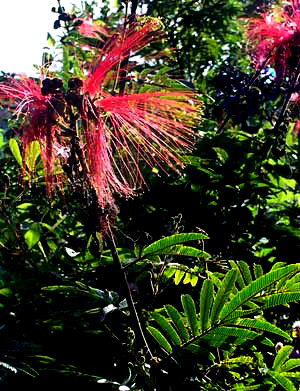
Averaging ten to fifteen feet tall, that's the genus CALLIANDRA, probably the species HOUSTONIANA. One local name for it is Barba de Chiva, which mean's Goat's Beard, but lots of plants go by that name. Those red, slender bristles poking nearly three inches from the brown, leathery calyxes and corollas are the stamens' filaments. You can see that each filament is tipped with a tiny, yellow, pollen-producing anther. This is one flower depending on its stamens' red filaments to draw the attention of pollinators, not colorful corollas the way it is in most flowers.
North Americans might say that both the twice-compound, ferny leaves and the red, powder-puff-like flowers look a lot like the pretty backyard tree up there often called Mimosa or Silk-tree, Albizia julibrissin, which is native from Iran to Japan. It's true that the two species are closely related, both belonging to the same subfamily of the huge and important Bean Family. However, botanists assign them to different genera largely on the basis that Calliandra's fruits split open when they're mature -- they're "dehiscent" -- while Albizia fruits don't.
The genus name Calliandra is a good one, based on the Greek root calli for beautiful, and andro for male, pertaining to the beautiful male stamens. We also find the root calli in "calligraphy" (beautiful graphics), and andro in "androgynous."
This is a common roadside weed throughout most of humid Mexico. My Las Plantas Medicinales de Mexico reports that people in Sinaloa chew the shrub's bark to toughen their gums. I'd be careful using the plant for that purpose, however, since the root bark contains an alkaloid said to paralyze the heart so that it's unable to contract -- hinders its systolic action.