PLANTS | ANIMALS | ECOLOGY | GEOLOGY | GARDENING | TOOLS
MEXICAN PLANTS & ANIMALS HOME

Excerpts from Jim Conrad's
Naturalist Newsletter
from the November 12, 2007 Newsletter issued from Yerba Buena Clinic just outside Pueblo Nuevo Solistahuacan, Chiapas, MÉXICO
about 1740 meters in elevation, ± LAT. 17° 11' 27"N, LONG. -92° 53' 35"W
BLOOD TREE, or PALO DE SANGRE
The walk to town continues to be a pleasure, especially on cool, sunny days with the sky so blue. Nowadays the most eye-catching flowering plant is a six-ft-tall, bushy composite with yellow blossoms whose beauty I've already extolled back in Querétaro where it also was a robust, pretty roadside weed. There it was called Acahual. It's Tithonia tubaeformis, and its picture is still at www.backyardnature.net/n/06/061211a.jpg.
The most eye-catching tree is conspicuous because of its sheer abundance in disturbed, eroded areas, its large, heart-shaped leaves and, most importantly, the foot-tall, rat-tail-like flower spikes arising from the tips of the trees' upper branches, as shown below.
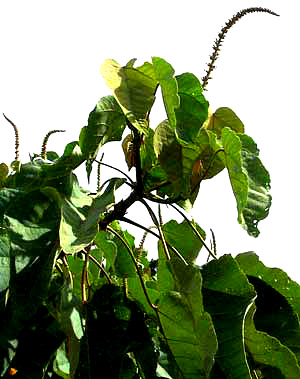
People here call the tree, which averages 20-30 feet tall, "Palo de Sangre," or "Blood Tree." In other parts of the country it's "Sangre de Drago," or "Dragon Blood." Any plant bearing such names nearly always exudes red sap or latex. As soon as I looked closely at the tree I could easily believe it might produce colored sap because it was clearly a member of the Euphorbia Family, many members of which, when wounded, "bleed" colored, sometimes skin-irritating, eye-blinding or poisonous juice. The tree's scientific name is CROTON DRACO.
Of course I wanted to see the "blood." I broke off a leaf and was surprised to see a clear, mucilaginous sap emerge that didn't redden with time. I nicked a small, woody branch and the same clear liquid oozed out. An invader I knew was macheteing weeds on reserve land not far away so I asked him why "Blood Tree" didn't bleed.
"It's full of blood!" he replied, and to emphasize his remark he chopped his machete into the air the way you'd hack at a tree's trunk, then stood there wide-eyed as if blood were spurting everywhere. "You want me to show you?" he asked, pointing his machete at a nearby tree.
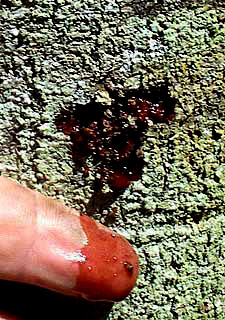 I didn't want the tree to be needlessly hacked so I declined his offer, but later I found a big tree and nicked a thumbnail-size hole in its smooth, soft trunk, and out oozed reddish "blood," which you can see at the right.
Now I know that the red sap emerges only from trunks of larger trees. I've never seen a tree that restricted its colored sap to its trunk, producing clear sap in younger parts.
My Las Plantas Medicinales de Mexico claims that the tree's bark has febrifugal properties (lessens fever) and drinking a tea of the cooked bark hardens the gums. The men renovating the ruined dwelling I'm occupying say that that may be true but around here if you have gastritis you need to drink about half a cup of the sap, or boil the bark and drink the tea.
