PLANTS | ANIMALS | ECOLOGY | GEOLOGY | GARDENING | TOOLS
MEXICAN PLANTS & ANIMALS HOME

Excerpts from Jim Conrad's
Naturalist Newsletter
from the February 18, 2008 Newsletter written in the community of 28 de Junio, in the Central Valley 8 kms west of Pujiltic, elev. ~700m (2300ft), ~N16.331°, ~W92.472°; southeastern Chiapas state, MÉXICO
"BRASIL"
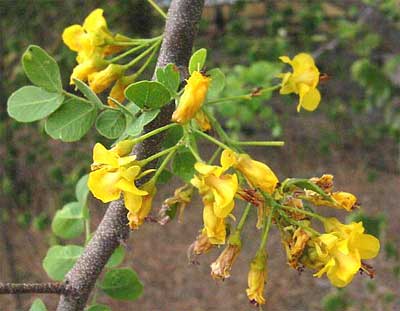
A tree known locally as Brasil is a native species adapted to an arid climate and calcareous soil, exactly as we have here. Brasil is HAEMATOXYLUM BRASILETTO, a member of the Bean Family. That's Brasil's flowers and leaves above.
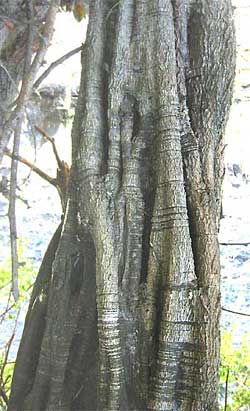
Brasil's flowers are a little tricky to interpret because their calyx lobes, or sepals, are large and yellow like the petals, or "petaloid." Brasil's leaves are pinnately compound -- once-divided, featherlike, and usually composed of only two or three pairs of oval leaflets whose tips are typically blunt or even notched. When such leaves are matched with the unusual trunk, typically bearing vertical depressions looking like old wounds, you know you have a Brasil. The trunk is at the left.
Brasil belongs to the same genus as the famous Logwood, HAEMATOXYLUM CAMPECHIANUM, found on the coasts of the Yucatan, Belize and elsewhere. Belize owes its nationhood to Logwood, for the British set up settlements there, largely of Black slaves, to harvest Logwood for the production of blue dye. The color "navy blue" has its roots in Belizean Logwood, and so does the Creole-English spoken in Belize.
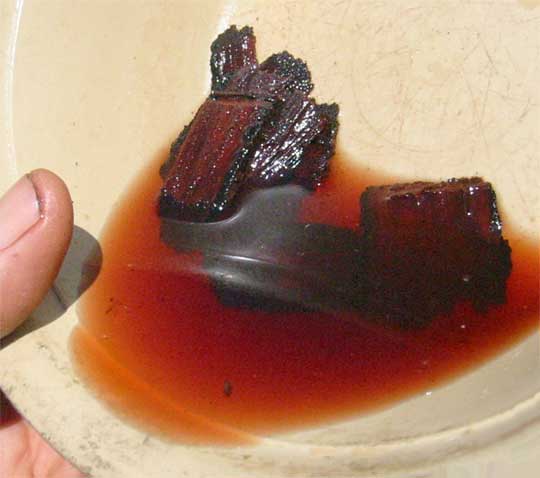
Below you can see Brasil's dye resulting from soaking a few chips in water for a couple of days: