PLANTS | ANIMALS | ECOLOGY | GEOLOGY | GARDENING | TOOLS
MEXICAN PLANTS & ANIMALS HOME

Excerpts from Jim Conrad's
Naturalist Newsletter
from the May 5, 2008 Newsletter written in the community of 28 de Junio, in the Central Valley 8 kms west of Pujiltic, elev. ~700m (2300ft), ~N16.331°, ~W92.472°; southeastern Chiapas state, MÉXICO
SOLDIER ANTS WITH BIG MANDIBLES
On my way into the reserve frequently I cross fast- moving lines of larger-than-normal ants. With their lines, they're unlike the army ants I spoke of earlier, who move as dark, broad blotches across the forest floor. That story is archived at www.backyardnature.net/chiapas/army-ant.htm.
The ants I'm talking about now move in straight lines several ants wide. Still, I suspect that they still may be army ants. For one thing, occasionally you'll see a whole grasshopper or caterpillar being carried along. For another, in this species large soldier ants patrol the line boundaries, and those soldiers possess enormous, incurved mandibles, seen at the lower right below:
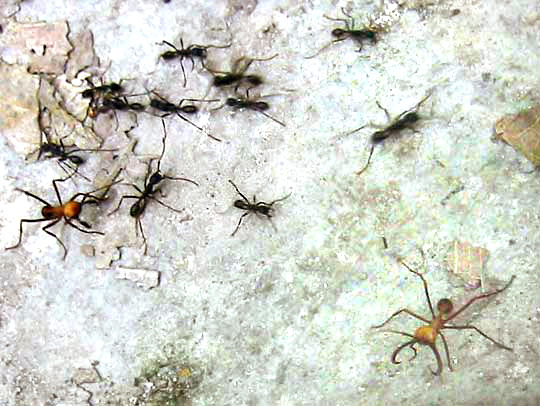
In that picture the big-mandibled ant is a fully developed soldier, while a less developed one stands guard at the far left, and smaller black workers stream by at the top of the picture.
I'm guessing that these are members of the genus ECITON* because soldiers of that genus are famous for bearing very large, incurved mandibles. In some ant genera ants use their huge mandibles to break seeds but in Eciton they're weapons for protecting the colony.
Looking at the soldier at the lower right you can easily imagine applying the critter to a cut in your skin, having her clamp down with one mandible on one side of the wound and the other mandible on the other side, so that the closed mandibles pinch the severed sides together. At that point with your thumbnail you could decapitate the ant, leaving the head serving as a suture. I've had this use described to me, though I've never seen it.
I think I'd rather try closing a wound with my fingers, then apply some strong spider-webs of the kind we can find here, which also are known for holding wounds closed.
from the December 11, 2011 Newsletter issued from Hacienda Chichen Resort beside Chichén Itzá Ruins, central Yucatán, MÉXICO
WASPS VS ANTS
Army ants streamed into the hut, found a large paper-wasp nest attached to the thatch roof above me, attacked the nest, drove the wasps away, and began carrying away wasp larvae. During this slaughter there were relative larger, red-headed ants at the perimeter of action, their rear ends hunched beneath them as if they could sting, and their powerful mandibles open like incurved pincers ready to stab inwards, seen below:
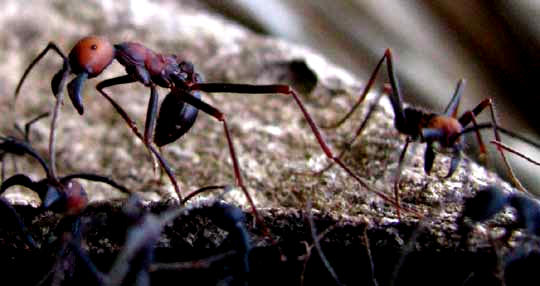
In about half an hour the wasp swarm in the Tree Cotton departed. Until darkness fell the ants continued ripping open larval cells and carrying out white pupae, presumably to be butchered and distributed at their leisure. These ants have been identified by iNaturalist user "mettcollsuss" as ECITON BURCHELII ssp. PARVISPINUM.
The next morning the nest was empty, and quiet. During subsequent days from time to time wasps came and briefly surveyed the nest, but then flew away. Today the nest remains silent and abandoned.