It's clear that thorns, spines and sharp bristles protect many plant species from animals who want to eat them. However, most plants don't have thorns, spines and bristles, so what keeps animals from eating them? The main answer is: CHEMICALS.
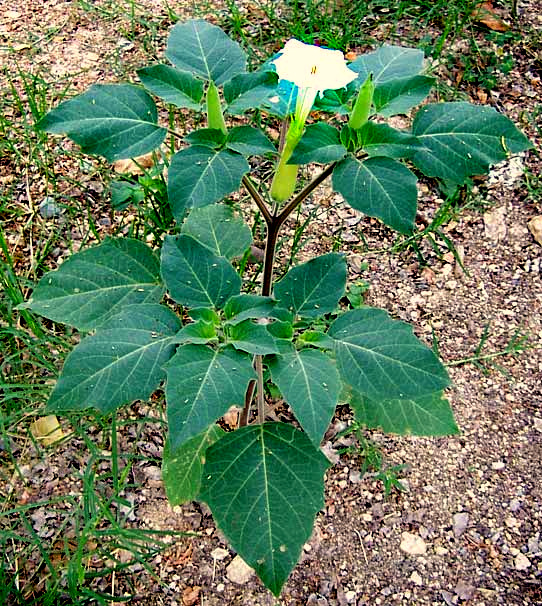
For example, at the right, the Angel's Trumpet, Datura inoxia, bears soft, somewhat fleshy leaves, stems and flowers, yet it's growing where any passing hungry herbivore can't avoid seeing it. The answer to how it manages to survive is that Angel's Trumpet, like other members of the genus Datura, contains the highly toxic alkaloid chemicals atropine, hyoscine and hyoscyamine. Ingesting these chemicals can kill humans and other animals. Animals know -- largely because of odor or bitter taste -- to stay away.
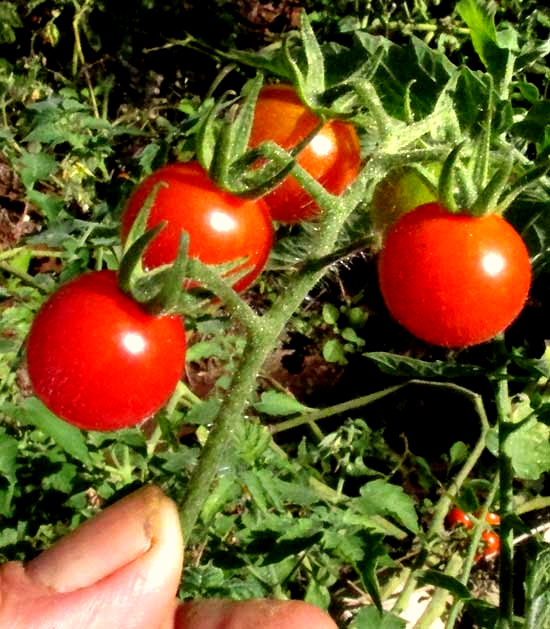
Many very common and important plants are toxic, especially before being cooked. Wikipedia provides a fine illustrated List of Poisonous Plants. Some species on that list might surprise you. For example, the leaves, stems and green, unripe fruit of tomato plants, such as the cherry tomatoes at the left, contain the poisonous alkaloid tomatine. Ripe tomatoes contain no detectable amounts of this chemical, however. Even apple seeds, which contain amygdalin, can kill you if you eat enough, though seeds in a single apple usually aren't dangerous to a human.
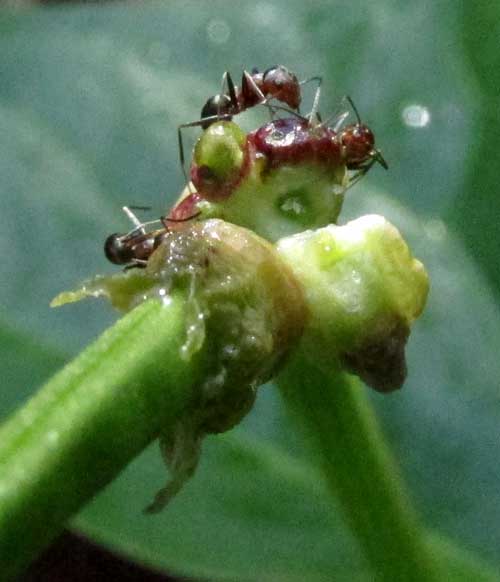
Plants protect themselves with chemicals in many ways other than by simply poisoning animals who eat them. For example, the Black-eyed Pea or Cowpea plant, Vigna unguiculata, produces glands on the main stem, or rachis, of its flowering heads, as well as among the plant's leaflets. The glands, technically known as "extrafloral nectaries," instead of producing toxic chemicals produce sweet ones: simple sugars -- sucrose, glucose and fructose -- which attract ants, as shown at the right. Why attract ants? If a herbivore begins nibbling on a Black-eyed Pea plant, the ants bite lips and tongue.
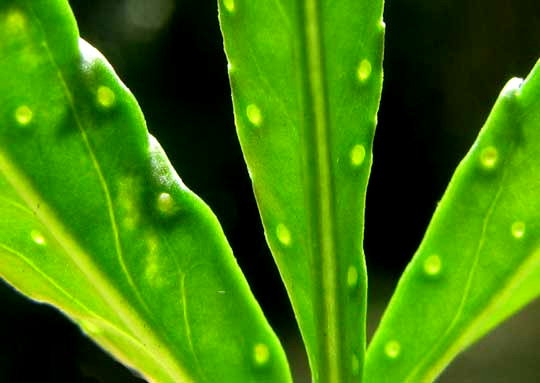
At the left, glands embedded in the leaves of the Aztec Marigold, Tagetes erecta, help explain why this and other marigold species are used in organic gardening to protect other plants against insects, root-damaging nematodes and diseases. Especially the flowers and leaves of Aztec Marigold have been shown to produce an essential oil functioning as a strong fungicide. (PROTA website).
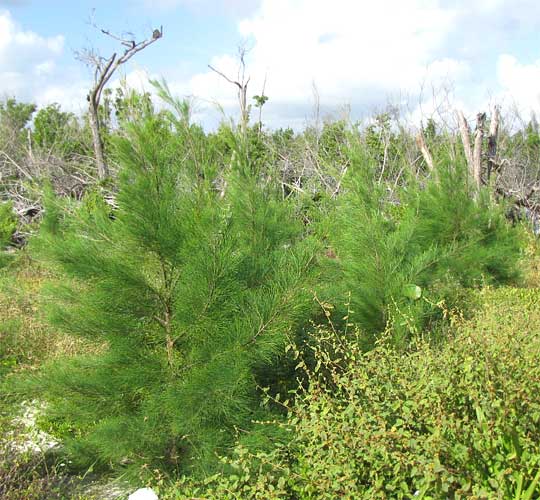
Some years ago a hurricane hit the Caribbean coast of Mexico's Yucatan Peninsula, severely damaging beach and mangrove ecosystems. At the right you see vigorous young trees growing with the shattered mangrove in the background. The young trees are invasive Australian Pines, Casuarina equisetifolia. One reason for their success in invading new territory is that they produce allelochemicals which produce an "allelopathic" effect on other plant species. The term allelopathy refers to the chemical inhibition of one organism by another, due to the release into the environment of chemical substances which inhibit the germination or growth of those other organisms. In the picture, allelopathy is enough to explain why the Australian Pines have no other plants growing among them, competing for resources.
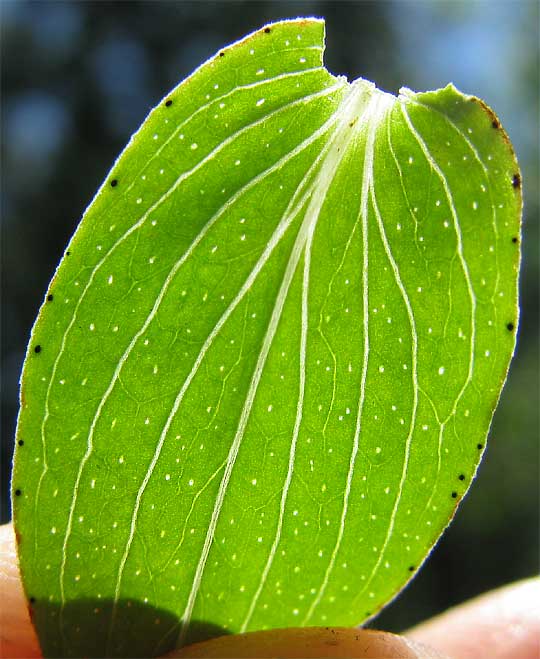
The herb St. John's Wort, Hypericum perforatum, has been used medicinally for thousands of years. Even today it's much sold commercially as a treatment for anxiety, depression, cuts, and burns. Recent research suggests that it's effective for certain kinds of cancer, inflammation-related disorders, and bacterial and viral diseases, plus it's an antioxidant and "neuroprotective agent." In the picture at the left of a St. John's Wort leaf, notice that both black and pale, translucent glands are present. The black glands produce the chemical hypericin while the translucent contain protohypericin. When cattle eat St. John's Wort amounting to about 1% of their weight, they are poisoned. Hypericin in the presence of sunlight causes acute inflammation and death of endothelial cells in capillaries in the skin, which results in a painful skin condition. This sunlight/chemical reaction is referred to as "photosensitization." (NIH National Library of Medicine)
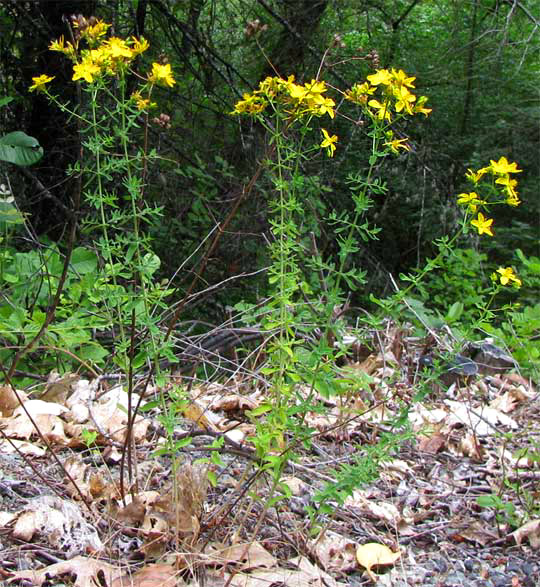
The above information about St. John's Wort -- shown at the right -- reminds us that toxic plants very often also serve as medicinal plants. Because living things share so much basic chemistry -- nearly all organisms use carbohydrates as their main source of energy, for example -- chemicals affecting a cabbage plant may also affect a human, though possibly in a very different way. Moreover, chemicals that kill or damage in one concentration often heal and nurture in another.
St. John's Wort's chemicals with their good and bad effects, depending on the species affected as well as the dosage taken in, also remind us that we humans are very much part of Nature. We, the Earth's community of organisms, are all mutually related, and all mutually interdependent.