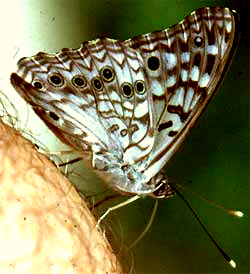
 Sometimes insects just make you pay attention to them. For example, throughout most of the eastern US, during the summer when you're sweating and sit down for a rest, if you're not far from some trees -- even in towns and suburbs -- you may feel a certain tickling on your back or arm, and it'll be the butterfly at the left, the Hackberry Butterfly, Asterocampa celtis, a critter with a perfect passion for sucking up sweat with its slender proboscis. Most insects are more retiring, however, and you need to go looking for them.
HOW INSECT WATCHING WORKS
Here is how insect watching works: You find something, being careful not to be stung or bitten and not to hurt the insect, and then you start really paying attention to it.
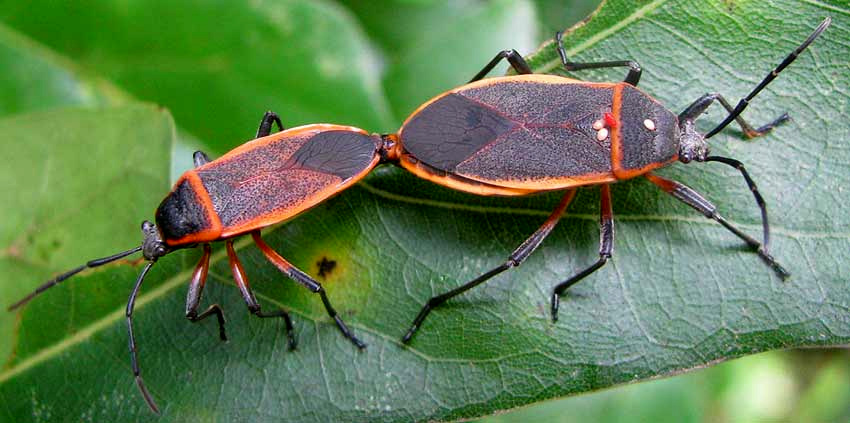
For example, maybe in early summer bug like the ones shown above start turning up running across the ground, climbing among low tree branches -- just about wherever plants occur. Right off there's something interesting about these bugs, which are Largus Bugs, Largus succinctus: They're mating. But there's something else to notice, if you look closely. On the larger bug's back, do you see the tiny, white, eggs and red item next to an egg? There's a story here...
It turns out that Largus Bugs often are parasitized by a tachnid fly species, and pictures on the Internet of tachnid fly eggs stuck on Largus Bug backs look just like ours. Could that red item beside an egg be a hatched tachnid fly larva? Internet pictures of tachnid fly larvae show whitish, grublike things, plus the larvae burrow directly from the egg into the bug's body, so for now the red item remains a mystery. Some tachnid fly larvae metamorphose into reddish puparia, but not this red. Well, sometimes you run into dead ends.
However, what about those tachnid flies? On the Internet you can read that female tachnids cement eggs to their victim's exteriors, exactly as shown in our photograph, and after the larvae burrow from into the bug's body, only one larva survives within each bug. The larva, a maggot, feeds on the living bug, eventually killing it. When the maggot exits the bug's body, it drops to the ground and pupates in a dark, reddish-brown puparium. An adult flies emerges to lay eggs about two weeks later. Each female fly may lay several hundred eggs, and there may be three generations each year, depending on location.
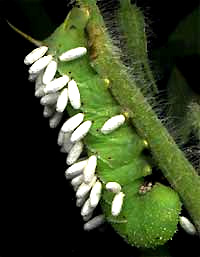
But the story doesn't end there. Once you begin noticing whether insects have eggs on them, someday on the tomato plant in the little garden you might you, maybe on a stem you'll notice a Tobacco Hornworm, Manduca sexta, looking like what's shown at the right. Looking for pictures on the Internet showing parasitized Tobacco Hornworms, it's soon learned that the white items on the worm are cocoons, not eggs, made by icheneumon wasps. Different from tachnids, female icheneumons lay their eggs inside the hornworm. Larvae emerge and feed inside the caterpillar, normally not killing it immediately. 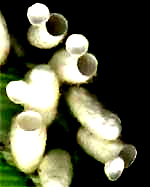 When the larva is ready to pupate, it munches its way to the caterpillar's surface and spins a silk cocoon, inside which a pupa develops. Not long later, a tiny adult wasp emerges from the cocoon. At the left you see several cocoons with open tops where the wasps escaped.
So, that's how but watching works. You find something, identify it, find out more about it, and just keep finding out more about it. Watch it, read about it, ask others about it, wrap your mind around it, relate to it, understand it, take notes on it, and let it be. And, how about producing an online insect collection showing living specimens? We have a special page showing how to do that.
One final thing: Remember that you can't watch an insect if you can't see it... even if you're looking right at it! Look below:
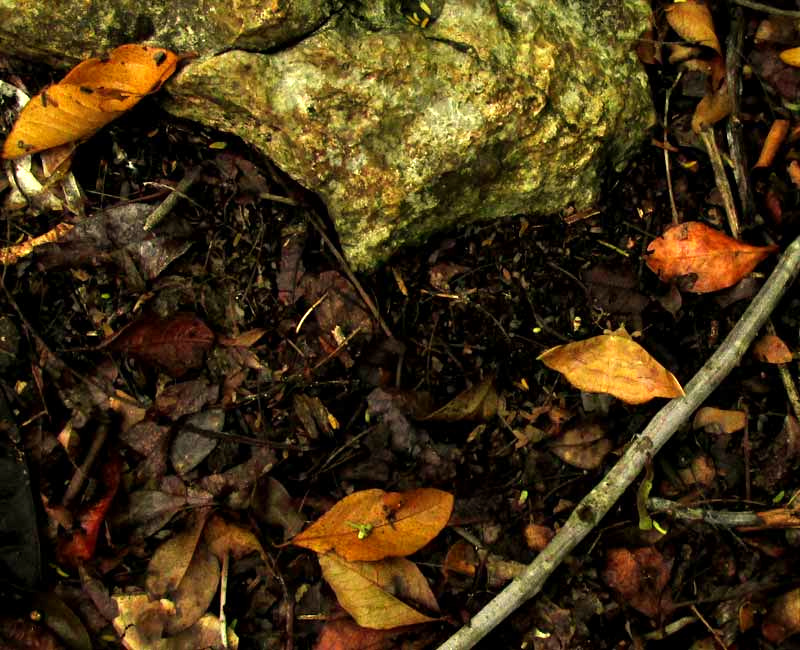
Can you find the moth in this picture? When you're looking for insects, look hard!
EGGS, PUPAE & CATERPILLARS
The best approach with eggs and pupae is to watch them where they've been deposited. If you find eggs under a cabbage leaf or on your petunias, tie a ribbon next to them and visit them regularly, hoping to catch them as they hatch, grow, and metamorphose. Don't bring cocoons or chrysalises into warm houses during the winter, for the adults will emerge too early, won't find appropriate food, and starve. However, during warm weather if you find a caterpillar and want to watch it close up, you might take a look at our How to Make a Caterpillar Rearing Container page.
THE GARDEN ZOO
Gardens are wonderful insect zoos not only because many plant species grow there, with each kind of plant supporting its own insect populations, but also because during the domestication process many garden plants lost their natural defenses, such as bitterness, and thus became favorite insect targets.
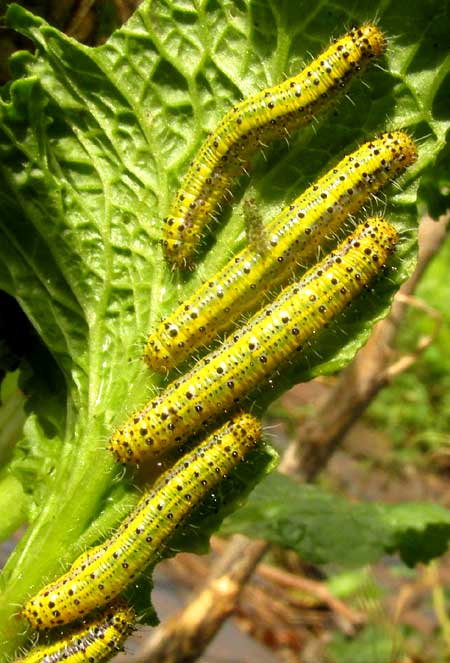
One sweet-tasting, fairly succulent garden plant with bitter, tough ancestors, for example, is cabbage. At the right, those are Cabbage Butterfly caterpillars, Pieris brassicae. According to Anna Carr's Rodale's Color Handbook of Garden Insects, the following insects eat cabbage: aphids, leafminers, thrips, whiteflies, cabbage maggots, five species of beetles, three species of true bugs, and five species of caterpillars. The caterpillars are the Cabbage Looper, Corn Earworm, Cutworm, Imported Cabbageworm, and Yellow Woollybear. In early summer when cabbage is lush, in a garden that hasn't been doused with insecticides, lie down next to a row and just look at all the different critters that nibble cabbage leaves.
The more kinds of plants inhabiting a certain area, the more kinds of insects will be there. Notice that we're saying "more kinds of insects", and not "more insects." That's because when many species live next to one another they tend to keep one another under control. In your garden, Ladybird Beetles consume huge numbers of aphids. Reduce the number of species by removing the Ladybird Beetles and you'll get "fewer species" with the Ladybirds gone, but "more insects" when aphid numbers skyrocket.
In gardens with many kinds of plants and where chemical insecticides haven't thrown garden ecology out of whack, don't expect abundant, easy-to-spot insects. Instead, look for shy, well camouflaged critters that probably won't show themselves unless you turn over a few dry leaves and decaying stems, or look beneath a rock or two.
WHAT'S GOING ON HERE?
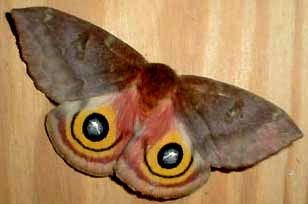 Maybe you've figured out by now that when you see something special, you need to ask yourself what's going on. For example, if you see the Io Moth, Automeris io, at the right, with those big eye-like circles, ask yourself why those circles look so much like eyes. If you think about it, maybe you'll decide that if you were a bird about to snatch up this moth as a meal, then suddenly the moth opened its wings and revealed those glaring, owlish eyes, you might get upset and fly away, and let the moth live a while longer. Nature's "secrets" nearly always make sense if you just think about them.