 It's nice just to see and be around birds. However, if we want to more intensely appreciate and experience those birds, we need to know things about them that aren't obvious just by looking at them. The key to that more satisfying interaction with birds is identification. And to identify birds, we must learn to see how each species differs from all others.
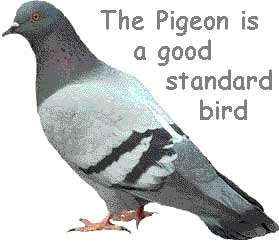
A "mental tool" helping us with that is the concept of the "Standard Bird." The pigeon -- the semidomesticated park bird whose wild form is called the Rock Dove, Columba livia -- makes a good Standard Bird. That's because most of us know what pigeons look like, plus there's nothing particularly mind boggling about their appearance (though they are a bit pigeon-toed). Here's some practice using the Standard Bird concept:
PRACTICE USING THE STANDARD BIRD CONCEPT
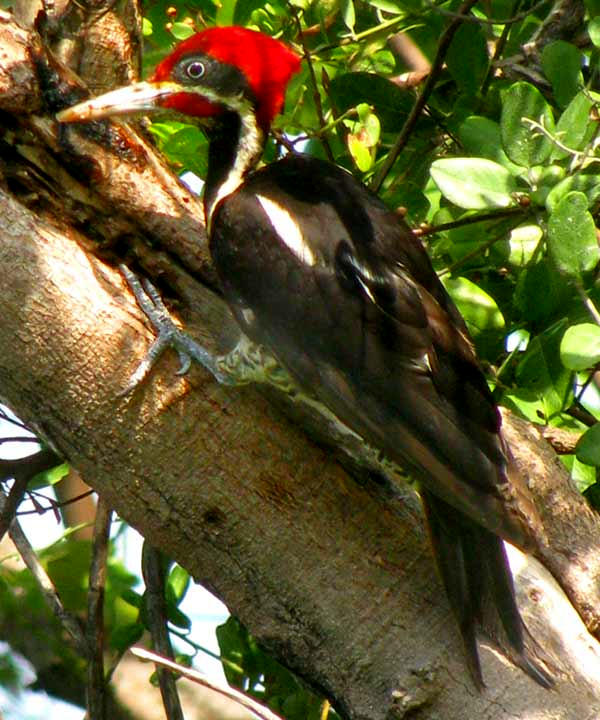
At the left you see a Lineated Woodpecker, Dryocopus lineatus, a species occurring in humid lowlands from Mexico south to Peru and northern Argentina. It's very closely related to North America's Pileated Woodpecker, Dryocopus pileatus. It takes a good birder to immediately recognize the differences between those two similar species, but that's not our chore here. Here the idea is to start noticing fundamental differences between bird types, which in the field is the first step toward a final identification.
The most conspicous differences between all woodpeckers and our Standard Bird are:
- The woodpecker's beak is long and chisel-like, very unlike the pigeon's (Beaks are so important in bird ID that we have a special bird-beak page)
- Its feet have two toes directed forward and two backwards, while our pigeon has three up front and one behind (Feet also are so important that we have a special bird-feet page)
- The woodpecker's tail is so stiff that's its used as a kind of "third leg" steadying the bird as it pecks and drills wood with its beak
THE STANDARD BIRD AND BIRD ORDERS
 On our Pigeon-holing Your Birding Finds page, we learn about the world's main bird orders. There's the "Parrot Order," the "Gull Order," and separate orders for hummingbirds, woodpeckers, doves, the "Passerine" or Songbird Order, and several other major groupings of birds. The beginning birder hoping eventually to see many kinds of birds in many interesting places, will do well to learn to recognize which order any newly encountered bird belongs to. That's exactly when the Standard Bird concept -- remembering the pigeon -- can be so helpful.
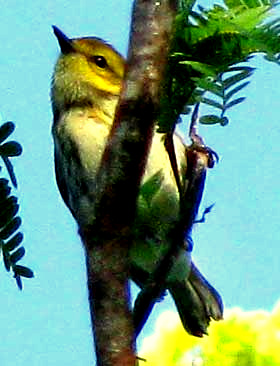
For, above, we were doing that very thing. Pigeons belong to the Pigeon/Dove Order, the Columbiformes, while woodpeckers belong to the Woodpecker Order, the Piciformes. And not one of the 450 or so of the world's woodpecker species has a beak, feet or tail looking like the beak, feet, or tail of any of the over 300 species of pigeons and doves! Moreover, no pigeon/dove OR woodpecker has such a slender, straight, pointed beak as the above Black-throated Green Warbler, belonging to yet a different order, the huge Passerine or Perching Bird Order, the Passeriformes.
THE STANDARD BIRD CONCEPT AND THE PASSERINE/ PERCHING BIRD ORDER
When most of us go birding, most of the species spotted will belong to just one bird order, the Passerine or Perching Bird Order, the Passeriformes. The Standard Bird concept is less useful when trying to determine which passerine we have, than it is which bird order we're dealing with.
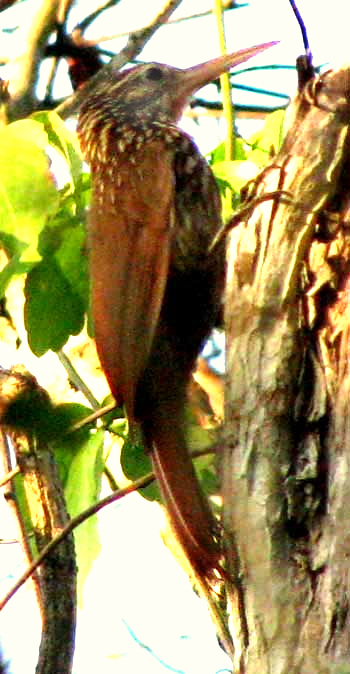
The main problem is that the Passerine Order is so huge and diverse, that many features thought of as main characteristics of certain other orders, also are found among the passerines. For example, there are tree-trunk-climbing passerines, the woodcreepers and treecreepers, with stiff tail feathers like the woodpeckers'! That's a passerine Ivory-billed Woodcreeper, Xiphorhynchus flavigaster, in Yucatan, Mexico, at the right (Note its three toes up front; woodpeckers have only two up front). Similarly, ornamental tails displayed during courtship normally are associated with peacocks, grouse, pheasants and such in the Gallinaceous Bird Order, but also the passerine Long-tailed Widowbird displays with a remarkable tail.
Still, the Standard Bird concept does help somewhat with passerines, as the toe-count example just showed. For one thing, most of us won't run into the really odd passerines. With field experience, before long we'll gain a general notion of what passerines look like. Sparrows, finches, warblers, vireos, flycatchers, wrens, jays and crows, orioles, swallows, thrushes, titmice and chickadees, nuthatches, tanagers and more of the most familiar kinds of birds all are passerines. 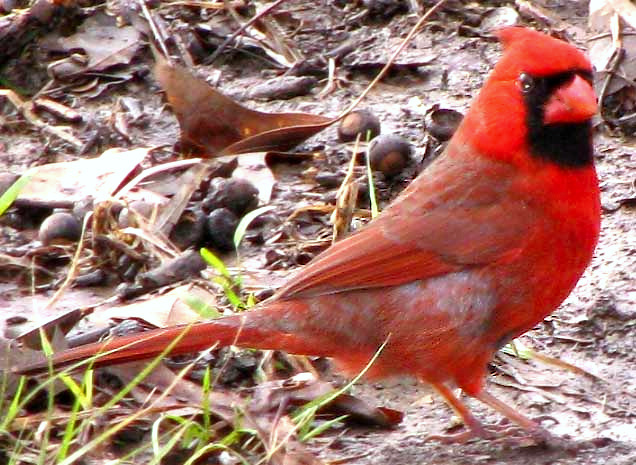 In the Temperate Zone, no species in any of the groups just listed looks like it belongs to the woodpecker, heron, stork, hummingbird or seagull orders, even if we look long enough in the world's tropics, there might be some kind of passerine who does.
That Cardinal, Cardinalis cardinalis, at the left: That's a passerine, a true member of the order Passeriformes.