FEATHER ANATOMY
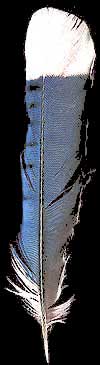 Several feather types are recognized. The best known is the one shown at the right, called a contour feather. The stiff, cylindrical, sharp-pointed "midrib" of that feather is known as the shaft, or rachis (RAY-kiss). The slender, parallel side branches arising from the shaft are barbs, and all the barbs considered collectively as one flat thing are known as the vane. Most of what we see in the picture is the vane.
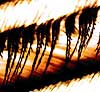 To see a feather through a microscopic
If you examine a barb under magnification you'll see that it bears minute branches called barbules. The barbules bear hooks, kind of like Velcro hairs, enabling the barbules to hang on to one another, thus keeping the barbs in place, forming a well organized vane. In the picture at the right, especially toward the vane's base, some barbs have come undone from their neighbors. You could run those barbs between your fingers, smoothing them out, and they'd stick back together, just like what happens when a bird preens.
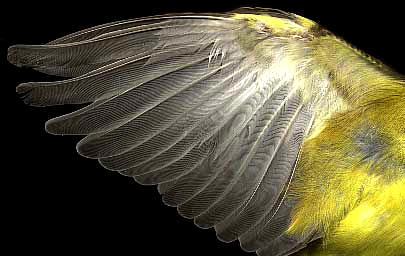
Below, you see the underside of a wing of a Pine Warbler, Dendroica pinus. The big, dark gray, fanned out contour feathers have their barbs neatly locked together. If the vanes were not held in place by the barbs' hooked-together barbules, when the bird tried to fly by pushing down on air with the down-stroking wing, air would gush between the feathers instead of keeping the bird aloft.
OTHER FEATHER TYPES
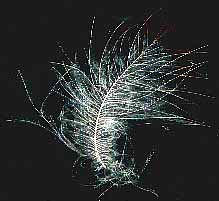 The picture at the right shows a feather-type known as a semiplume. Semiplumes have shafts like contour feathers, but their vanes are fluffy, not well organized with "zipped together" barbs forming flat vanes as with contour feathers.
Powder down feathers, found on such birds as herons and parrots, are structured much like fluffy semiplumes, except that the barbs don't stop growing. As the barbs elongate, their tips crumble into a powder when the birds nibble at them. While preening, the powder is spread over the body, helping waterproof the plumage. Usually powder downs occur in patches on the chest and pelvic regions, or sometimes all across the bird's underside.
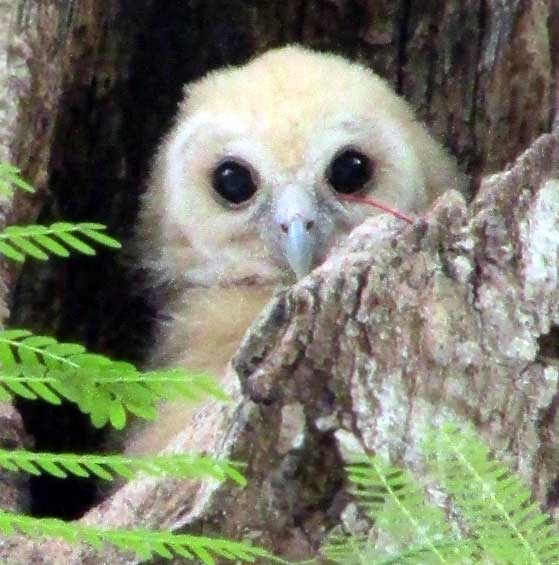 At the left, a nestling of a Mottled Owl, Strix virgata, is covered with fluffy down feathers. Down feathers cover most newly hatched birds but on mature birds they're usually hidden beneath contour feathers, which have grown up through the original down.
  As the sketch at the right shows, down feathers are similar to semiplumes, except that, instead of the non-hooked-together barbs arising all along the shaft, they issue from one point atop the "foot" of the feather (known as the calamus).

Filoplume (FILL-oh-ploom) feathers, one sketched at the right, are like down feathers, except that they're mostly stiff shaft with only a few disorganized barbs clustered near the tip. Filoplumes often appear sparsely on the undersides of birds or on their wings, beneath their contour feathers. Probably they help keep the other feathers in place.

Bristle feathers, one sketched at the left, are the opposite to filoplumes in the sense that instead of bearing a modest plume of barbs at the shaft's top, the barbs are at the bottom. Bristle feathers most typically occur around the mouth and/or eyelids of certain bird types, such as flycatchers and nighthawks, who capture insects during mid-flight. Presumably the bristles' stiffness somewhat protects the head's most sensitive spots during high-speed captures, and enhances the ability to feel and manipulate what's been captured.
FEATHER FUNCTIONS
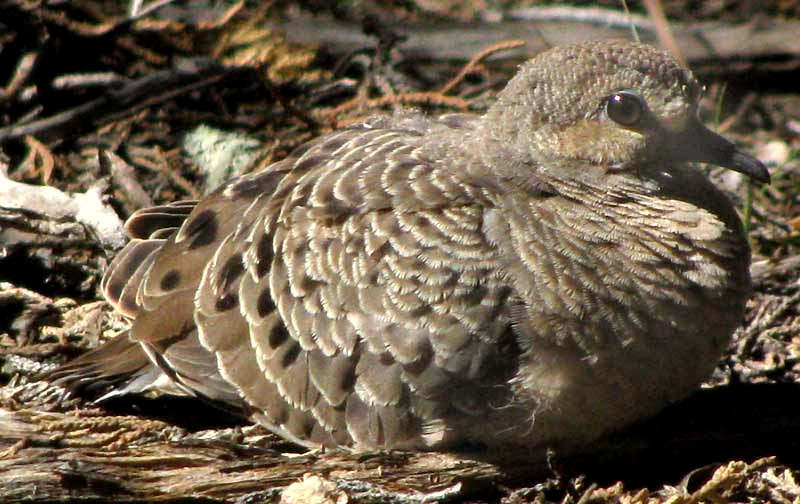
Like clothing on a human, feathers help birds control their body temperatures. Fluffed-out feathers trap air, and hardly anything insulates against cold weather better than trapped air. If you want a super-lightweight sleeping bag for extremely cold temperatures, it's hard to beat a bag filled with goose down. In the picture, this Common Ground Dove, Columbina passerina, has fluffed up the feathers so loosely that instead of holding warm air in place, they're letting in fresh, warm morning air during a wintertime sun-basking moment.
Feathers also supply a little armor. Duck hunters know that sometimes their buckshot hitting at an angle glance off a duck's feathers.
The US Fish & Wildlife Service Forensics Laboratory offers an interesting, freely accessible Identify Feather Tool you might enjoy trying.
HOW FEATHERS FORM
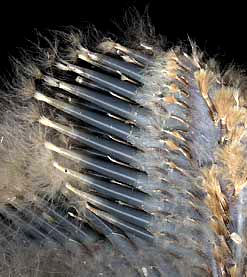 A feather begins as a feather follicle, which is a tiny pimple-like, tubular structure embedded in the skin. The feather emerges through this follicle's outer opening. The lower part of the emerged feather's shaft, or rachis, where no barbs are formed, called the calamus, is rooted in the follicle. The picture at the right shows the wingtip of a nestling, where barbs of the wing's contour feathers are just beginning to emerge from the calamus. In the picture, most of the future feather's stiff shaft and vane still are wrapped into a tight bundle inside the calamus, but the bundle is issuing through the calamus's open top, and soon will expand into a fully developed contour feather.
FEATHER NUMBERS
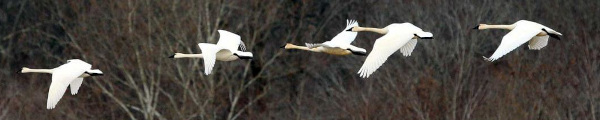
How many feathers does a bird have? It depends on which bird species, their age, and maybe sometimes the season. Most songbirds possess 1,500 to 3,000 feathers, of which 30 to 40 percent are located on the head and neck. Birds of prey, such as hawks and eagles, usually have 5000-8000 feathers. A swan, however, may have as many as 25,000.
The concentration of feathers around the head and neck reflects the need to protect the brain against temperature extremes. Most naturalists can tell stories about snakes and lizards caught outside during cold snaps, who were so dazed they didn't try to escape. As a general rule, the colder the climate a bird species lives in, the greater its number of feathers. Each Tundra Swan so prettily flying by below bears about 25,000 feathers, of which some 80 percent are on the head and neck!