PLANTS | ANIMALS | ECOLOGY | FUNGI | GEOLOGY | GARDENING | TOOLS
MEXICAN PLANTS & ANIMALS HOME

Excerpts from Jim Conrad's
Naturalist Newsletter
from the February 6, 2011 Newsletter issued from Hacienda Chichen Resort beside Chichén Itzá Ruins, central Yucatán, MÉXICO; limestone bedrock, elevation ~39m (~128ft), ~N20.676°, ~W88.569°
TREE CALLED "SUN"
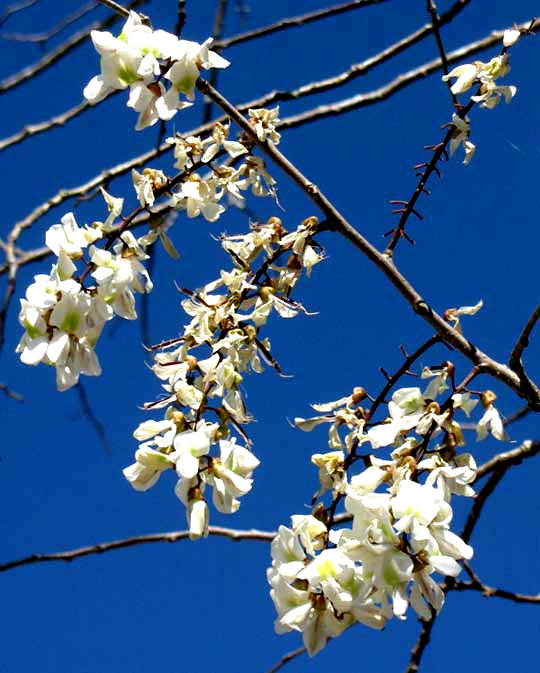
Nowadays along Pisté's backstreets and in abandoned lots there's a small, leafless tree dazzlingly flowering and when I see its six-inch-long (15cm) racemes of glowing-white flowers against the blue sky, shaking in the wind, I'm filled with a springy feelng. You can see a small part of one of these trees below:
A close-up of a ¾-inch long (2cm) flower is shown below:
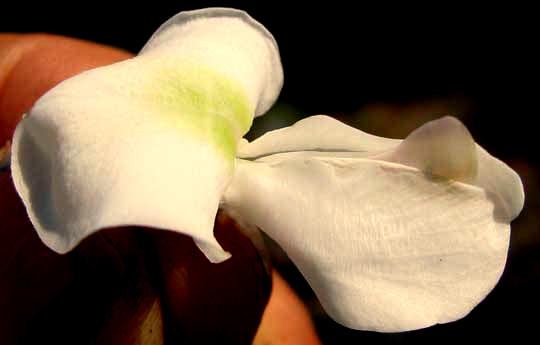
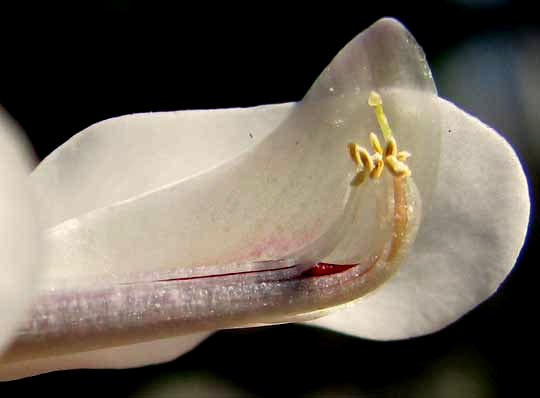
The flowers may remind readers in the US Northeast of those of Redbuds, and that's appropriate because this tree like the Redbud is a member of the Bean Family. We've seen that most flowers in the Bean Family are "papilionaceous," with a big "standard" petal atop the blossom, two "wings" along the sides, and two petals below joined along their common margins to form a scooplike "keel." With that in mind I removed a flower's nearest wing and the near side of its keel so you can see how the flower's ten or so stamens' filaments are fused into a cylinder split at its top. The cylinder envelops the ovary, which has a slender, upturned style with a tiny, blunt stigma, as shown below:
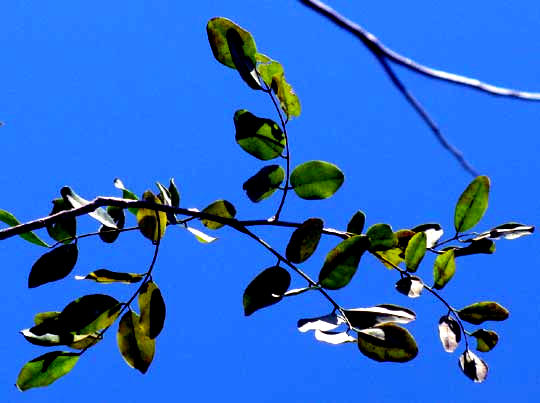
Though here during the dry season most of these trees are leafless, a few are sprouting new foliage. You can see a tree's once-pinnate leaves, which look a lot like those of the US Northeast's Black Locust, below:
*UPDATE: This is the genus Gliricidia, which in 2011 I recognized, but back then I only knew Gliricidia sepium, planted in the tropics worldwide because it makes such a great fencepost tree; plant it in a row and before long you can put your fence there. In 2025, many more identification resources are available on the Internet. When this page's pictures are contributed to the wonderful iNaturalist website, user @mattlavin recognizes that it's a second Gliricidia species, GLIRICIDIA MACULATA, mainly found in the Yucatan Peninsula and a little farther south. In Spanish often it's called Palo de sol, or "Sun Tree," which is a great name.