PLANTS | ANIMALS | ECOLOGY | FUNGI | GEOLOGY | GARDENING | TOOLS
MEXICAN PLANTS & ANIMALS HOME

Excerpts from Jim Conrad's
Naturalist Newsletter
entry from field notes dated January 17, 2023, taken on trail up the southeast-facing slope of Peña de Bernal on the northwestern side of Bernal, elevation ±2,220m (7280 ft); bedrock of intrusive, igneous dacite, similar to granite; Querétaro state, MÉXICO, (N20.748°, W99.949°)
GONOLOBUS CHLORANTHUS
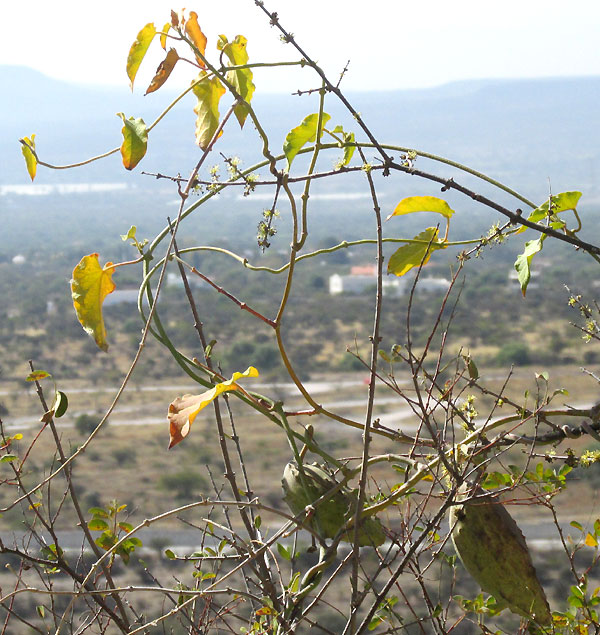
During the dry season after a rainy season that never fully developed, the above out-of-reach fruiting vine twined among upper branches of a Desert Olive tree. The view beyond the vegetation shows the flatlands southward. The distant white items are greenhouses growing tomatoes, chili peppers, lettuce and such.
Though most of the vine's leaves have fallen off, several pairs of leaves at the vine's nodes indicate that this species bears opposite leaves. The leaves themselves show backward-projecting lobes at their bases, so the leaves are slenderly heart-shaped, or cordate. Opposite, cordate leaves on a vine bring to mind the "climbing milkweeds" of the Dogbane Family, the Apocynaceae. Moreover, the follicle-type fruiting pods -- follicles being dry fruits composed of only one compartment, the compartment containing two or more seeds, and the mature fruit splitting along one side to release seeds -- look like the group of climbing milkweeds known as the anglepods, genus Gonolobus.
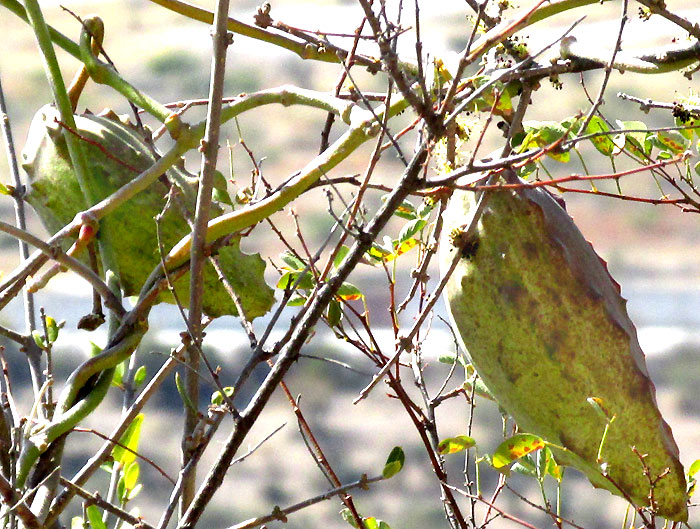
Up closer, the fruits' modest angularity is easier observed, as are the fruits' short, broad-based, pointed tubercles, and the green skins' ample dark splotches.
Here in the central uplands of Mexico, no comprehensive study of the Dogbane Family of Querétaro state is available. However, a list of documented species for Guanajuato State, just to our west, entitled "Documento Técnico Base del Inventario de Especies Vegetales Nativas del Estato de Guanajuato," lists three Gonolobus species. Also, a list of documented species for Hidalgo State, just to our east, entitled "Riqueza y distribución de la flora vascular del estado de Hidalgo, México," lists seven Gonolobus species. All three species in Guanajuato also occur in Hidalgo.
On the Internet, of pictures of fruits and leaves of the seven Hidalgo species, only one species displays features matching those seen in our pictures. The main field marks are the presence, shape and arrangement of the tubercles and, most obviously, the profuse dark splotches. The one species matching our pictures is GONOLOBUS CHLORANTHUS.
According to Kew's distribution map for Gonolobus chloranthus, the species is endemic just to Mexico, occurring from the northeastern states to the southernmost states.
Other than the name Gonolobus chloranthus appearing on various checklists of plants found in different locations, and remarks on its taxonomy, hardly any information is available about this species. Here we can at least report that Gonolobus chloranthus occurs on Peña de Bernal, Querétaro, Mexico, in the environment indicated above.