LOESS HILLS INDIGENOUS PEOPLE BEFORE COLUMBUS
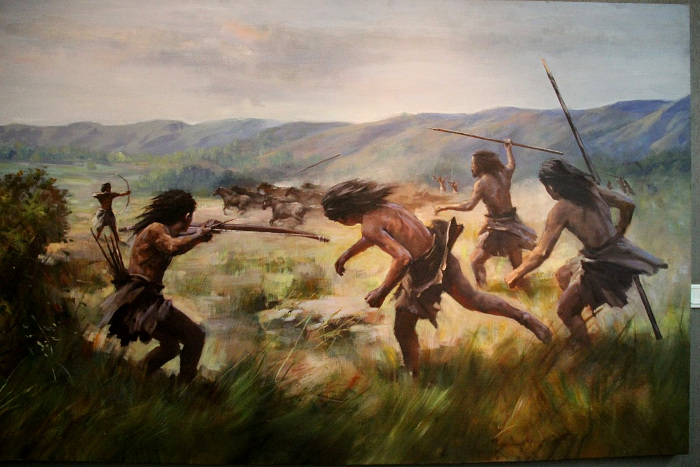
Painting of Late Paleolithic hunters in Shanxi Provincial Museum, Taiyuan, China; image courtesy of Gary Todd from Xinzheng, China, & Wikimedia Commons
The first humans to reach the Americas were physically like people today, and their brains were capable of our kinds of thoughts; They were Homo sapiens, not an early human form such as Homo erectus or Homo habilis, restricted to the Africa and Eurasia. As such, they can be expected to have had somewhat complex living patterns, and to have left behind useful tools.
PALEO-INDIAN PERIOD
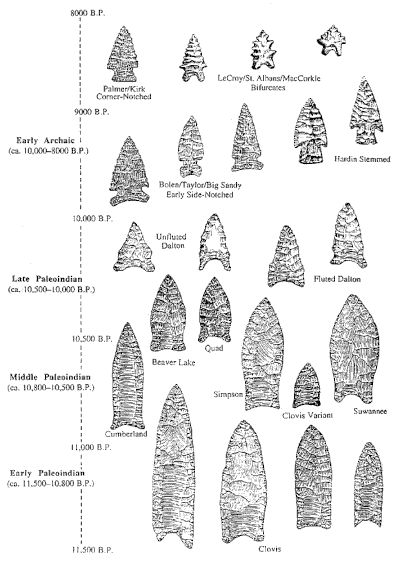
Various early projectile point types from the southeastern US; image courtesy of National Park Service
Much debate centers around when the first Paleo-Indians arrived in North America. Some would say that no solid proof exists having them arrived here, probably crossing from Siberia into present-day Alaska some 17,000 years ago. Others claim they may arrived in the Americas as early as 40,000 years ago, or even 50,000. They may have passed from eastern Siberia into present-day Alaska, much of their food deriving from hunting now-extinct large animals -- such as mammoths, camels, and horses.
Other, multiple entries into the Americas, sometimes taking different routes, also are proposed. However, among the Loess Hills along the lower Mississippi River, there's little indication of their presence here, though there seems to be little reason why they wouldn't have passed our way. Paleo-Indian projectile points turn up regularly farther east.
The above chart indicates that early Paleo-Indian stone points in general were larger than during later times, plus in later times the points seem to have been formed more for a greater variety of tasks. In the chart, "B.P" means "before the present."
ARCHAIC PERIOD
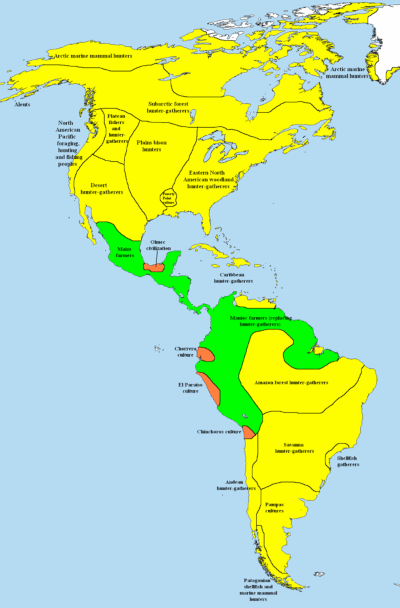
Archaic societies in the Americas; yellow for hunter-gatherers, green for simple farming societies, and golden for complex farming societies; the small circular spot in our area denotes the Poverty Point Culture; image courtesy of 'Moxy' at English Wikipedia
As various Paleo-Indian cultures adapted to post-glacial times and their social and technical skills grew more complex, gradually the Archaic Period arose. The Archaic Period is commonly supposed to have begun maybe 10,000-3000 years ago, and to have lasted until possibly 1000 years ago. Its beginning is seen as coinciding with when Pale-Indians stopped hunting the now-extinct "magafauna," like mastadons and camals.
An interesting feature of this vast period of time, reflected by the map at the left, is that while in South America and Mexico complex farming societies formed -- these were surrounded by simpler societies which nonetheless practiced certain agricultural techniques, -- North America's Archaic groups mainly remained hunter-gatherers. However, villages of the Lower Mississippi Valley, during the late Archaic, did develop a somewhat distinctive society,the Poverty Point Culture, which functioned from about 3750 to 3400 years ago, reaching its peak bout 3500 years ago.
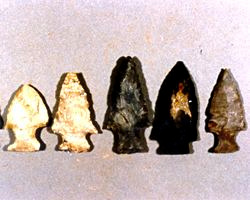
Projectile points found at the Jaketown Site; image courtesy of US National Park Service
The Poverty Point Culture was more complex than surrounding cultures, and possibly was the first culture in the US to acquire a social structure complex enough for organizing a tribal system. Poverty Point villages extended nearly 100 miles (160kms) from both sides of the Mississippi River, though there's little to see of them among the Loess Hills. The Jaketown Site near Belzoni, Mississippi is part of the Poverty Point culture. It consists of two earthwork mounds which haven't been excavated. However, pottery sherds have been found. While the Jaketown site is in the swampy bottomlandes, not among our Loess Hills, it indicates that our area surely was visited by Archaic people.
WOODLAND PERIOD
The Woodland Period, maybe lasting from about 3000 years ago to European contact. Different experts divide and subdivide the archaeological times covered here as the PaleopIndian/Archaic/Woodland. For more detail on the matter, check out Wikipedia's much more detailed and confusing
List of North American Archeological Periods page.
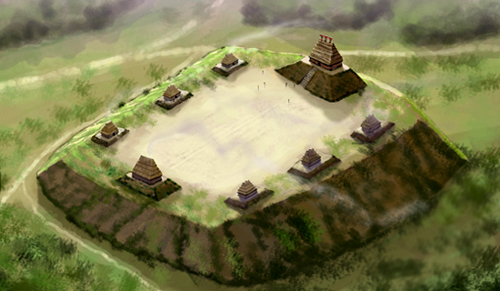
Artist's conception of the Emerald Site begun about 750 years ago; image courtesy of Herb Roe and Wikimedia Commons
During that long period, either late Paleo-Indian or an early Archaic civilization occupying the Lower Mississippi Valley began building complex earthwork mounds, probably for religious purposes. Among the Loess Hills, one of those mounds, Emerald Mounds, was erected just north of present-day Natchez. Today the buildings shown at the right are missing; Just a lesser mound atop the main mound indicates the earlier presumed main temple.
Mississippian culture
In North America,
Among the Ice-Age animals they hunted were mammoths, camels, horses, and bison. They may have killed many large animals by driving them over cliffs, but they also had formidable spears. Their spears were equipped with sharp, well crafted stone points often around two inches long but sometimes as long as nine inches, and typically chipped from chunks of the siliceous mineral called chert. The knappers of these points characteristically chipped shallow grooves into the point's tops, where the split ends of the spear's wooden shaft would fit, before being tied and secured. These shallow grooves are referred to as flutes. Some fluted spear points are so outlandishly large and beautifully crafted that it is easy to believe they must have been ceremonial in function, not used for hunting. Wikipedia has a good Paleo-Indians Page.
Paleo-Indians left artifacts other than fluted spear-points. They produced "burins" or "gravers" used for carving wood and stone, stone scrapers and other blades, and knives. It's quite possible that they also knew how to throw their spears with the help of the atlatl, or spear thrower, a sort of stick that added power to every throw. It functioned on the same principle that causes a ball hit with a long-handled tennis racket to sail farther than one hit with a pingpong paddle. Fragments of woven and braided sandals, ropes, and fabrics of paleo-Indian age have been recovered from certain dry caves and rock shelters. Skins were surely sewn with animal sinew, bone needles, and awls.
In the early 1800's, quite a stir was created when an ancient human pelvis was found in Mammoth Bayou on the northern side of Natchez. Not far from the pelvis lay bones of extinct Ice-Age mammals, such as those of a ground-sloth, so immediately many experts thought that the remains of an Ice-Age paleo-hunter had been found, perhaps lying next to the animals who had killed him. Others believed the pelvis to be much younger, and to have washed next to the animals from much younger strata upslope. The individual who provided the pelvis soon became famous, and referred to in archeology books as
"Natchez Man."
Of course, once carbon-14 dating became available, the question could be settled at last. Results: Ground sloth bones found near "Natchez Man" were about 17,840 years old, while the man's pelvis was "only" 5,580 years old.
"Natchez Man" was old, but he was not a Paleo-Indian.
In fact, to date no Paleo-Indian points have been found in our loess zone, but it's probable that Paleo Indians have been here, or at least in the vicinity. Sites around us producing fluted points include Wells Creek in Tennessee, Kimmswick in Missouri, and Domebo in Oklahoma.
Remains left behind by the Paleo-Indians are so scanty that it is very hard to know what their lives were like. Any living in the Loess Hills must be visualized as existing in a climate and ecology much different from what we have now. We can imagine the men periodically forming hunting parties to go after large Ice-Age animals such as mammoths and bison. We can be sure that on the hunt they carried their spears and probably talismans they hoped would protect them. The possibility of their being injured or killed on such hunts must have been so great that each hunt was preceded by considerable spiritual preparation, perhaps by making sacrifices, praying before whatever gods they had, and exercising what magic their shaman could muster.
Women and children may have been responsible for providing most of the actual bulk of the people's diet, by gathering herbs, nuts, wild fruits, digging roots, and catching small animals such as frogs, turtles, birds, and rabbits.
Like other hunter-gatherer cultures, Paleo-Indians probably lived nomadic existences, following the big game and perhaps moving on a seasonal basis to known locations where certain nuts or fruits were coming into season. There may have been favorite camping areas returned to year after year.
But even if the Paleo-Indians managed to return to a favorite camping spot, living could not have been easy. Life among the Paleo-Indians must have been brief, but intense. One can imagine the fierce pleasure experienced seeing sunrise after a night of raw coldness and unknown sounds of animal or spirits -- of smelling warm spring mud after spending a hard winter, or of smelling sweet plum blossoms in a world where clothing seldom was washed, plumbing did not carry away human excreta, and where the deer killed three days ago reeks of decay, but is the only thing left to eat.
The Paleo-Indian period in North America began when the first Paleo-Indians filtered south at the end of the last Ice Age some 12,000 years ago, and ended approximately 8,000 years ago, when the last of the large Ice Age mammals succumbed to extinction. Possibly Paleo-Indians hunted some of the large mammals to extinction, but, more likely, in post Ice-Age times the big animals simply could not compete with the smaller, more efficient species better adapted for living in warmer times.
Whatever caused the great Ice-Age mammals to vanish, the Paleo-Indian manner of living vanished with them.