PLANTS | ANIMALS | ECOLOGY | FUNGI | GEOLOGY | GARDENING | TOOLS
MEXICAN PLANTS & ANIMALS HOME

Excerpts from Jim Conrad's
Naturalist Newsletter
from the December 27, 2009 Newsletter issued from Hacienda Chichen Resort beside Chichén Itzá Ruins, central Yucatán, MÉXICO; limestone bedrock, elevation ~39m (~128ft), ~N20.676°, ~W88.569°
SABAL PALMETTO
Hacienda Chichen hosts a nice variety of palms, and palms can be hard to identify, at least in garden settings where the species may be native to anywhere. Therefore, when I do finally feel satisfied with a name it's time to celebrate by telling you about it. Therefore, meet the Sabal Palmetto, SABAL PALMETTO, below:
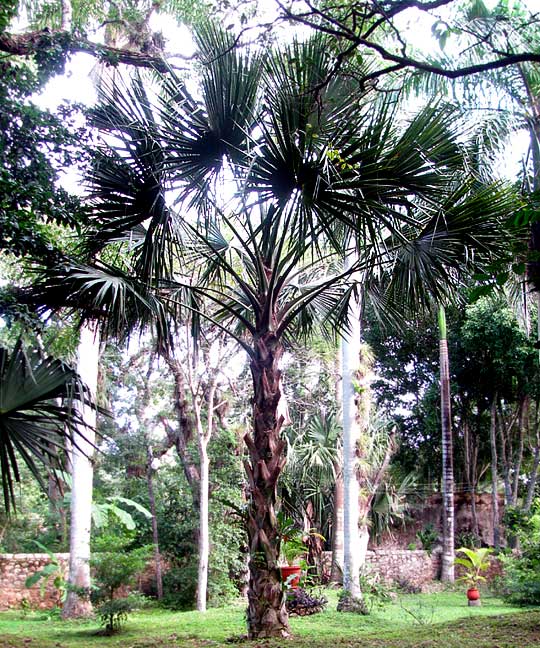
Sabal Palmettos, also known as Cabbage Palms, Cabbage Palmettos, Palmetto Palms, and Sabal Palms (but not Saw Palmettos, which are another species), are native to Florida and coastal zones of Georgia, South Carolina, Mississippi, Alabama, North Carolina and Louisiana, as well as Cuba and the Bahamas, so they're strictly garden plants here. You can see that they are "fan palms," as opposed to most palm species whose frond segments arise from the long midrib like barbs on a feather's shaft. Sabal Palmettos can grow over 65 feet tall (20 m).
Features distinguishing Sabal Palmettos from other similar fan palms are:
You can see this interesting last feature below:
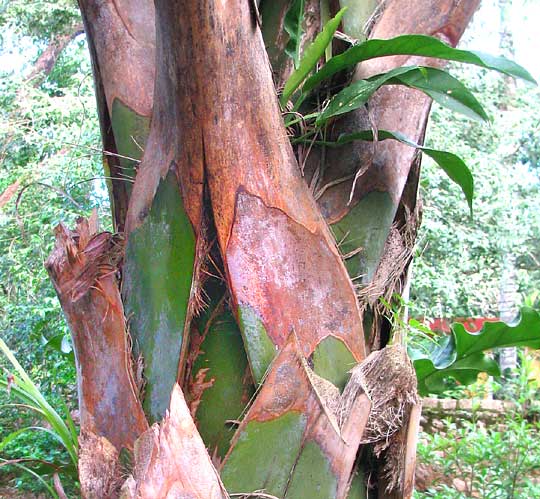
That photo also shows you yet another feature which is that the long-persisting petiole bases create such deep irregularities in the trunk that debris collects there enabling plants such as orchids and aroids to find footing as if they were in airborne pots! The Sabal Palmetto's trunk creates its own little ecosystem.